
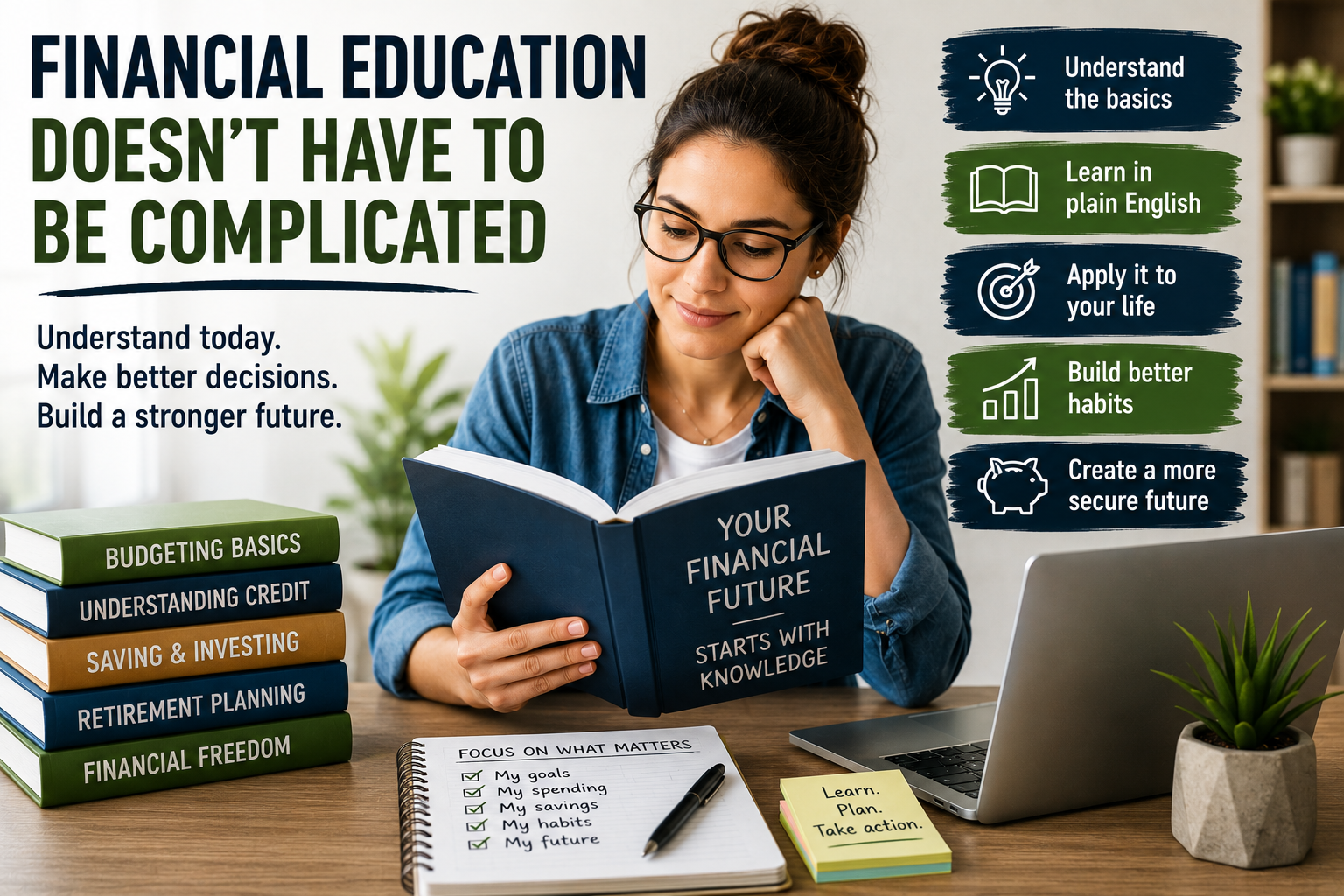
Financial education can feel like learning another language. Have you ever started reading something about money and felt as though the writer suddenly switched languages?
You’re doing fine for the first few paragraphs. Then come the terms: asset allocation, expense ratio, tax-deferred, diversification, required minimum distribution. You recognize the words. You may have even heard them dozens of times. But put enough of them together and personal finance can start sounding like a conversation you’re supposed to understand, but don’t.
That’s when people sometimes decide, “I’m just not good with money.” I don’t think that’s usually the problem. Sometimes financial information is simply explained badly.
Good financial education shouldn’t make you feel like you need an economics degree to understand your own checking account. It should help you understand the financial decisions that actually affect your everyday life. And you don’t have to learn everything at once.
Start Your Financial Education Here
Financial education means learning how money works so you can understand your choices before making a decision. This guide is your starting point: choose the question that matters today, follow the related guide, and come back when you are ready for the next topic.
- Understand the basics: Understand Money: The Basics Everyone Should Know explains money, purchasing power, saving, and borrowing.
- Put learning into everyday decisions: The Money Skills Most People Wish They Learned Earlier connects the concepts to common situations.
- Find learning resources: Financial Education for Adults points you toward free resources and ways to keep learning.
- Help children learn: Teaching Kids About Money offers lessons parents can use at home.
- Check advice before acting: How to Find Financial Advice You Can Actually Trust helps you evaluate the source.
Choose the Money Question You Need to Answer
The concepts become useful when you apply them. For help planning income and expenses, start with How to Make a Budget. For repayment decisions, use How to Get Out of Debt and Stay Out for Good. To build repeatable routines, visit Money Habits: Small Changes That Can Transform Your Life. For retirement questions, explore Retirement & Real Life.
Why Does Financial Education Seem So Complicated?
Money touches almost everything. Think about how many subjects fall under personal finance: budgeting, banking, credit, debt, insurance, mortgages, taxes, investing, retirement, Social Security, and estate planning.
Now add hundreds of financial terms, thousands of products, changing tax rules, differing opinions, and an internet where everybody seems to have the “right” answer. No wonder people get overwhelmed.
The solution isn’t to become an expert in everything. It’s to learn enough to make the next financial decision in front of you. That’s a much more manageable goal.
Start With the Decision, Not the Entire Subject
Suppose you’re thinking about buying your first home. You don’t need to learn everything there is to know about personal finance before talking to a lender. You do need to understand things like how much house you can reasonably afford, down payments, interest rates, loan terms, closing costs, property taxes and insurance, and the difference between the purchase price and the total monthly housing cost.
Now suppose you’re starting to invest. That’s a different learning list. You might begin with why you’re investing, your time horizon, risk, diversification, investment fees, retirement versus taxable accounts, and the difference between saving and investing.
Trying to learn mortgages, investing, taxes, insurance, Social Security, credit scoring, and estate planning all at once is a good way to learn none of them very well. Learn what you need. Use it. Then build from there.
Don’t Let Financial Language Get in the Way of Financial Education
Financial terminology creates an unnecessary barrier for many people.
Take a relatively simple idea like compound interest. The phrase may sound technical. The concept isn’t. Your money earns a return, and then future returns may be earned on both the money you originally invested and the returns that have already accumulated. That’s the idea. You can add formulas and terminology later if you need them.
The same principle applies to plenty of financial concepts. Diversification means not putting all your financial eggs in one basket. Liquidity describes how readily an asset can generally be converted into cash without significantly affecting its value. Net worth is essentially what you own minus what you owe. Learn the idea first. Then learn the terminology attached to it.
If financial terms are one of the things holding you back, that’s exactly why I wrote Financial Terms People Pretend to Understand. It explains commonly used money language in plain English so you can follow financial conversations without feeling left behind. There’s no prize for pretending you understand a term you don’t. Look it up. Ask. Learn it. Then move on.
Be Careful With Information Overload
The internet has solved one financial-education problem and created another. Information is everywhere.
Search for something as simple as “how should I start investing?” and within minutes you may encounter ETFs, index funds, individual stocks, bonds, Roth IRAs, traditional IRAs, 401(k)s, dollar-cost averaging, asset allocation, market timing, dividend investing, growth investing, and someone on social media insisting that everyone else is doing it wrong. That’s a lot to absorb when you started with one basic question, and more information isn’t always better information.
Start with reliable sources and basic principles. Government agencies like the Consumer Financial Protection Bureau, the SEC’s Investor.gov, the IRS, and the Social Security Administration can be useful starting points depending on the question. Then expand your research when you need more detail. You don’t need 50 opinions to make every financial decision — sometimes you need one clear explanation from a reliable source.
You Don’t Have to Learn Personal Finance in Order
There’s no required curriculum. If high-interest credit card debt is causing you problems today, learn about debt. If you’re six months away from retirement, retirement planning probably deserves more attention than learning how a mortgage works. If you’ve never created a spending plan and regularly wonder where your paycheck went, start there.
That’s why knowing where you stand financially can be so useful. If you’re not sure which area deserves attention first, our Money Checkup can help you look at your financial situation and identify areas you may want to examine more closely.
Start with what’s affecting your life right now. Financial education becomes much more interesting when the information solves a real problem.
Learn the Basics Before Chasing Advanced Strategies
There’s always something more sophisticated to learn. But sophisticated doesn’t necessarily mean useful. Someone carrying high-interest credit card debt while trying to identify the next hot investment may be focusing on the wrong problem. Likewise, spending hours researching complicated investment strategies isn’t particularly helpful if you haven’t established basic emergency savings or don’t understand your monthly cash flow.
Build the foundation first. That generally means understanding what comes in, what goes out, what you owe, what you’re saving, what financial risks you face, and what you’re trying to accomplish. Once those pieces make sense, more advanced financial topics have somewhere to land.
If you’re starting near the beginning, Understanding Money: A Beginner’s Guide to Personal Finance was written for exactly that purpose — to make the fundamentals understandable without assuming you already know the language.
Financial Education Often Arrives Just in Time
Most of us weren’t sitting around at 20 years old thinking, “I’d really like to understand Medicare today.” We tend to get interested in financial subjects when they become relevant.
You learn about mortgages when you’re considering buying a house. You become interested in credit scores when you apply for credit. You study retirement accounts when retirement starts feeling less theoretical. You learn about Social Security when claiming decisions get closer. You start reading about estate planning when you realize there are things you’d like handled properly for the people you care about.
That’s not necessarily a weakness. It can actually be an effective way to learn, because the information has an immediate purpose. The trick is to learn before you decide, not after you discover an expensive mistake.
Don’t Be Embarrassed to Ask Basic Questions
Money can be an uncomfortable subject. People are often reluctant to admit they don’t understand something because they assume everyone else already does.
Trust me, plenty of people nod through financial conversations while quietly hoping nobody asks them to explain what was just said. There’s nothing embarrassing about asking “what does that mean?” You weren’t born knowing how credit scores work. Nobody enters the world understanding an IRA. And most people didn’t learn how mortgages work while practicing multiplication tables in elementary school.
Financial knowledge is learned. If you don’t understand something today, that just means you can learn it tomorrow.
Use Tools to Turn Financial Education Into Real Numbers
Some financial ideas become much easier to understand once you stop reading about them and start working with your own numbers.
A mortgage payment is theoretical until you enter a loan amount, interest rate, taxes, and insurance and see the estimated monthly cost. A spending plan becomes more meaningful once you enter your actual income and expenses. Retirement savings become easier to understand when you see what consistent contributions might mean over many years.
That’s one reason we’ve built Money Tools on this site. Calculators and checkups aren’t substitutes for learning—they make it concrete. Instead of asking “what does this concept mean?” you can start asking “what does it mean for me?” That’s where financial education starts becoming useful.
Knowing What to Do Isn’t the Same as Doing It
Another challenge financial education alone can’t solve. You can understand perfectly well that you should save money and still not save it. You can know that carrying expensive credit card debt is hurting your finances and keep adding to the balance. You can understand the importance of retirement contributions and keep telling yourself you’ll increase them next year.
Knowledge matters. But knowledge doesn’t automatically change behavior. There’s often a gap between “I know I should do this” and “this is something I actually do.” That’s the idea behind The Habit Gap.
Closing that gap means turning financial knowledge into repeatable actions. Instead of simply knowing you should save, automate a transfer. Instead of knowing you should review your spending, schedule a regular time to do it. Instead of saying you’ll increase retirement savings someday, decide what event will trigger the increase — maybe your next raise. Financial education gives you the map. Habits are what get you moving.
Build Your Financial Education One Question at a Time
You don’t need to understand everything about money. Nobody does. You need enough knowledge to recognize what you don’t understand, find reliable information, ask useful questions, and make informed decisions.
Start small. If a financial term confuses you, learn that term. If you’re struggling with spending, learn how to create a spending plan. If you’re carrying debt, understand the interest rates and your repayment options. If retirement is approaching, start putting together your expected income, expenses, savings, and other resources.
Then take the next question. And the next. Over time, those individual pieces start fitting together.
You Can Learn This
Financial education doesn’t have to begin with a textbook, a complicated spreadsheet, or a stack of investment reports. It can begin with one question: what financial decision do I need to understand better right now?
Learn enough to make that decision more confidently. Then keep going. If you’re starting with the fundamentals, Understanding Money can help you build the foundation. If financial terminology keeps getting in the way, Financial Terms People Pretend to Understand can help translate the language. And if you already know many of the basics but struggle to put them into practice consistently, The Habit Gap focuses on turning financial knowledge into everyday action.
You don’t have to become a financial expert. You just have to keep learning enough to make the next good decision.