
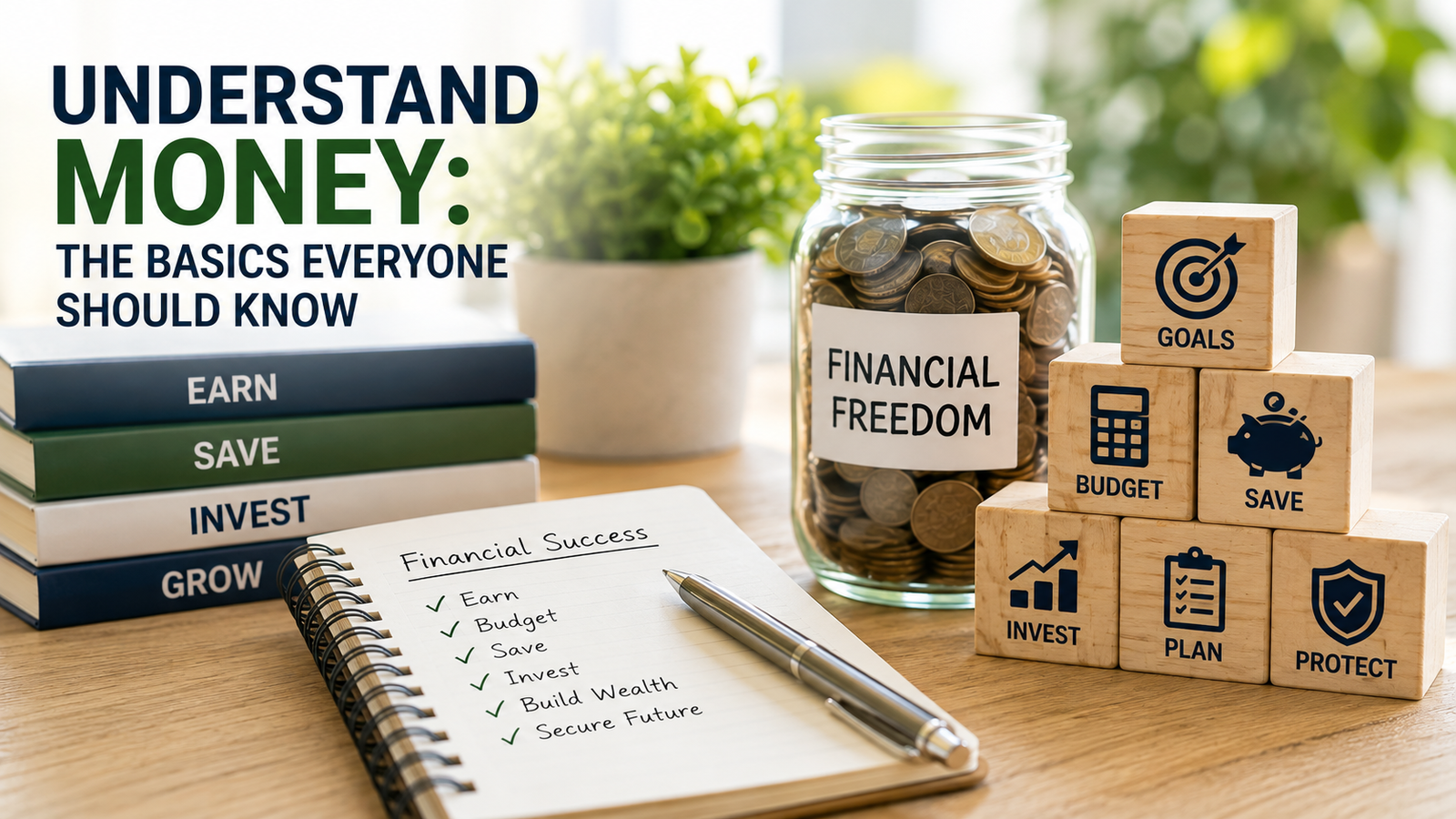
Ever checked your account balance and wondered what that money can actually cover? To understand money, start with a few everyday ideas: what it buys, when you need it, and what it costs to borrow.
You do not need an economics degree for this. Personal finance means managing your own or your household’s money: what comes in, what goes out, what you set aside, and what you borrow. We will use groceries, an upcoming bill, and a simple loan to make the basics useful.
What Is Money? The Basics You Need to Understand
Money is something people accept in exchange for goods and services. It lets you earn from one person and spend with another without arranging a trade each time.
Suppose you help a neighbor with yard work and earn $40. You can use $15 for lunch, keep $20 for later, and spend $5 on a bus ride. Your neighbor does not have to provide the exact things you need.
Money also gives us a common way to compare prices, set money aside, and agree on what a borrower will repay. A $40 balance tells you how many dollars you have. What those dollars can buy is a separate question.
Why Does Money Actually Have Value?
U.S. dollars work because people and businesses widely accept them, supported by the country’s laws and financial system. You can accept dollars for your work because you expect to use them for your own purchases.
The Federal Reserve explains the legal-tender status of U.S. currency. For everyday decisions, the useful idea is simpler: money provides a widely accepted way to pay, while prices determine how much it buys.
Inflation: A Key Part of Understanding Money
Purchasing power means how much your money can buy. Inflation is a rise in the general level of prices. When prices rise, the same number of dollars buys less.
For a simple illustration, suppose your usual basket of groceries costs $100. Later, the same basket costs $105. Your $100 still counts as $100, but you need another $5 to buy those groceries.
The Bureau of Labor Statistics measures average consumer price changes through the Consumer Price Index. Individual prices can rise or fall, and your household costs may change differently from the national average.
When you understand money in terms of what it buys, changing prices become easier to spot. Review your spending plan as costs change. A grocery allowance that worked last year may need adjusting this year.
Saving vs. Investing
To understand money choices, start with the difference between saving and investing. Saving means setting money aside for later. Investing means putting money into assets, such as stocks or bonds, with the aim of earning a return. Investments can lose value.
Think about two goals: a $600 bill due in six months and retirement many years away. Money for that bill needs to be available when the payment is due. Long-term money may have more time to ride out market changes, although time does not guarantee a profit.
Start with the question, “When will I need this money?” Then consider access, risk, and potential return. Investor.gov explains why the time before you need your money matters.
For a place to keep money you expect to use soon, read Savings Account vs Money Market vs CD. For longer-term learning, start with the Investing and Wealth guide.
Credit Can Help — or Hurt
Learning to understand money also means looking beyond what you can buy today. Credit lets you receive money, goods, or services now and pay later. A loan may help you meet a need, but the repayments become a claim on your future income. The practical examples in About Your Money explain why moving debt is different from repaying it and why an available credit limit is not extra income.
Suppose you borrow $1,000 and the agreed cost is $100 in interest plus $25 in fees. You will pay $1,125 altogether. The monthly payment tells you how the cost is spread out; the total tells you what borrowing costs.
Before borrowing, check the payment, repayment period, fees, and total amount you will repay. The CFPB explains interest rates and APR, which includes certain borrowing fees as well as interest.
Put the proposed payment into your spending plan before agreeing to it. If you already have balances to repay, use the Debt and Credit guide for your next step.
Money Is a Tool, Not the Goal
Money pays for practical things: somewhere to live, food, transport, and choices you value. Understanding money helps you decide what the dollars available to you need to do.
Your priorities may include covering next month’s bills, helping family, or enjoying a trip. What Does Enough Money Look Like for You? can help you name those priorities. Learning more is useful, but income, costs, and responsibilities still shape your options.
How to Understand Money Better, Starting Today
Choose one real decision you are facing. Write down the amount, when the money is needed, and what you need to understand before acting.
For example: “My insurance renewal is expected to cost $600 in six months. I have nothing set aside for it yet.” Dividing $600 by six gives a starting target of $100 a month. Check whether that fits your income and essential expenses. If it does not, you have time to explore adjustments or payment options.
Then follow the guide that fits your question: planning income and expenses, repaying debt, or understanding investing. You do not need to study everything today.
Understanding Money Builds Confidence
Start with one concept and apply it to one decision. Can you explain what the money is for, when you need it, and what the choice will cost? If a term or condition is unclear, ask before committing.
Return to Financial Education Doesn’t Have to Be Complicated to choose your next learning topic. To make the action part of your routine, visit the Money Habits guide.