
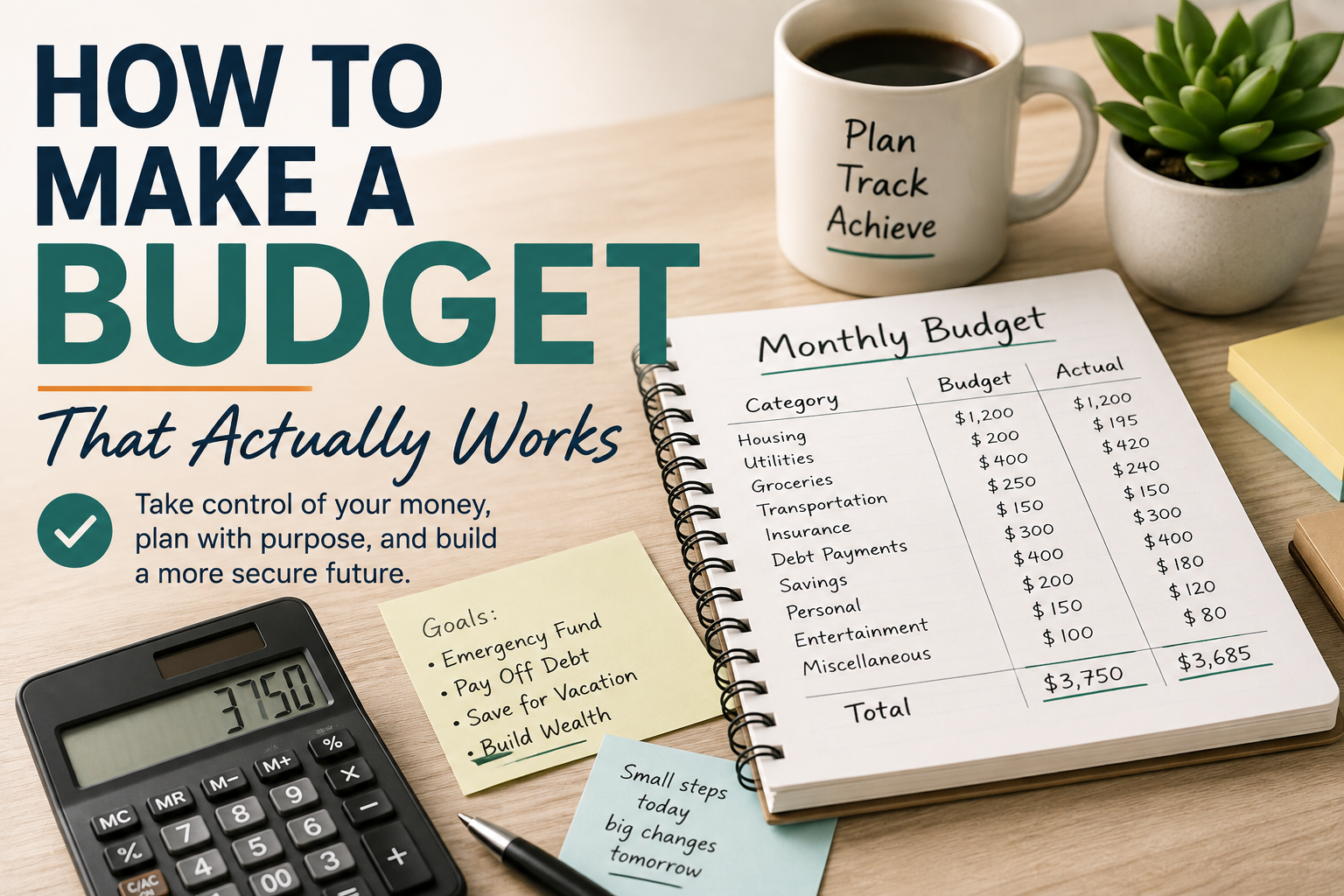
For a long time, I did something with my credit card that seemed perfectly reasonable—until I finally recognized how much it was hurting me.
Every month, I made the minimum payment. Then I would look at the available credit that payment had freed up and use the card again, sometimes right back to where it had been.
I was paying on time, so it felt as though I was doing what I was supposed to do. The account was current, and according to the credit-card company, I had money available to spend.
Except it wasn’t money.
It was room to borrow again.
Month after month, I repeated the process. The balance barely moved, interest charges continued to build, and keeping the balance near the credit limit wasn’t doing my credit score any favors.
I was getting the satisfaction of making a payment while keeping myself trapped in the same cycle.
What finally taught me how to make a budget that worked wasn’t a clever formula or a new budgeting app. It was recognizing that available credit was not available money.
Once I stopped borrowing back what I had just paid, making and following a budget finally began to make sense.
How to Make a Budget That Works in Real Life
Many budgets fail because they are created for an imaginary month.
In this imaginary month, nothing breaks. There are no birthdays, medical copays, higher utility bills, school expenses, home repairs, or invitations to spend money you hadn’t planned to spend.
Apparently, no one needs to have any fun either.
The numbers may look wonderful on paper, but real life rarely follows the paper.
A workable budget starts with the life you actually have. It includes real expenses, imperfect habits, occasional surprises, and enough flexibility that you won’t abandon it after one difficult week.
That is also why I prefer to think of a budget as a spending plan.
A spending plan isn’t there to scold you for buying something. Its purpose is to help you decide where your money needs to go before a credit limit, an advertisement, an unexpected bill, or an impulse makes that decision for you.

Some Money Decisions Feel Better Than They Really Are
My credit-card habit didn’t make much sense once I stepped back and examined it. But while I was doing it, the behavior made sense to me.
That is how many damaging money habits work.
They provide some immediate relief or reassurance:
- The minimum payment was made.
- The bill was paid on time.
- There was still money in checking.
- The monthly installment looked affordable.
- The credit card still had room available.
Everything appears to be under control—at least for the moment.
I know someone who regularly bought groceries with a credit card so the cash would remain in the checking account.
On the surface, that also seemed sensible. The checking balance stayed higher, regular bills could still be paid, and the credit-card statement would be handled later.
For a while, it worked.
Then one month there wasn’t enough money to pay the full statement balance. The groceries had already been eaten, but their cost was still sitting on the card—and now interest was being added.
The person hadn’t really preserved the cash.
The expense had simply been postponed.
When Available Cash Gives You a False Sense of Security
Suppose you have $1,000 in checking and $400 in grocery purchases sitting on a credit card.
It may feel as though you still have $1,000 available.
You don’t.
Four hundred dollars of that balance is already spoken for. It belongs to the credit-card company even though it hasn’t left your checking account yet.
There is nothing inherently wrong with using a credit card for groceries, convenience, or rewards when the money is already available and you pay the full statement balance on time.
The trouble begins when the card is used to protect the appearance of cash rather than the cash itself.
If this purchase came directly out of my checking account today, could I still afford it?
If the answer is no, the credit card isn’t solving the problem. It is moving the problem into next month—and may attach interest to it along the way.
Depending on the terms of the card, failing to pay the full statement balance may also cause you to lose the grace period that previously allowed you to avoid interest on purchases. The Consumer Financial Protection Bureau explains how credit-card grace periods work.
Start by Finding the Habit That Keeps Putting You Behind
Most budgeting instructions begin by telling you to list your income and expenses.
That is useful, but I think there is an earlier question:
What do I keep doing that gives me relief today but creates a bigger problem next month?
For me, it was reusing the credit I had just paid down.
For someone else, it might be:
- Moving money from savings and promising to replace it later
- Paying off a credit card and immediately charging regular expenses again
- Using buy-now-pay-later plans because each payment looks small
- Treating an overdraft limit as part of the checking balance
- Leaving annual expenses out of the budget and charging them when they arrive
- Making an extra debt payment without leaving enough cash for regular expenses
- Carrying a balance because of the mistaken belief that it helps a credit score
Until you see the behavior clearly, a spreadsheet may only help you document the problem more neatly.
That doesn’t mean you need to correct every money habit before creating a spending plan. It means your plan should be designed around the problem you actually have—not the problem a budgeting template assumes you have.
Use Your Actual Income and Expenses
The first step in learning how to create a budget is finding out what is actually happening—not deciding what you think should be happening.
Pull together the last two or three months of:
- Bank statements
- Credit-card statements
- Automatic payments
- Regular income deposits
- Payment-app activity
- Cash withdrawals
Don’t begin by judging every purchase. Look for patterns.
Where does your money go? Which expenses keep surprising you? Are several small subscriptions adding up? Are groceries consistently higher than the amount you estimate? Are you making credit-card payments while continuing to add new charges?
You don’t have to account for every nickel for the rest of your life. You need enough accurate information to stop guessing.
I would pay particular attention to the two or three categories that repeatedly surprise you. Those are usually more important than one occasional small purchase.
Include Expenses That Don’t Arrive Every Month
Some expenses are easy to include because they arrive every month:
- Mortgage or rent
- Car payments
- Insurance
- Utilities
- Internet and telephone service
- Minimum debt payments
Other expenses change:
- Groceries
- Gas
- Dining out
- Entertainment
- Clothing
- Household purchases
Then there are expenses that cause trouble precisely because they don’t arrive every month:
- Car repairs and maintenance
- Home repairs
- Medical and dental expenses
- Birthdays and holidays
- Annual memberships
- Insurance renewals
- Travel
- Property taxes
We often describe these as unexpected expenses, but many aren’t truly unexpected. We simply don’t know exactly when they will arrive or how much they will cost.
If car maintenance averages approximately $600 a year, setting aside $50 each month makes more sense than acting surprised when the tires wear out.
The timing may be uncertain. The eventual expense isn’t much of a mystery.
See Whether Your Numbers Actually Fit
Once you know what is coming in and going out, compare the totals.
If your income is greater than your expenses
Decide where the remaining money should go.
- Build emergency savings
- Prepare for irregular expenses
- Reduce debt
- Save for a specific goal
- Invest for the future
- Create more breathing room
Give the extra money a job. Unassigned money has a habit of finding one for itself.
If your income and expenses are about equal
Your plan may work, but there is little protection against an unexpected bill.
Building even a small cushion should become a priority. The first goal doesn’t have to be thousands of dollars. It may be enough to create a little distance between an unexpected expense and the credit card.
If your expenses are greater than your income
Begin by measuring the size of the gap.
A $75 monthly shortage may be corrected through several smaller changes. An $800 shortage probably won’t be solved by canceling one subscription and eating out less often.
A larger shortfall may require decisions involving:
- Housing
- Transportation
- Insurance
- Debt payments
- Income
- Assistance programs
- Professional help
This is one place where generic budgeting advice often falls short. Telling someone to “cut unnecessary expenses” isn’t particularly helpful when essential bills are consuming nearly all the income.
Before choosing a solution, understand the size and source of the problem.
Choose a Budgeting Method You Will Actually Use
Simple category budgeting
Set reasonable amounts for major areas such as housing, food, transportation, savings, debt, and personal spending. This provides structure without requiring you to assign every individual dollar.
The 50/30/20 method
This approach generally assigns 50% of take-home income to needs, 30% to wants, and 20% to savings and additional debt payments.
It can be a useful starting point, but the percentages may not fit your housing, healthcare, or transportation costs. Use the percentages as guidelines—not as a grade on how well you manage money.
Zero-based budgeting
With zero-based budgeting, every dollar receives a purpose before the month begins.
Income minus planned spending, savings, investing, and debt reduction equals zero. That doesn’t mean you spend everything. It means nothing is left without an assignment.
This method provides more control, but it also requires more attention.
Pay-yourself-first budgeting
Money is directed toward savings, investing, or additional debt payments soon after income arrives. You then manage the remaining amount for bills and everyday spending.
This can work when income and essential expenses are predictable.
The best method isn’t necessarily the most popular or detailed one. It is the one you can still imagine yourself using three months from now.
Not sure which approach fits the way you manage money? Compare the best budgeting methods before choosing an app, spreadsheet, or other tool.
If maintaining the system feels like preparing a tax return every weekend, you probably won’t keep doing it.
How to Stick to a Budget Without Feeling Punished
A spending plan that allows nothing for enjoyment may look responsible, but it often doesn’t last.
Include reasonable amounts for things such as:
- Eating out
- Hobbies
- Entertainment
- Small personal purchases
- Time with family and friends
This isn’t permission to ignore financial limits. It is recognition that deprivation is difficult to maintain.
If one dinner out causes the entire budget to collapse, the plan may be too rigid.
A small miscellaneous category can also help. Something almost always costs more than expected. A little breathing room allows you to adjust without throwing away the whole plan.
Track Your Spending Without Making It a Second Job
You can track your spending with:
- Pen and paper
- A spreadsheet
- A budgeting app
- Automatic bank categories
- A budgeting worksheet
- A short weekly account review
How you do it matters less than whether you will continue doing it.
For many people, a brief weekly review works better than waiting until the end of the month.
- Are the essential bills covered?
- Is any category running higher than expected?
- Did something change this week?
- Am I charging something I cannot afford to pay for now?
- Do I need to adjust the rest of the month?
Ten honest minutes can prevent a nasty surprise three weeks later.
You may not need to track every transaction forever. You need to track closely enough to understand your habits and recognize when the plan is beginning to drift.
Adjust Your Budget Instead of Abandoning It
At the end of the month, compare what you planned with what actually happened.
- A category was unrealistic
- An annual expense was overlooked
- Prices increased
- Income changed
- A spending habit needs attention
- The chosen budgeting method requires too much work
Adjusting the plan does not mean you failed.
It means you learned something.
I would be more concerned about a budget that never changes. Life changes, prices change, and priorities change. Your spending plan should be allowed to change with them.
The important thing is to recognize the difference between adjusting the plan and repeatedly using debt to avoid what the plan is telling you.
How to Start Your Budget Today
Don’t try to rebuild your entire financial life tonight.
- Gather the last two or three months of bank and credit-card statements.
- Add your average monthly take-home income.
- Total your major expenses.
- Identify one behavior that keeps putting you behind.
- Create a first-draft spending plan using those real numbers.
Does this plan reflect the way I actually live—or the way I think I’m supposed to live?
Your first spending plan doesn’t need to be perfect. It needs to be honest enough to help you make a better decision.
For me, that better decision began when I stopped treating available credit as available money. Once I stopped borrowing back what I had just paid, the balance finally had a chance to move in the right direction.
That was when budgeting stopped feeling like a classroom exercise and started becoming something I could use.
Ready to See What Your Numbers Are Telling You?
Use the free Money Habits Budget Calculator to enter your monthly income, expenses, savings, and financial goals.
It will show you where your money is going, how much remains, and which areas may deserve attention.
A good spending plan doesn’t tell you never to spend money. It helps you recognize which money is truly available, prepare for what is coming, and avoid making today easier by making next month harder.
That is what makes it worth following.
More Help With Your Spending Plan
A spending plan becomes easier to use when you solve one specific problem at a time. These guides can help with the next step:
- How to Track Your Spending provides a simple way to see where your money is actually going.
- Why Most Budgets Fail explains how to repair a plan that keeps falling apart.
- The 50/30/20 Budget Rule shows how to adapt the familiar percentages when they do not fit your real expenses.
- How to Save Money on Groceries focuses on practical habits for one of the most flexible household expenses.
- Emergency Fund: Why It Matters explains how to prepare for expenses that do not fit neatly into the monthly plan.
Start with the guide that addresses the part of your spending plan giving you the most trouble.
Frequently Asked Questions
How do I make a budget for the first time?
Start with two or three months of actual income and expenses. Include regular bills, flexible spending, debt payments, savings, and expenses that don’t arrive every month. Build the first plan from what you really spend rather than what you think you should spend.
What should I do if my expenses are more than my income?
Calculate the size of the monthly shortage first. A small gap may be corrected through several modest changes. A larger gap may require decisions involving housing, transportation, debt payments, income, or outside assistance. Knowing the size of the problem helps you choose a solution large enough to matter.
How often should I review my budget?
Review it briefly each week and more thoroughly at the end of each month. Update the plan when your income, expenses, prices, or priorities change.
Is it bad to use a credit card for regular expenses?
Not necessarily. The important question is whether the money to pay the full statement balance is already available. Using a card becomes risky when it is used to make the checking balance appear healthier or to postpone expenses that cannot currently be afforded.
Why do I keep failing to follow my budget?
The plan may be unrealistic, too restrictive, too complicated, or missing irregular expenses. A repeated breakdown may also point to a particular behavior—such as continuing to use a credit card while trying to pay it down—that the budget has not addressed.