
Trying to sort through the best budgeting methods always felt like a crapshoot. It usually started with choosing a budgeting app.
A Google search produces one list after another of apps promising relief from financial stress if you’ll just use their product. Many reviews don’t help much. You get rating scales, feature lists, and a declaration that one app is “best overall,” but very little explanation of whether it will fit the way you actually manage money.
Suppose you choose one.
There is usually a scaled-down version or free trial that lets you look around. Before long, you’re asked to link your bank and credit-card accounts. Then you discover that some of the features you really want require a paid subscription.
Not for nothing, but I’d like to know whether the system fits me before I start linking accounts and paying for the privilege of finding out.
That was the part I had backward.
I was trying to choose the app before choosing the budgeting method. The app may track the numbers, but the method determines what I’m supposed to do with them.
Do I want to assign every dollar a job? Set broad spending limits? Separate bill money from spending money? Control only the categories causing trouble? Or simply make sure I’m saving something before the rest disappears?
Those are different problems, and they don’t all require the same solution.
The best budgeting methods aren’t defined by the app with the highest rating. The right one fits the way you receive, spend, save, and think about money—and is simple enough that you will still use it after the free trial loses its shine.
So before choosing an app, let’s choose the kind of budgeting system you actually need.
Start With the Problem, Not the Product
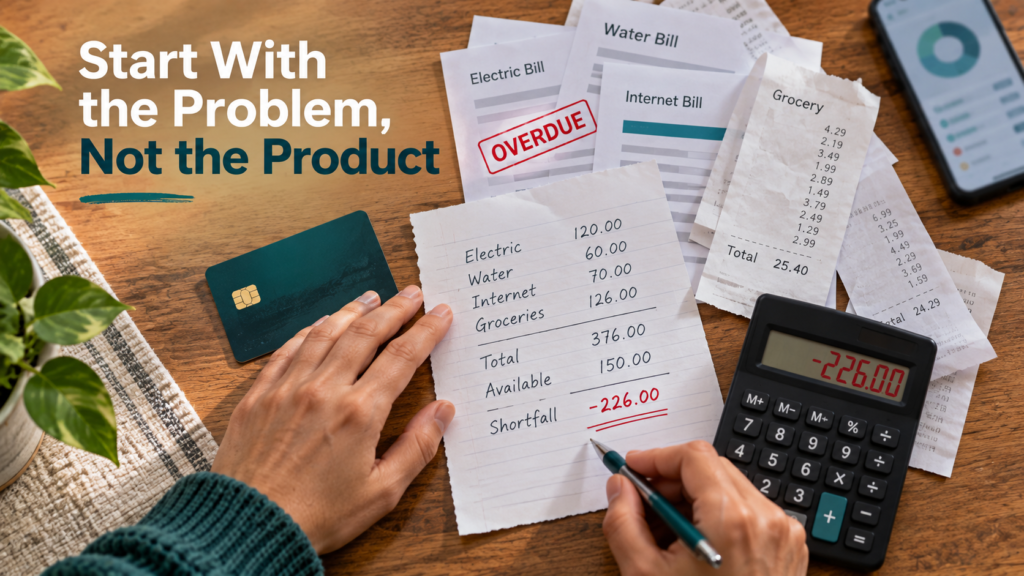
Budgeting tools are often marketed as though everyone has the same problem.
We don’t.
One person may need to find out where the paycheck goes. Another knows exactly where it goes but struggles to set limits. Someone else has irregular income and cannot make a conventional monthly budget work.
Some people understand the numbers perfectly well but abandon any system that requires too much daily attention.
Comparing the best budgeting methods begins with the problem you need the system to solve. Before choosing one, ask:
What do I need this system to help me do?
Which statement sounds most like you?
- I need a simple picture of where my money goes.
- I want general guidelines without tracking every purchase.
- I need tighter control because I keep running short.
- I overspend in one or two predictable categories.
- I want to make saving a priority.
- My income changes from month to month.
- I have tried detailed budgets and always stopped using them.
Once you identify the problem, choosing a method becomes easier.
Then—and only then—does it make sense to decide whether you need an app, spreadsheet, worksheet, or plain old pen and paper to manage it.
If you haven’t yet worked through your actual income and expenses, start with How to Make a Budget That Actually Works for You. Once you understand your numbers, this article will help you decide how to manage them.
For another straightforward starting point, Consumer.gov explains how to make and use a monthly budget.
How the Best Budgeting Methods Compare
The table below matches several of the best budgeting methods with the situations they are most likely to help:
| If this sounds like you | Method to consider |
|---|---|
| I want something uncomplicated | Simple category budget |
| I want broad spending guidelines | 50/30/20 method |
| I want to account for every dollar | Zero-based budget |
| I overspend in particular categories | Envelope method |
| Saving always gets pushed aside | Pay-yourself-first method |
| My income changes every month | Base-income budget |
| I hate detailed budgeting | Two-account spending plan |
This isn’t a financial personality test carved in stone. It’s a reasonable place to begin.
Simple Category Budget: A Good Starting Point
A simple category budget divides your spending into broad areas such as:
- Housing
- Transportation
- Food
- Insurance and healthcare
- Debt payments
- Savings
- Personal spending
You decide how much each area can reasonably receive and compare the plan with what actually happens.
This method may fit if:
- You want structure without excessive detail.
- Your income and bills are fairly predictable.
- You are willing to review your spending weekly or monthly.
- You want to understand the overall picture before digging into individual purchases.
It may become frustrating if:
- Broad categories can make you overlook smaller spending habits.
- You need tighter day-to-day control.
- You continually move money from one category to another without adjusting the plan.
This is where I would suggest many beginners start.
You can always add detail later if the broad categories don’t tell you enough. Starting with a complicated system is like buying an entire workshop when you only needed a screwdriver.
The 50/30/20 Method: Broad Guidelines Without Much Detail
The 50/30/20 approach generally divides take-home income into:
- 50% for needs
- 30% for wants
- 20% for savings and additional debt payments
Its strength is simplicity. It offers a quick way to see whether one broad spending area may be consuming too much income.
Its weakness is that real life doesn’t always cooperate with the percentages.
Housing, insurance, transportation, or healthcare may push essential expenses well beyond 50%. That doesn’t automatically mean you’re irresponsible. It means the guideline may not fit your circumstances.
This method may fit if:
- You want broad guardrails.
- Your income comfortably covers essential expenses.
- You don’t want to manage numerous categories.
- You need a simple way to balance current spending with future goals.
It may become frustrating if:
- Essential expenses already consume most of your income.
- Your income changes significantly.
- You need closer control over spending in individual categories.
- You treat the percentages as rules you have failed to follow.
The percentages are a starting point, not a financial commandment.
Our separate article on the 50/30/20 budget rule will examine how to test the percentages against real living costs.
Zero-Based Budgeting: More Control and More Attention
With zero-based budgeting, every dollar receives a purpose before the month begins.
If take-home income is $5,000, the complete plan for bills, spending, saving, investing, and debt reduction should also total $5,000.
The zero at the end does not mean you have spent everything. It means none of the money has been left without an assignment.
This method may fit if:
- You like detailed planning.
- You are working toward an aggressive savings or debt goal.
- Money tends to disappear because it was never given a purpose.
- You want to make deliberate decisions about nearly every part of your income.
- You are willing to update the plan regularly.
It may become frustrating if:
- Detailed tracking causes you to avoid budgeting altogether.
- Your income or expenses change frequently.
- You abandon systems that require regular attention.
- You spend more time correcting categories than making useful decisions.
Zero-based budgeting can provide excellent control.
But excellent control isn’t especially helpful if maintaining it makes you miserable.
The Envelope Method: Control the Categories That Cause Trouble
The envelope method places a firm spending limit around selected categories.
Traditionally, people put cash into physical envelopes for groceries, entertainment, clothing, and other flexible expenses. When an envelope was empty, spending in that category stopped.
You can use the same idea without cash. Separate accounts, spreadsheet categories, or digital envelopes can serve the same purpose.
This method may fit if:
- You repeatedly overspend in certain categories.
- You want a visible stopping point.
- Credit and debit cards make spending feel less immediate.
- You don’t need tight controls around every expense.
It may become frustrating if:
- You have numerous shared or automatic expenses.
- Moving purchases among categories becomes confusing.
- You continually borrow from one envelope to support another.
- You need a complete financial plan rather than limits around a few problem areas.
You don’t need an envelope for everything.
If groceries and dining out are the two categories causing trouble, start with those two. There is no prize for creating seventeen envelopes and then forgetting what half of them were for.
Pay Yourself First: When Saving Keeps Getting Postponed
The pay-yourself-first method changes the usual order.
Instead of waiting to see what remains at the end of the month, you move money toward savings, investing, or additional debt payments soon after income arrives. You then manage what remains for bills and everyday spending.
This method may fit if:
- Saving always gets postponed.
- Your income and regular bills are predictable.
- You prefer automation over detailed tracking.
- You have enough room in the budget to make the transfer reliably.
It may become frustrating if:
- The automatic transfer leaves too little for essential expenses.
- You regularly transfer the money back.
- Your monthly income varies significantly.
- You automate the transfer without first checking whether the amount is affordable.
Paying yourself first only works when the amount is realistic.
Transferring $500 to savings and withdrawing $400 a week later doesn’t accomplish much besides giving the money a round trip.
Base-Income Budget: When Income Changes Each Month
A conventional monthly budget can become difficult when income changes.
If you build the plan around your best month, you may commit yourself to spending that a slower month cannot support.
A base-income budget begins with the amount you can reasonably expect during a lower-income month. That amount first covers essential expenses and minimum commitments.
Income above that amount can then be directed toward:
- Irregular expenses
- Emergency savings
- Taxes
- Additional debt payments
- Longer-term goals
- Discretionary spending
This method may fit if:
- You are self-employed.
- Your hours, commissions, or tips vary.
- Your income is seasonal.
- You receive occasional larger payments.
- You want to avoid depending on your best month.
It may become frustrating if:
- You choose a base amount that is unrealistically low.
- You don’t establish priorities for income above the base.
- Essential expenses already exceed what a lower-income month provides.
The purpose isn’t to pretend every month will be bad. It is to avoid committing your regular spending to income that may not arrive.
The Two-Account Spending Plan: When You Hate Detailed Budgeting
Some people don’t want to manage twelve categories. They probably won’t start simply because an article tells them to.
A two-account approach can provide basic structure:
- One account holds money for bills and other financial commitments.
- A second account holds money available for everyday spending.
When income arrives, move or keep enough in the bills account to cover upcoming commitments. The remainder becomes the amount available for flexible spending.
This method may fit if:
- Detailed tracking causes you to quit.
- Your bills are predictable.
- You need a clear separation between committed and spendable money.
- You are comfortable managing more than one account.
It may become frustrating if:
- Irregular expenses aren’t included in the bills amount.
- You repeatedly move money out of the bills account.
- Your income doesn’t cover essential obligations.
- Automatic payments come from the wrong account.
It isn’t the most sophisticated budgeting method.
But a simple method you use is more valuable than an impressive method you avoid.
Can You Combine Budgeting Methods?
Absolutely.
You might:
- Use broad categories for the overall spending plan.
- Create envelopes for groceries and entertainment.
- Pay yourself first through an automatic savings transfer.
- Use a base-income amount because your earnings vary.
- Keep bill money separate from everyday spending.
The goal is not to become loyal to one name on a list of the best budgeting methods. The goal is to build a system that helps you make better decisions.
Just be careful not to combine so many methods that the result becomes harder to manage than the original problem.
If you need three apps, two spreadsheets, seven bank accounts, and a wall chart to understand your budget, the system may have gotten away from you.
Do You Need a Budgeting App?
Maybe. But now you can decide based on what you need.
Before linking your accounts or paying for a subscription, ask:
- Which budgeting method does the app support?
- Can it handle irregular income?
- Does it allow flexible or custom categories?
- Will it help with the problem I identified?
- Can I try its important features before paying?
- Do I understand what account information it will access?
- Can I use the same method without the app?
- How difficult will it be to cancel or move my information elsewhere?
An app may make tracking easier, automate categories, and keep everything in one place. But even the best budgeting methods don’t require an app unless the technology makes the chosen system easier to maintain.
But it cannot decide what matters to you. It also cannot make an unrealistic spending plan work simply by displaying it in better colors.
Choose the system first. Then decide whether an app makes that system easier to maintain.
Test Your Method for 30 Days
You don’t need to commit for life.
Choose one method and test it for 30 days. Reading about the best budgeting methods can narrow the choices, but using one for a full month tells you whether it fits.
During the month, notice:
- How long does it take to maintain?
- Does it help you decide before you spend?
- Can you see whether your bills and goals are covered?
- Does it expose the problem you wanted to solve?
- Do you understand what needs to change next month?
- Are you actually using it—or avoiding it?
At the end of the 30 days, decide whether to keep, adjust, or replace it.
Changing methods isn’t failure. Continuing to use a system that tells you nothing useful would be the bigger problem.
Which of the Best Budgeting Methods Should You Choose?
If you are still uncertain, I would start with a simple category budget.
It provides enough information to understand the major parts of your spending without requiring you to track every dollar.
If it doesn’t provide enough control, you can move toward zero-based budgeting or add envelopes around the categories causing the most trouble.
Whatever you choose, remember:
The best budgeting method is the one that shows you the truth, helps you make a decision, and is simple enough that you will use it again next month.
Once you select a method, use the free Money Habits Budget Calculator to enter your income, expenses, savings, and financial goals.
Don’t try to make your life fit a budgeting method.
Choose a budgeting method that fits your life.
Frequently Asked Questions
What are the best budgeting methods for beginners?
The best budgeting methods for beginners are usually the easiest to understand and maintain. A simple category budget is often a good starting point because it groups spending into broad areas without requiring you to track every dollar or transaction individually.
Which budgeting method is best for beginners?
The best method depends on the problem the beginner needs to solve. A simple category budget works well for a general overview. The envelope method may be better when particular categories are causing problems.
Is the 50/30/20 budget realistic?
It can provide useful guidelines, but the percentages do not fit every household. High housing, transportation, insurance, or healthcare costs may push essential expenses above 50% of take-home income.
Do I need an app to create a budget?
No. You can manage a budgeting method with paper, a spreadsheet, separate accounts, envelopes, or an app. The app is a tool, not the budgeting method itself.
How long should I test a budgeting method?
Try it for approximately 30 days. That should give you enough time to see whether it helps you make decisions and whether maintaining it fits your routine.