

If you’ve never sat down and formally “taught” your kids about money, you’re not behind. Most parents haven’t either. Only 15% of Americans say school is where they learned the most about money — the rest of us picked it up from family, trial and error, or just figuring it out the hard way as adults.
That’s actually good news, because it means teaching kids about money isn’t about a formal lesson plan. It’s about small, repeated moments woven into everyday life — the grocery store, the allowance jar, the birthday check from grandma. You don’t need a finance degree to hand your kids a head start. You just need to start.
Why Teaching Kids About Money Matters More Than You Think
Money habits form early, and they stick. Parents seem to sense this too. In T. Rowe Price’s Parents, Kids & Money survey, about 60% of parents said money conversations in their house don’t happen nearly enough, and more than half worried they weren’t preparing their kids to handle money by the time they turned 18.
Meanwhile, schools are only slowly catching up. As of 2025, 45% of high schoolers took a personal finance class, up from 31% the year before — real progress, but still less than half. And 61% of adults say their own high school never offered one at all. Whatever your kids get outside your house is still hit or miss. What happens at your kitchen table matters just as much, if not more.
Start With the Basics: Earning, Saving, Spending
Before kids can understand budgeting or investing, they need to grasp three simple ideas: money comes from somewhere, some of it should be saved, and some of it gets spent.
A classic way to make this concrete is the three-jar method — one jar for spending, one for saving, one for giving. It’s simple enough for a five-year-old to understand, and it turns an abstract concept into something they can literally hold in their hands.
Piggy banks still do a lot of this work too. 85% of parents in the T. Rowe Price survey said their kids have one, mostly to show them what saving looks like over time. It’s an old-school tool, but it works because it’s visual. Kids see the pile grow.
Use an Allowance to Teach Real Decisions
An allowance isn’t just extra pocket money — it’s a low-stakes training ground for decision-making. When kids control even a small amount of money, they get to feel the consequences of spending it too fast, firsthand.
That’s actually the point. Among parents who give an allowance, 41% say their kids come back asking for more once it runs out. That’s not a failure — that’s the lesson. Running out of money because you spent it on something impulsive is a much easier thing to learn at age eight with a five-dollar allowance than at twenty-eight with a paycheck.
If you want to add structure, tie a portion of the allowance to saving toward a goal — a toy, a game, a bigger purchase down the road. Watching a goal get closer paycheck by paycheck teaches patience in a way no lecture ever will.
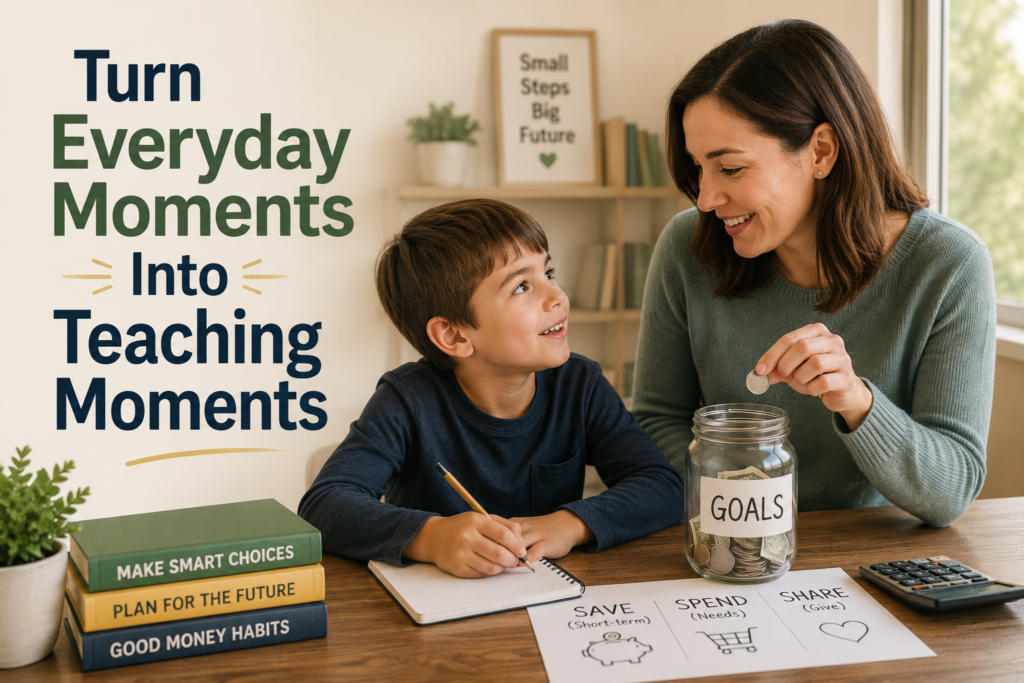
Turn Everyday Moments Into Teaching Moments
You don’t need to schedule “money lessons.” The moments are already happening — you just have to point them out.
- At the grocery store, let your kid compare prices on two similar items and talk through which one’s the better deal.
- When a birthday check or cash gift shows up, walk through the same spend-save-give decision instead of just banking it quietly. Half of parents skip this one, according to that same survey, even though it’s one of the easiest opportunities you’ll get all year.
- When you’re paying a bill online, say it out loud. “This is the electric bill, and it’s due every month.” Kids don’t know money is a recurring responsibility until someone shows them.
- Let older kids see you compare prices before a big purchase, or walk them through why you’re skipping something you want because it’s not in the budget.
None of this needs to be a big production. A thirty-second comment while you’re already doing the task sticks better than a sit-down lecture anyway.
Adjust the Lessons as They Get Older
What works for a six-year-old won’t land the same way with a fourteen-year-old, so the lessons should grow with them.
Young kids (ages 4-8): Focus on the basics — earning, saving, spending, and the idea that money is limited. Jars, piggy banks, and simple chores tied to small rewards work well here.
Tweens (ages 9-12): Introduce a real bank savings account, basic budgeting for something they want to buy, and the difference between needs and wants. This is also a good age to start talking about how credit cards work, even in simple terms.
Teens (ages 13-18): Give them more independence — a debit card, a part-time job, a bigger say in their own spending decisions. Nearly half of teens in one recent study believed an 18% interest rate on debt is manageable, which says a lot about how much teens still need real guidance on credit and interest before they’re out on their own managing it. If you want a resource to hand an older teen directly, my book, Understanding Money: A Beginner’s Guide to Personal Finance, walks through these exact fundamentals in plain language.
Don’t Worry About Getting It Perfect
Here’s something else that survey found: over half of parents said their kids quickly forget the money lessons they try to teach. That’s normal. Nobody absorbs a lesson about compound interest the first time they hear it, whether they’re eight or eighty.
The goal isn’t a single perfect conversation that sticks forever. It’s repetition — bringing money up naturally, again and again, until it stops feeling like a special topic and just becomes part of how your family talks. That’s really what teaching kids about money comes down to: showing up consistently, even in small ways, so it’s normal for them by the time it actually matters.