
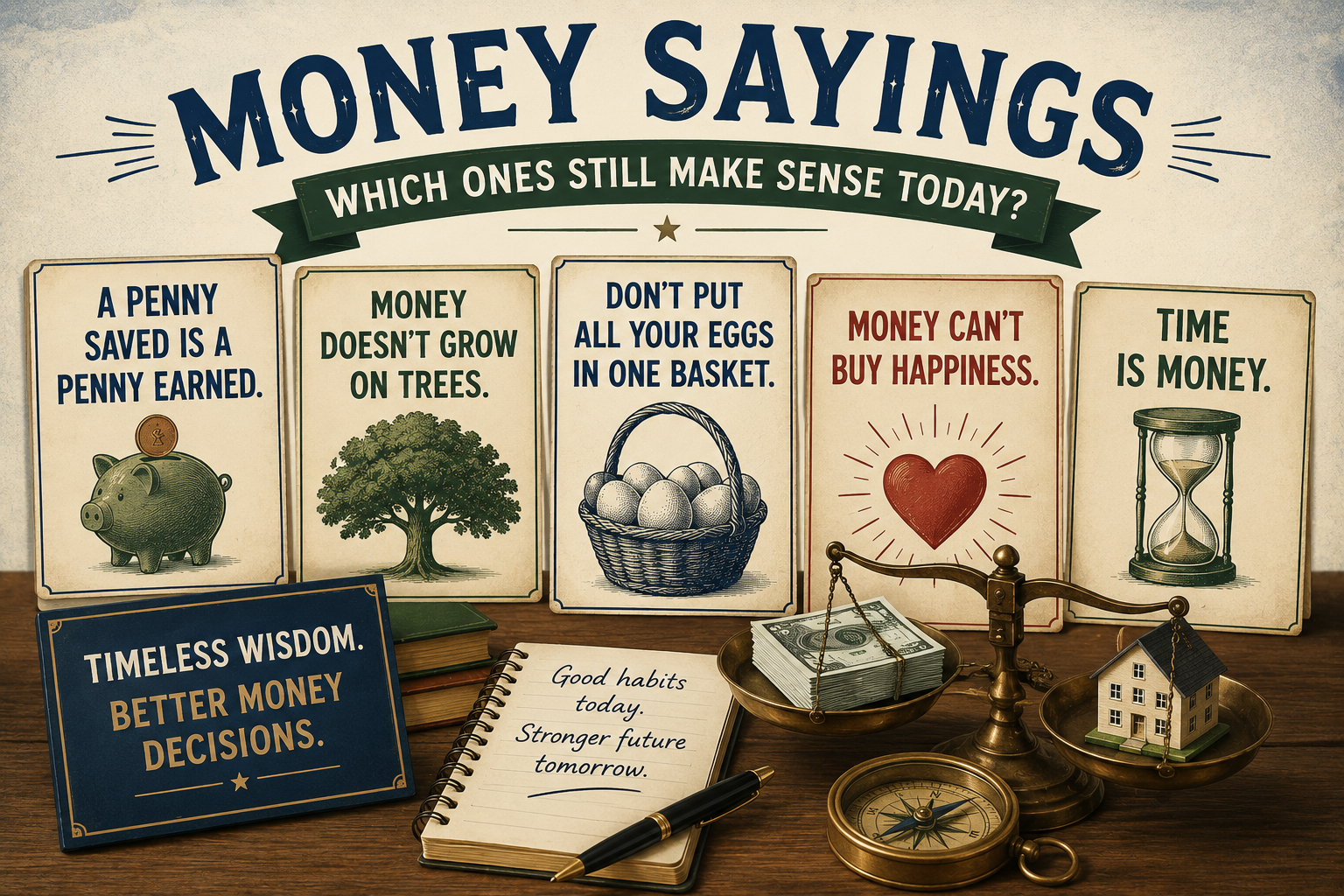
Money sayings have been passed down for generations. Some contain practical financial wisdom that still applies today, while others oversimplify complicated financial decisions.
You’ve probably heard many of these sayings from parents, grandparents, teachers, or friends. The question is whether they still offer good advice in today’s financial world.
Let’s take a closer look at seven popular money sayings and what they really mean. For a broader look at the concepts behind them, visit our Financial Education guide.
“A Penny Saved Is a Penny Earned”
This is one of the best-known financial sayings—and it still holds up.
Every dollar you don’t spend is a dollar that remains available for future goals. Saving money doesn’t increase your paycheck, but it does increase the amount you keep.
The lesson is to spend intentionally. For example, skipping a $20 purchase you do not really want leaves $20 for a goal that matters more. Buying something on sale only saves money if it was something you needed or had already planned to buy.
“Money Doesn’t Grow on Trees”
Most children hear this phrase at some point.
While it may sound cliché, it teaches an important lesson: money is a limited resource.
Every purchase represents a choice. Spending money on one thing means it can’t be used elsewhere.
That trade-off is called opportunity cost: choosing one use for your money means giving up another. If you spend your last $30 on takeout, you cannot also put that same $30 toward your savings goal. Money sayings become more useful when you connect them to an actual choice.
“Don’t Put All Your Eggs in One Basket”
This saying has become one of the guiding principles of investing.
Diversification helps reduce risk by spreading investments across different assets rather than depending on a single investment to succeed.
For example, holding shares in many companies makes you less dependent on the fortunes of one employer or business. Diversification can reduce that concentration risk, but it cannot prevent losses when a broader market falls. Owning several funds with similar holdings may also give you less variety than you expect.
“Money Can’t Buy Happiness”
This saying is both true and misleading.
Money can’t guarantee happiness, meaningful relationships, or good health.
However, money can reduce financial stress, provide security, create opportunities, and give you greater freedom to make choices.
The better lesson might be this:
Money can support well-being, but it does not guarantee happiness. Having enough to cover rent and groceries can ease a very real worry. Buying something expensive to impress others may do much less for your peace of mind. These money sayings need room for both realities.
“Time Is Money”
Benjamin Franklin’s famous phrase reminds us that time has value.
Time can have financial value, but every hour does not need to produce income. Rest, family, friendships, and caring for someone also matter. Taking an extra shift may increase your paycheck while leaving less time for something you value just as much.
But this saying also applies to investing.
Starting earlier gives savings and investments more time to grow, although investment returns are not guaranteed. For a simple savings example, $100 earning 5% interest annually becomes $105 after one year. If the interest stays in the account and the rate remains the same, the next year’s interest is calculated on $105. Our guide to how interest works explains the idea.
In personal finance, time is often your greatest asset.
“You Get What You Pay For”
Sometimes buying the cheapest option ends up costing more.
A quality appliance that lasts 15 years may be a better value than replacing a cheaper model every five years.
The same principle applies to insurance, education, professional services, and many everyday purchases.
A higher price does not guarantee better quality. Compare reliability, repair costs, warranties, and how often you will use the item. A $60 pair of shoes that lasts two years could cost less per year than a $30 pair replaced every six months. But the $60 option still needs to fit your budget. Use money sayings as a prompt to compare value, rather than a reason to overspend.
“Neither a Borrower Nor a Lender Be”
This famous advice comes from Shakespeare’s Hamlet.
Taken literally, it doesn’t fit modern life.
Most people will borrow money for a home, education, or business at some point.
The practical lesson is to borrow carefully and understand the full cost. Before accepting a loan, check the interest rate, fees, monthly payment, and total repayment amount. If you lend money to a friend, ask whether you could afford to lose it and agree on expectations beforehand. An affordable loan and a pressured promise to help someone are very different decisions.
Which Money Sayings Should You Follow?
No financial saying applies perfectly to every situation.
Some remain timeless.
Others require a little context.
The best financial decisions come from understanding the principle behind the saying and checking whether it fits your situation. Our guide to finding financial advice you can trust offers more ways to evaluate the guidance you hear.
Good money habits aren’t built on catchy phrases alone. They’re built on consistent decisions made over many years.
Final Thoughts
Money sayings have survived for generations because many of them contain a kernel of truth.
They remind us to save consistently, spend wisely, diversify our investments, and think about the long-term consequences of today’s financial choices.
The next time you hear one of these familiar expressions, don’t just repeat it.
Ask yourself whether the lesson behind it can help you make a better financial decision today.