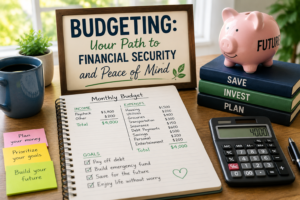
A budgeting workspace with a notebook, calculator, piggy bank, and signs related to saving and financial planning on a desk—perfect for building financial security and achieving peace of mind.
Budgeting

Budgeting: Your Path to Financial Security and Peace of Mind

Budgeting is one of the most important financial habits you can develop. If you’ve ever wondered where your paycheck went before the month was over, you’re not alone. Many people struggle to balance their income with everyday expenses, leaving little room for savings or unexpected costs. The good news is that budgeting gives you a

Read More »
Chalkboard reads "Pay Off Student Loans." Nearby are a graduation cap, books, cash, a calculator, and a notepad with an expert debt-crushing strategy payoff plan.
Debt & Credit

How to Pay Off Student Loans: Practical Strategies

If you’re looking for ways to pay off student loans faster, you’re not alone. Millions of borrowers struggle to balance monthly loan payments with everyday expenses and other financial goals. The good news is that you don’t need a perfect income or a windfall to make meaningful progress. With the right strategy and consistent money

Read More »
A print with a piece of paper with the words credit scoring on it. There's an approved ink stamp laying on it's side.
Debt & Credit

Your Credit Score and What You Need to Know

Have you ever been surprised by a loan denial or wondered why someone else qualified for a lower interest rate? In many cases, the answer comes down to your credit score. Your credit score is one of the most important numbers in your financial life. It can affect whether you’re approved for a mortgage, qualify

Read More »
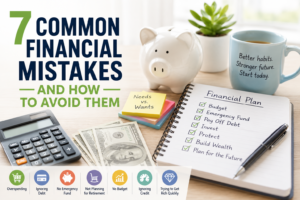
A piggy bank, money, calculator, and a notepad labeled “Financial Plan” with a checklist; text highlights seven common financial mistakes and practical ways to avoid financial mistakes.
Money Habits

7 Common Financial Mistakes and How to Avoid Them

Have you ever looked at your bank account and wondered, “Where did all my money go?” If so, you’ve probably experienced one or more common financial mistakes without even realizing it. Most people don’t get into financial trouble because of one major decision. Instead, it’s usually a series of small habits that quietly chip away

Read More »
a print of Man holding smart phone making online shopping and banking payment. Blurred background .
Money Habits

Social Media and Your Finances: The Effect on Money?

Social media and your finances may be more closely connected than you realize. What begins as a few minutes of checking messages can quickly become an encounter with targeted advertisements, influencer recommendations, limited-time offers, and carefully presented lifestyles—all accompanied by convenient links encouraging you to buy. Social platforms are not merely places where people share

Read More »
A man stands confidently with arms crossed; behind him are financial charts and a calculator, symbolizing his journey toward personal wealth, while a group of people, young and old, gather outside under a heart-shaped cloud.
Money Habits

Net Worth and Self-Worth: Only One Is About Money

Net worth and self-worth can become dangerously tangled when you’re struggling with debt, comparing yourself with others, or feeling behind financially. Your net worth is a useful financial measurement. Your self-worth is the value you possess as a human being. One can rise and fall over time; the other should never depend on a bank

Read More »
Newsletter Signup Form
Newsletter Consent
By subscribing, you consent to us processing your email for newsletters. Your data is stored securely, used to send emails, and kept no longer than necessary. You can unsubscribe anytime and review details in our Privacy Policy

Each month, you'll receive a roundup of the latest articles, practical money tips, and new resources published on Money Habits For Me.