
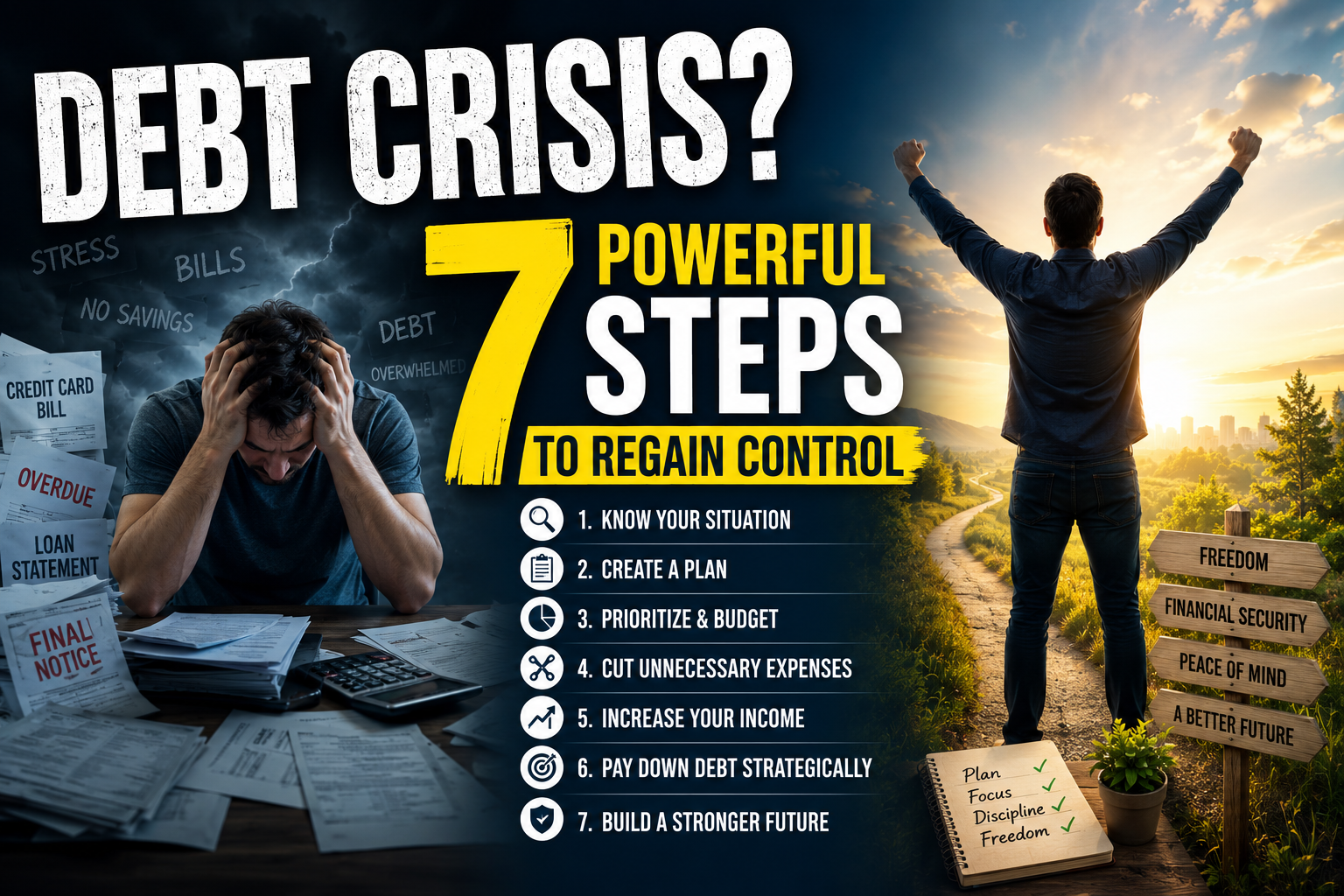
Ever feel as if your paycheck arrives already spoken for?
The mortgage or rent is due. Credit cards want their minimum payments. The car loan is waiting, groceries cost more than expected, and another bill just landed in the mailbox.
Having debt does not automatically mean you are facing a debt crisis. Many people carry mortgages, car loans, student loans, or credit card balances while still meeting their obligations.
A debt crisis begins when your required payments consistently exceed what you can afford—or when paying your debts prevents you from covering basic needs.
That can feel frightening, but avoiding the numbers only lets the problem grow. The next step is to understand where you stand and choose the right level of help.
How Do You Know You’re in a Debt Crisis?
Debt becomes a serious problem when it starts controlling the rest of your financial life.
Possible warning signs include:
- Using credit cards to buy groceries or pay utilities
- Missing payments or regularly paying late
- Borrowing from one account to pay another
- Taking cash advances to cover everyday expenses
- Paying only the minimum while balances continue growing
- Falling behind on housing, utilities, insurance, or taxes
- Receiving collection calls or legal notices
- Having no money available for emergencies
- Losing sleep or avoiding conversations about money
- Withdrawing money from retirement accounts to make routine payments
One difficult month does not necessarily mean you are in a debt crisis. However, if these problems continue month after month, an ordinary debt-payoff strategy may no longer be enough.
If you are still making your payments but want to understand what debt is costing you, read The Impact of Debt: How It Affects Your Money and Your Life.
If you cannot pay everything currently due, start with Unpaid Bills? Here’s How to Decide What to Pay First.
1. Get the Complete Debt Crisis Picture
The first step is also the one many people dread most: write down everything you owe.
For every debt, record:
- The creditor
- Current balance
- Interest rate
- Minimum payment
- Due date
- Whether the account is current or past due
- Whether the debt is secured by property
- Any collection or legal action already underway
Include credit cards, personal loans, medical bills, student loans, tax debts, payday loans, mortgages, vehicle loans, and collection accounts.
Then calculate the total required monthly payments.
Do the same with your income and essential expenses. The purpose is to answer one important question:
After covering basic living expenses, is there enough income left to make the required debt payments?
If the answer is no, a snowball or avalanche payoff method will not solve the immediate problem. Those methods require extra money. You need to stabilize the situation first.
The total may be uncomfortable to see. Still, a difficult number is more useful than a vague fear. Once the facts are visible, you can begin making informed decisions.
2. Protect Your Basic Needs First
When you cannot pay everyone, the company calling most often shouldn’t automatically get your first dollar.
Protect the expenses that keep you safe, housed, healthy, and able to earn income.
These generally include:
- Housing
- Essential utilities
- Food
- Necessary medications and healthcare
- Transportation needed for work
- Required insurance
- Childcare needed for employment
- Court-ordered obligations
- Essential taxes
Some debts are also secured by property. Falling behind on a mortgage or vehicle loan could eventually place your home or transportation at risk.
Unsecured debts, such as most credit cards, remain important, but they should not leave you unable to buy food, keep the electricity on, or get to work.
This is not permission to ignore creditors. It is a way to make calm decisions when your money cannot cover every obligation.
3. Contact Creditors Before Things Get Worse
Calling a creditor is nobody’s idea of a relaxing afternoon. Still, waiting usually reduces your options.
Contact the company as soon as you know you cannot make a payment. Explain the situation honestly and ask whether it offers:
- A temporary hardship program
- A lower interest rate
- Reduced payments
- A different due date
- Waived late fees
- Short-term payment deferral
- A structured repayment plan
Do not promise an amount you cannot afford just to end an uncomfortable conversation.
Before agreeing to anything, ask:
- What will the new payment be?
- How long will the arrangement last?
- Will interest continue accumulating?
- Will fees be added?
- How will the account be reported to the credit bureaus?
- What happens after the hardship period ends?
Get the agreement in writing and keep copies of all correspondence. If you speak with someone by telephone, record the date, representative’s name, and what was discussed.
A hardship program will not erase the debt, but it may give you enough breathing room to develop a longer-term solution.
4. Choose a Solution That Matches the Problem
Not every type of debt relief works the same way. The right option depends on whether you are current on your payments, how much income you have, the kinds of debt you owe, and whether your financial hardship is temporary or permanent.
A Self-Managed Payoff Plan
If you can make all minimum payments and still have money left over, you may be able to repay the debt yourself. Start with How to Get Out of Debt and Stay Out for Good, the main debt-payoff guide for building a structured repayment plan.
Two common approaches are:
- Debt avalanche: Put extra money toward the debt with the highest interest rate first. This generally saves the most money.
- Debt snowball: Put extra money toward the smallest balance first. This can provide faster wins and help you stay motivated.
Neither method is magic. The best one is the approach you can continue using until the debt is gone.
A Creditor Hardship Plan
This may be appropriate when your financial problem is temporary, such as a job interruption, medical emergency, or short-term income reduction.
The creditor may agree to temporarily reduce your payment or interest rate. Make sure you understand what happens when the temporary arrangement ends.
Debt Consolidation
Debt consolidation combines several debts into one new loan or account.
It may help if the new debt offers:
- A lower interest rate
- An affordable payment
- Reasonable fees
- A clear payoff date
- No unnecessary extension of the repayment period
Consolidation does not eliminate debt. It moves it.
A lower monthly payment can look attractive while costing more overall if the repayment period is stretched out for several additional years. You also risk running credit card balances back up after transferring them to the new loan.
Run the numbers before signing anything.
5. Consider Nonprofit Credit Counseling
If you cannot create a workable plan on your own, speaking with a credit counselor may be the most practical next step.
A reputable counselor can review your income, expenses, debts, and available options. The counselor may help you build a budget or recommend a debt management plan.
Under a debt management plan, you typically make one payment to the counseling organization. It then distributes payments to participating creditors. Creditors may agree to lower interest rates or waive certain fees, although results vary.
A debt management plan does not erase what you owe. It creates a structured way to repay eligible debts.
The Consumer Financial Protection Bureau explains the differences between credit counseling, debt management, consolidation, settlement, and credit repair.
Before enrolling, ask the counseling organization:
- Is it a nonprofit?
- What fees will I pay?
- Which debts can be included?
- What will my monthly payment be?
- How long will the plan last?
- What happens if I miss a payment?
- Will participating accounts be closed?
- How will the plan affect my credit?
- What happens if a creditor refuses to participate?
“Nonprofit” does not automatically mean free, so review every fee and agreement carefully.
6. Be Careful With Debt-Settlement Promises
Debt settlement is different from credit counseling and a debt management plan.
A settlement company may offer to negotiate with creditors so you can pay less than the full amount owed. Some companies instruct customers to stop making payments and instead deposit money into a separate account until enough accumulates to propose settlements.
That approach carries serious risks.
According to the Consumer Financial Protection Bureau, stopping payments can lead to additional interest, late fees, collection activity, and possible legal action. Creditors are not required to accept a settlement offer, and the company may be unable to settle every account.
Be especially cautious if a company:
- Guarantees it can eliminate your debt
- Charges large fees before providing results
- Tells you to stop communicating with creditors
- Promises access to a special government program
- Avoids explaining the possible credit or tax consequences
- Pressures you to enroll immediately
If an offer sounds as if your debt will vanish with very little effort, slow down. Debt problems are difficult enough without adding an expensive promise that may not work.
7. Know When Bankruptcy Deserves Consideration
Bankruptcy isn’t right for everyone, but you shouldn’t automatically dismiss it as a personal failure.
It is a legal process designed for situations in which debts have become unmanageable. The consequences can be significant, which is why a qualified bankruptcy attorney should review your individual circumstances.
The two forms most often associated with individual consumers are:
- Chapter 7: Certain nonexempt property may be sold to repay creditors, and qualifying debts may be discharged.
- Chapter 13: Individuals with regular income may propose a court-approved repayment plan lasting three to five years.
Not every debt can be discharged, eligibility rules apply, and the effect on your home, vehicle, other property, and credit depends on your situation.
The federal courts provide a general overview through Bankruptcy Basics, but that information is not a substitute for legal advice.
Talking with an attorney does not commit you to filing. It gives you the information needed to compare bankruptcy with the cost and likelihood of repaying the debt through other means.
Build a Recovery Plan That Prevents Debt Crisis
Resolving the current debt is only part of the job. You also want to reduce the likelihood of returning to the same situation.
As your finances stabilize, work toward:
- A small emergency fund
- A realistic spending plan
- Regular account and bill reviews
- Less reliance on credit for routine expenses
- Insurance appropriate for your circumstances
- A plan for irregular expenses
- Open conversations about money within your household
Do not wait until every debt is repaid before saving anything. Even a modest emergency buffer can keep a car repair, medical copay, or home expense from immediately going back on a credit card.
Progress may feel slow at first. That does not mean the plan is failing. A debt crisis usually develops over time, and recovery often works the same way—one payment, one decision, and one month at a time.
The Bottom Line
A debt crisis is not simply having a large balance. It is reaching the point where required payments interfere with basic needs, and no realistic path forward exists under your current budget.
Start with the facts. Protect essential expenses. Contact creditors. Compare your options carefully. If the numbers still do not work, ask a reputable credit counselor or qualified attorney for help.
You do not need to solve the entire problem today. Your next step might be listing every debt, making one phone call, or scheduling a counseling appointment.
The important thing is to stop letting fear make the decisions for you.