
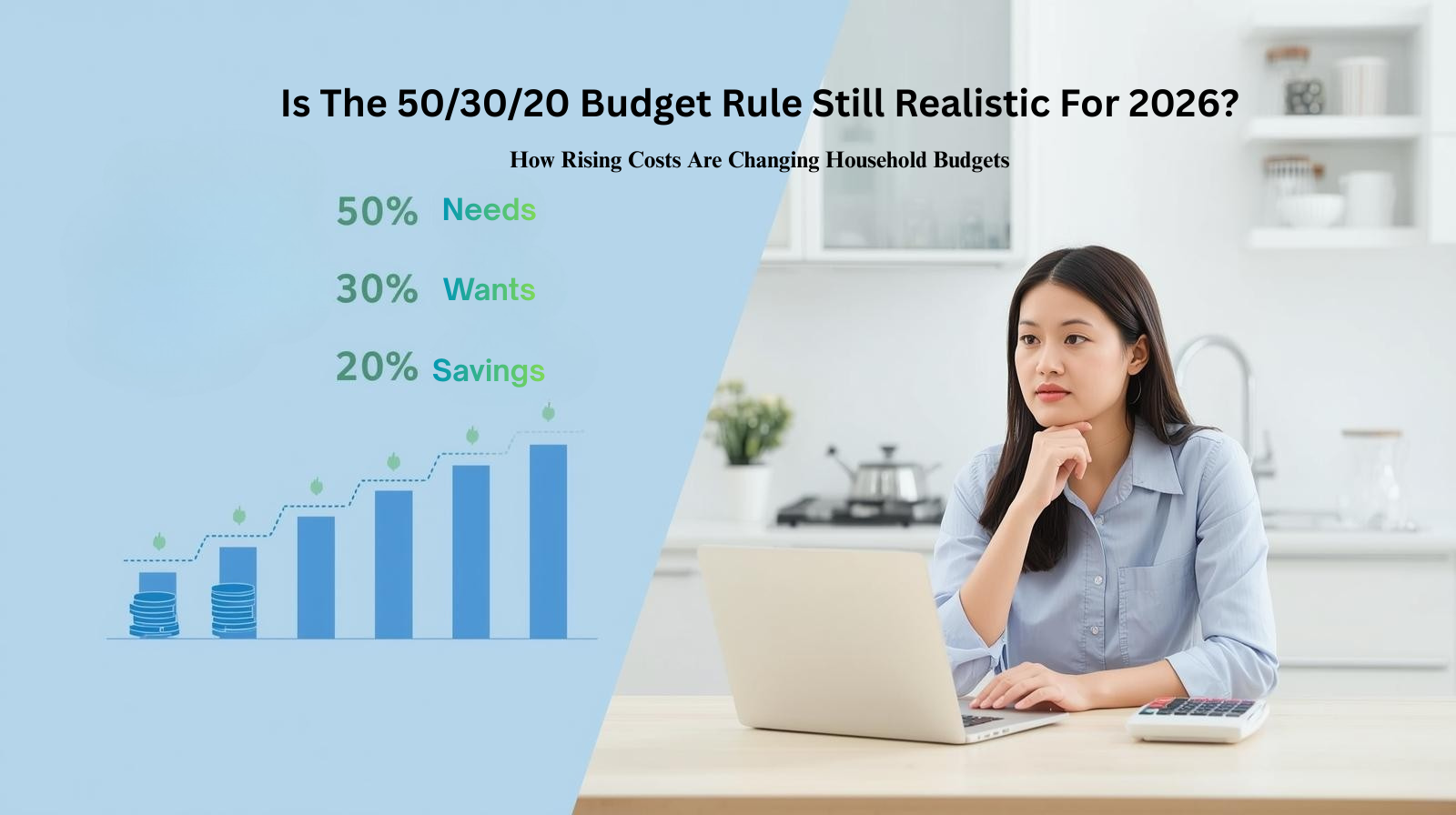
The 50/30/20 budget rule sounds wonderfully simple.
Use 50% of your take-home pay for needs, 30% for wants, and 20% for savings and additional debt payments. Divide the money, follow the percentages, and watch your finances improve.
Then real life shows up and ruins the math.
Your mortgage or rent takes a large bite. Insurance increases. Groceries cost more than expected. The car needs work. Before you know it, your needs consume considerably more than 50% of your income—and you haven’t bought anything extravagant.
Does that mean the 50/30/20 budget rule failed?
More importantly, does it mean you failed?
No. It means the percentages uncovered something worth examining.
The 50/30/20 budget rule works best as a measuring tool, not a financial report card. It can help you see how your income is being used, but it cannot decide what is realistic for your household.

A Budget That Looked Wrong on Paper
Consider a woman I’ll call Linda.
Linda brought home $4,000 a month. According to the 50/30/20 budget rule, her monthly spending should have looked something like this:
- $2,000 for needs
- $1,200 for wants
- $800 for savings and additional debt reduction
It looked reasonable until she used her actual numbers.
Her rent, utilities, groceries, insurance, transportation and minimum debt payments totaled approximately $2,550. Her needs weren’t 50% of her take-home pay. They were almost 64%.
Linda’s first reaction was that she must be spending too much.
She stopped eating lunch out. She canceled two subscriptions. She became more careful at the grocery store. Those changes helped, but they didn’t transform 64% into 50%.
Why?
Her occasional lunch wasn’t the real problem. Her rent and car payment were.
Linda had been trying to solve a fixed-expense problem by cutting small pleasures. It was like trying to lighten a moving truck by removing the sunglasses from the glove compartment.
Once she understood that, she could make better decisions. She still reduced some unnecessary spending, but she stopped treating every small purchase like a character flaw. She began planning for a less expensive car when her current loan ended and considered whether moving could eventually reduce her housing costs.
The percentages didn’t give Linda an immediate solution. They showed her where the pressure was coming from.
That is the real value of the 50/30/20 budget rule.
What the 50/30/20 Budget Rule Means
The formula divides your monthly take-home pay into three broad categories.
50% for Needs
Needs are the expenses required to maintain your household and meet your financial obligations.
They commonly include:
- Rent or mortgage payments
- Basic utilities
- Groceries
- Insurance
- Healthcare expenses
- Necessary transportation
- Minimum debt payments
- Essential childcare
- Other required household expenses
The difficult part is deciding what truly belongs here.
A basic internet connection may be a need if you work from home. The fastest package available, combined with several premium entertainment services, probably isn’t entirely a need.
Transportation may be necessary. That doesn’t automatically mean every vehicle payment is unavoidable.
The purpose isn’t to judge the expense. It is to classify it honestly.
30% for Wants
Wants make life more comfortable or enjoyable but aren’t required for basic living.
They may include:
- Restaurant meals
- Vacations
- Entertainment
- Hobbies
- Premium subscriptions
- Nonessential shopping
- Upgraded services
- Convenience purchases
This category isn’t a list of things you should feel guilty about buying.
You are allowed to enjoy your money. A spending plan that removes everything enjoyable from your life probably won’t last very long.
The question is whether these purchases fit comfortably after your needs are covered and you are making progress toward your financial goals.
20% for Savings and Additional Debt Reduction
The final 20% is intended to improve your future financial position.
It can include:
- Emergency savings
- Retirement contributions
- Investments
- Saving for future goals
- Additional credit-card payments
- Extra loan payments beyond the required minimum
Minimum debt payments generally belong under needs because you are contractually required to make them. Payments above the minimum belong here because they help reduce debt faster.
The Consumer Financial Protection Bureau presents 50/30/20 as one possible budgeting guideline. It also acknowledges an important point: not everyone can follow it, and people may need guidelines that fit their own financial situations.
That distinction matters. This is a rule of thumb, not a law.
Use Take-Home Pay, Not Gross Income
The 50/30/20 budget rule should generally be calculated using the money that reaches your household after taxes and payroll deductions.
That is your take-home pay.
Suppose your monthly gross income is $6,000, but only $4,500 reaches your checking account. Building the percentages around $6,000 would create a spending plan using money you never received.
Using $4,500, the starting targets would be:
- Needs: $2,250
- Wants: $1,350
- Savings and additional debt reduction: $900
These numbers give you something to compare with your actual spending. They are not automatic instructions to spend the full amount in every category.
If your wants equal only 15%, you do not need to increase them to 30%. You can direct the difference toward savings, debt or another important goal.
What If Your Needs Exceed 50%?
This is where the formula becomes useful—provided you don’t use it to beat yourself up.
Suppose your numbers look like this:
- Needs: 62%
- Wants: 23%
- Savings and additional debt reduction: 15%
You are not following the traditional formula, but that doesn’t automatically mean your finances are out of control.
Start by asking why your needs equal 62%.
Is it because:
- Housing is expensive?
- Insurance increased?
- You have a high vehicle payment?
- Minimum debt payments consume too much income?
- Childcare or healthcare costs are unusually high?
- Your income recently decreased?
- Several temporary expenses arrived at once?
The answer determines what you do next.
If the problem is temporary, you may need a temporary adjustment. If the problem is an expensive fixed commitment, the solution may require a longer-term decision. If the numbers remain tight after removing unnecessary spending, you may be dealing with an income problem rather than a budgeting problem.
Those situations should not receive the same advice.
Don’t Invent New Percentages Just to Make the Chart Look Better
When people discover that 50/30/20 doesn’t fit, they are sometimes told to use 60/20/20, 70/20/10 or another variation.
That may be reasonable, but simply renaming your current percentages doesn’t change your finances.
If your needs consume 70% of your income, calling it a “70/20/10 budget” doesn’t solve the problem. It merely describes it.
Before selecting new percentages, ask:
- What are my actual percentages now?
- Which expenses are creating the most pressure?
- Which expenses can realistically change?
- What financial progress can I still make?
- What should improve over the next six to twelve months?
Your adjusted percentages should represent a deliberate plan—not a nicer label for whatever happened last month.
The Needs-Versus-Wants Trap
Some purchases do not fit neatly into one category.
Groceries are a need, but every grocery purchase isn’t necessarily essential. Transportation is a need, but the cost of the vehicle may include both need and preference. A phone may be necessary, while the newest model and premium plan are choices.
You don’t need to dissect every receipt until grocery shopping feels like a tax audit.
Use reasonable judgment.
Ask yourself:
Could I meet this need in a less expensive way without creating an unreasonable burden?
If the answer is yes, part of the expense may reflect a want. That doesn’t make the purchase wrong. It simply helps you see where you have flexibility.
The goal is an honest picture, not a perfect accounting exercise.
How to Test the 50/30/20 Budget Rule Against Your Life
Before changing anything, look at what actually happened during the last one to three months.
Step 1: Calculate Your Take-Home Income
Include the money available for household expenses after taxes and payroll deductions.
If your income changes from month to month, use a conservative monthly average.
Step 2: Review Your Transactions
Use your bank statements, credit-card statements, receipts and payment accounts.
Don’t rely entirely on memory. Memory has a funny way of remembering the mortgage and forgetting the six smaller purchases made over the weekend.
Step 3: Sort the Transactions
Place each expense into:
- Needs
- Wants
- Savings and additional debt reduction
You can use a notebook, spreadsheet, budgeting app or bank-provided spending report. The best tool is the one you will consistently use.
Step 4: Calculate Your Percentages
Divide the total for each category by your monthly take-home income.
For example, if your needs total $2,700 and your take-home income is $4,500:
$2,700 ÷ $4,500 = 60%
Your needs consume 60% of your take-home pay.
Step 5: Investigate the Largest Difference
Don’t try to fix every category at once.
If your needs are far above 50%, find the expenses driving that number. If your wants are unusually high, determine which purchases no longer feel worthwhile. If savings are low, look for an amount you can begin contributing consistently.
Start with the part of the picture that matters most.
For a complete system, see How to Make a Budget That Actually Works for You. If the percentage approach doesn’t suit you, compare the other budgeting methods before forcing yourself into one that doesn’t fit.
What Progress Can Look Like
Assume your current breakdown is:
- Needs: 65%
- Wants: 30%
- Savings and additional debt reduction: 5%
Reaching 50/30/20 next month may be impossible.
A reasonable first target could be:
- Needs: 64%
- Wants: 27%
- Savings and additional debt reduction: 9%
That might not earn a gold star from a budgeting chart, but you have nearly doubled the portion going toward your future.
That is progress.
Later, a debt may be paid off, an insurance cost may change, or your income may increase. When that happens, resist allowing every freed-up dollar to disappear into new spending. Capture part of the improvement and move it toward savings or another priority.
A workable spending plan improves over time. It doesn’t need to arrive fully formed on the first day.
When the 50/30/20 Budget Rule Works Well
This method may fit you if:
- Your income is reasonably predictable.
- Your essential expenses are near half your take-home pay.
- You prefer broad categories rather than tracking dozens of limits.
- You want room for enjoyment while still saving.
- You need a quick way to evaluate your overall financial balance.
It may not be your best choice if:
- Your income changes substantially each month.
- Your essential expenses consume most of your income.
- You need detailed control over individual spending categories.
- You are managing a serious debt or cash-flow problem.
- You regularly face large irregular expenses.
Choosing another method isn’t quitting. It is choosing a tool that fits the problem.
The 50/30/20 Budget Rule Is a Compass, Not a Command
The 50/30/20 budget rule can show whether your spending is generally balanced. It can reveal that fixed expenses are too high, wants have quietly expanded or too little is being directed toward the future.
What it cannot do is understand your household from three percentages.
Use it to begin a conversation with your numbers:
- What is working?
- What is creating pressure?
- What can change now?
- What requires a longer-term solution?
- Am I moving in a better direction?
If your numbers don’t match 50/30/20, don’t immediately conclude that you’re bad with money.
Find out why they don’t match.
That answer will tell you far more than the percentages ever could.