
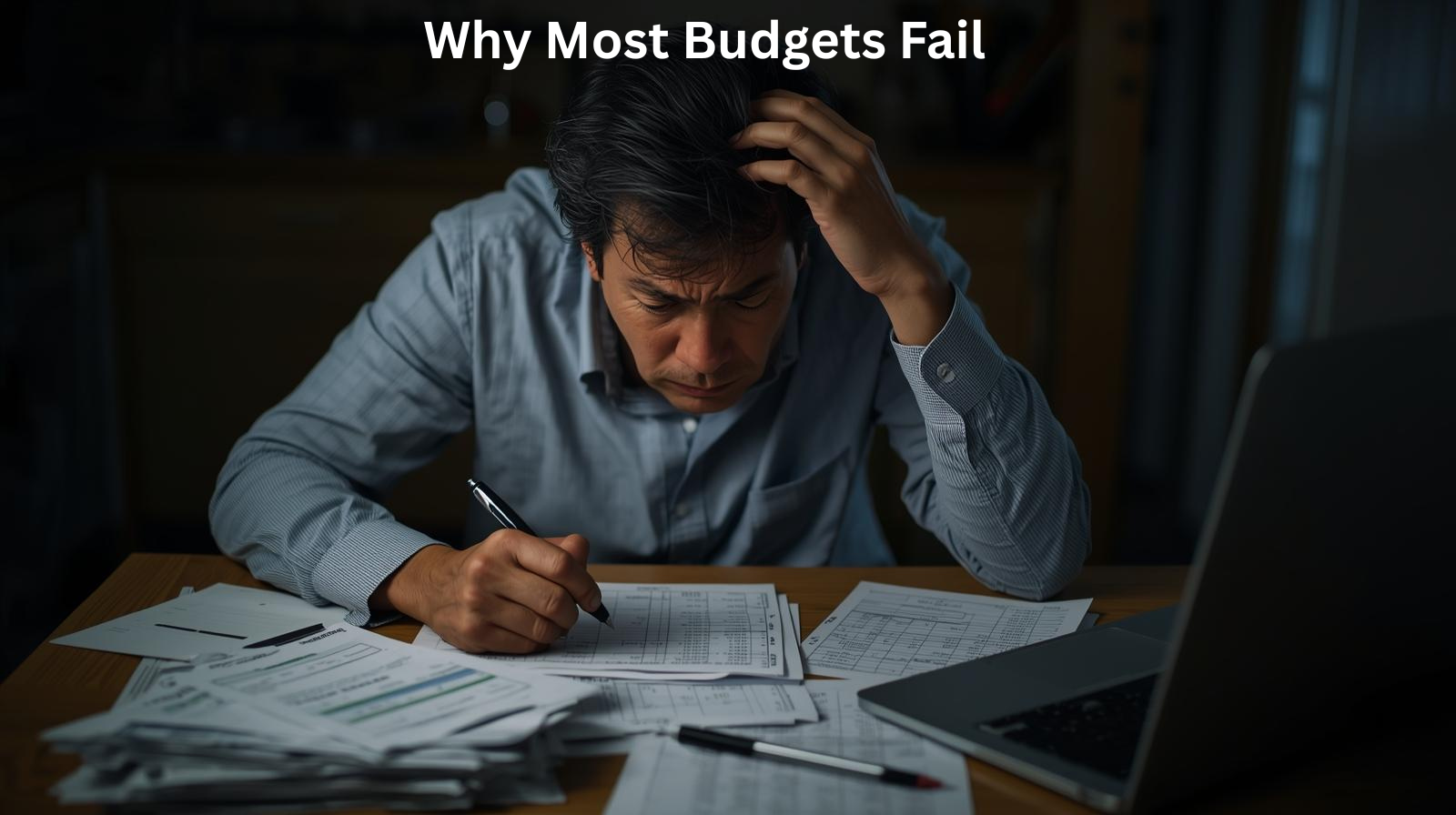
If you’ve ever wondered why most budgets fail, the answer may be hiding in the way the budget was built.
A budget can look perfect on the first day of the month. Every dollar has a purpose. The categories add up. Savings are included. Even the miscellaneous category appears ready for whatever might happen.
Then whatever might happen actually happens.
The car needs work. The electric bill is higher. A family birthday was forgotten. Three grocery trips replace the one you planned. Before long, the numbers no longer match the plan.
That is usually when people say, “I’m terrible at budgeting.”
Maybe you aren’t.
Maybe your budget was built for an imaginary month instead of the life you actually live.
The Budget That Lasted Eleven Days
Consider someone I’ll call Robert.
Robert had tried budgeting several times. Each attempt began the same way. He sat down, listed his income and regular bills, assigned limits to groceries and entertainment, and promised himself that this time would be different.
His latest budget looked especially good.
Then, eleven days into the month, his car needed a $375 repair.
Robert didn’t have a category for car repairs, so he charged it to a credit card. That meant the budget was already off by $375. A few days later, he spent more than planned on groceries. Then an annual membership renewed automatically.
By the third week, Robert stopped tracking altogether.
From his perspective, the budget had failed again.
But the real problem wasn’t that Robert lacked discipline. His plan included his regular monthly bills but ignored expenses that didn’t arrive every month. It also left no room for adjustment after something changed.
Robert didn’t need another motivational speech about self-control.
He needed a budget that expected real life.
That distinction helps explain why most budgets fail—and what can make the next one work better.
Tracking Shows Where the Budget Broke
Before throwing out a failed budget and starting over, compare the plan with what actually happened.
This is where tracking your spending becomes useful. The Consumer Financial Protection Bureau also recommends starting with a realistic picture of the money coming in and where it is going.
Ask three questions:
- What did I expect to happen?
- What actually happened?
- What caused the difference?
Perhaps groceries were $150 higher than planned. That difference doesn’t automatically mean you were careless. Your original estimate may have been unrealistic. Prices may have changed. You may have purchased household supplies in the same transactions. An extra family member may have visited.
The difference is information.
Once you understand what caused it, you can decide whether to change your behavior, change the budget or make a longer-term financial adjustment.
Why Most Budgets Fail Before the Month Even Begins
Some budgets are set up to fail before anyone spends the first dollar.
Here are the most common reasons.
1. The Budget Was Based on an Ideal Month
An ideal month has no repairs, birthdays, school expenses, medical copayments, travel, household replacements or unexpected invitations.
Real months have several of those.
If you build your plan using only mortgage or rent, utilities, groceries, insurance and other predictable bills, the budget may look affordable. The trouble begins when everything else arrives.
What Works Instead
Review several months of bank and credit-card statements before building the plan.
Look beyond the regular bills. Find expenses such as:
- Vehicle maintenance
- Home repairs
- Gifts
- Holidays
- Annual subscriptions
- Insurance premiums
- Medical costs
- Clothing
- School expenses
- Pet care
- Membership renewals
- Travel
Add the yearly estimate for each irregular expense and divide it by 12. Set aside that amount monthly.
A $600 annual insurance bill becomes a $50 monthly expense. It is still $600, but it no longer arrives as a complete surprise.
A workable budget doesn’t assume nothing will go wrong. It prepares for the things that eventually happen.
2. The Numbers Came From Memory
Most of us know approximately what the mortgage costs. We may also remember the electric bill, car payment and insurance.
Everyday spending is harder.
You may believe groceries cost $600 a month when the actual average is $775. You may remember one streaming service and forget three smaller subscriptions. Cash withdrawals may appear as ATM transactions without showing where the cash went.
This is one reason why most budgets fail: the numbers were estimates pretending to be facts.
What Works Instead
Track your spending for at least 30 days. If possible, review the previous three months.
Use actual transactions from every place you spend money:
- Checking accounts
- Credit cards
- Payment apps
- Cash
- Automatic payments
- Online shopping accounts
Your first budget does not need perfect numbers, but it does need honest ones.
3. Credit-Card Spending Was Counted Too Late
A credit card can create the illusion that money is still available.
You spend $120 on groceries with the card, but your checking-account balance doesn’t change. If you are watching only checking, the money appears untouched.
The expense becomes visible when the credit-card bill arrives—possibly weeks after the purchase.
That delay can make a budget look healthy while new obligations quietly accumulate.
What Works Instead
Count a credit-card purchase when you make it, not when you pay the card.
If you charge $120 for groceries today, record $120 in the grocery category today. The later card payment is a transfer from checking to the credit-card account, not a new grocery expense.
This keeps the budget connected to the spending decision.
4. Every Category Was Too Restrictive
A budget sometimes fails because it was designed as a punishment.
No restaurant meals. No entertainment. No personal spending. No flexibility. Every available dollar goes toward debt or savings.
That may work briefly, especially when someone feels highly motivated. Eventually, ordinary life begins to feel like a violation of the budget.
One unplanned dinner becomes evidence that the entire plan has collapsed.
What Works Instead
Include a reasonable amount for enjoyment and personal choices.
The amount will depend on your income, obligations and goals. What matters is recognizing that a sustainable spending plan needs room for being human.
Spending money on something enjoyable is not automatically irresponsible. The problem begins when the purchase creates debt, prevents essential bills from being paid or repeatedly pushes aside a more important goal.
A budget you can live with is more valuable than a severe plan you abandon after two weeks.
5. The System Required Too Much Work
Some budgeting systems require dozens of categories, daily updates, multiple spreadsheets and constant adjustments.
That may appeal to someone who enjoys detailed financial tracking. For everyone else, it can become exhausting.
The more effort required to maintain the budget, the easier it becomes to fall behind. Once several days are missed, catching up feels unpleasant, and the entire system is abandoned.
What Works Instead
Use the simplest system that gives you enough information to make decisions.
You might need only:
- Regular bills
- Everyday living expenses
- Debt payments
- Savings
- Personal spending
- Irregular expenses
Review the plan once a week rather than repeatedly checking it throughout the day.
If the current system feels like a second job, compare the different budgeting methods and choose one that better matches how you naturally manage money.
The tool should serve you. You shouldn’t spend your life serving the tool.
6. The Budget Had No Adjustment Process
A budget is a plan made before the month unfolds.
Plans need to change when circumstances change.
If the electric bill is $75 higher than expected, that money must come from somewhere. You might reduce another category, temporarily save less or use money already set aside for variable expenses.
A rigid budget labels the higher bill as failure. A flexible budget asks what should be adjusted.
What Works Instead
When one category changes, use this order:
- Confirm why the category changed.
- Decide whether the change is temporary or ongoing.
- Identify another category that can reasonably be adjusted.
- Protect essential bills first.
- Update next month’s plan if the change is likely to continue.
Moving money between categories is not cheating.
It is budgeting.
7. Income and Bills Arrived at the Wrong Times
Some households earn enough during the month to cover their expenses but still run short between paychecks.
The mortgage, car payment, utilities and credit-card bills may all be due during the first half of the month. The income needed to cover them may not arrive until later.
That is a cash-flow problem.
A monthly budget can hide it because the total income exceeds total expenses when viewed across the entire month.
What Works Instead
Place your income dates and bill due dates on a calendar.
Identify which bills must be covered by each paycheck. Ask creditors and service providers whether payment dates can be changed to better match when income arrives.
You can also begin building a small checking-account cushion.
The monthly totals matter, but timing matters too.
8. The Budget Exposed a Bigger Problem
Sometimes the budget isn’t failing at all.
It is accurately showing that essential expenses and minimum payments exceed the available income.
That can happen because of:
- High housing costs
- Large debt payments
- Expensive transportation
- Insurance increases
- Healthcare or childcare costs
- Reduced income
- Several major obligations occurring at once
Canceling another small subscription may help slightly, but it won’t repair a large monthly shortfall.
What Works Instead
Identify the size of the gap.
If expenses exceed income by $50, several smaller changes may solve it. If the gap is $700, the response may need to include larger decisions involving housing, transportation, debt restructuring or additional income.
A spending problem and an income problem are not the same. They should not receive the same solution.
The budget may be delivering difficult news, but difficult news is still useful when it points you toward the real issue.
9. One Bad Week Was Treated as Complete Failure
This may be the most unnecessary reason why most budgets fail.
A person overspends during one week and decides the month is ruined. Because the budget is already “broken,” they stop tracking and tell themselves they will start again next month.
That turns one difficult week into several weeks without a plan.
What Works Instead
Restart with the next decision.
You don’t need to wait for Monday, payday or the first day of a new month.
Review what remains:
- Which bills still need to be paid?
- How much income is still expected?
- Which spending categories can be adjusted?
- What should be protected?
- What is the next best action?
You cannot undo last week’s spending. You can keep it from controlling the rest of the month.
How to Repair a Failed Budget
Before creating a completely new plan, conduct a short budget review.
Step 1: Find the First Point of Failure
When did the numbers stop matching the plan?
Look for the first unexpected bill, underestimated category, credit-card purchase or missed transaction.
Step 2: Identify the Type of Problem
Was it:
- A forgotten expense?
- An unrealistic estimate?
- An unplanned purchase?
- A timing problem?
- A system that required too much effort?
- A fixed-expense problem?
- An income shortfall?
Different problems require different repairs.
Step 3: Change One Part of the System
Don’t rebuild everything unless everything is truly broken.
Increase an unrealistic category. Add an irregular-expense fund. Simplify the number of categories. Change the weekly review process. Adjust a due date.
Make the smallest change that addresses the actual problem.
Step 4: Test the Repair for One Month
A budget is not proven when it looks good on paper.
It is proven when it survives contact with your household.
Use the revised plan for a month. Track what happens and make another adjustment if necessary.
Step 5: Keep What Works
Your budget does not need to resemble anyone else’s.
If a notebook works, use a notebook. If broad percentages help, consider the 50/30/20 budget rule. If detailed categories give you control, keep them.
The best method is the one that provides useful information and helps you make better decisions without consuming your life.
Build a Budget That Expects Real Life
Understanding why most budgets fail can be a relief.
It means you don’t need to become a completely different person before you can manage money successfully. You need a plan built around your actual income, actual expenses and actual household.
A useful budget should:
- Use realistic numbers
- Include irregular expenses
- Account for credit-card purchases immediately
- Leave room for reasonable enjoyment
- Be simple enough to maintain
- Allow adjustments during the month
- Reflect when income and bills arrive
- Help identify problems it cannot solve by itself
For the complete process, see How to Make a Budget That Actually Works for You.
If a full budget still feels overwhelming, the 7-Day Money Habits Starter Plan can help you begin with one manageable action at a time.
A Failed Budget Is Information
Robert’s budget didn’t fail because of one car repair.
It failed because the plan had no place for car repairs, annual renewals or adjustments. Once he recognized that, his next budget could include them.
That is the lesson worth carrying forward.
When your budget stops working, don’t immediately ask:
What is wrong with me?
Ask:
What happened that my plan did not account for?
Then repair that part.
A failed budget isn’t proof that you cannot manage money. It is a rough draft showing you what the next version needs.