
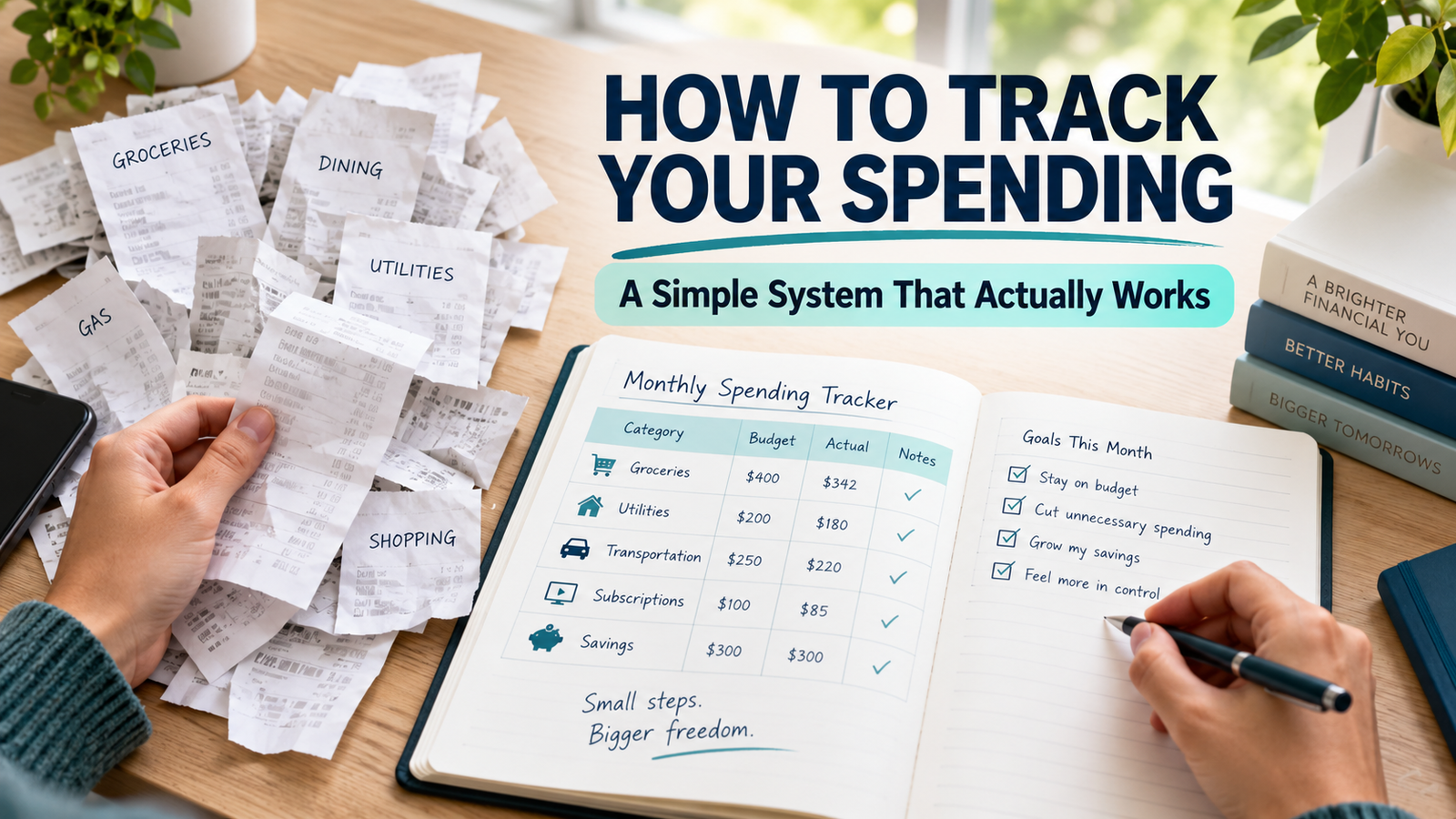
Learning how to track your spending sounds simple enough. Look at what comes in, record what goes out, and find out where the money went.
Then you actually try it.
There are checking-account purchases, credit-card charges, automatic payments, cash withdrawals, online orders and subscriptions you forgot were still active. By the time everything is gathered, tracking your spending can feel like a second job—except this job doesn’t pay you.
That is usually when people give up.

The answer isn’t to track every penny for the rest of your life. It is to track long enough to see what your normal spending really looks like. Once you understand the pattern, you can build a spending plan around reality instead of relying on what you think should be happening.
The Money Was Accounted For—Except It Wasn’t
Consider someone I’ll call David.
David believed he was tracking his spending because he checked his bank balance several times a week. He knew when his mortgage, utilities and car payment cleared. If the checking account still had money in it, he assumed the month was going reasonably well.
But David used a credit card for groceries, gasoline and many of his online purchases.
Those expenses didn’t immediately reduce his checking-account balance. From his perspective, the money was still there.
At the end of the month, David paid the amount due on the card. Then he looked at the checking account and wondered why so little remained. The following month, he did the same thing again.
David wasn’t ignoring his money. He was looking at an incomplete picture.
His checking balance showed the money that hadn’t left the account yet. It did not show how much of that money had already been committed to the credit-card bill.
Once David reviewed both accounts together, the mystery disappeared. He wasn’t dealing with one unusually expensive purchase. He was spending more than he realized across dozens of ordinary transactions.
Tracking didn’t shame him or magically produce more income. It showed him what was actually happening.
That is the point.
Tracking Your Spending Is Not the Same as Budgeting
These two activities work together, but they serve different purposes.
Tracking shows what happened.
Budgeting decides what should happen next.
Suppose you plan to spend $600 on groceries this month. That number belongs in your budget.
If you review your transactions and discover that you actually spent $785, that is tracking.
The difference between the two numbers gives you something useful to investigate:
- Was the original grocery amount unrealistic?
- Did food prices change?
- Did several convenience purchases get included?
- Did you buy household supplies that should be separated?
- Did extra grocery trips lead to unplanned spending?
- Was this simply an unusual month?
Without tracking, you might continue placing $600 in the budget and missing it every month.
A budget based on wishful thinking isn’t much of a budget. It’s more like writing down the weather you hoped to have and then becoming annoyed when it rains.
If you haven’t built your basic plan yet, start with How to Make a Budget That Actually Works for You. If you are unsure which system to use, review the best budgeting methods before committing to an app or complicated setup.
How to Track Your Spending Beyond Your Bank Balance
Your bank balance answers one question:
How much money is currently in this account?
It does not necessarily tell you:
- How much is available to spend
- Which bills haven’t cleared
- How much you charged to a credit card
- Whether an annual expense is approaching
- How much cash you withdrew and spent
- Whether several automatic payments are about to arrive
- Whether your current pace will leave enough for the rest of the month
You might have $1,800 in checking and still have only $300 truly available after accounting for upcoming bills and credit-card purchases.
That doesn’t make the balance wrong. It means the balance needs context.
Learning how to track your spending gives it that context.
How to Track Your Spending for 30 Days
You do not need a permanent commitment or a perfect system. Start with 30 days.
One full month will usually reveal regular bills, everyday spending and several habits that are easy to overlook. Three months will give you a more reliable average, but one month is enough to begin.
Step 1: Gather Every Place You Spend Money
Start by identifying the accounts and payment methods you use.
These may include:
- Checking accounts
- Credit cards
- Payment apps
- Cash
- Online shopping accounts
- Automatic bank withdrawals
- Buy-now-pay-later accounts
This step matters because looking at only one account can create the same incomplete picture David had.
If you transfer money from checking to pay a credit card, don’t count both the original purchases and the card payment as separate spending. Otherwise, you will count the same expenses twice.
Track the individual card purchases. Treat the payment as a transfer between accounts.
Step 2: Choose a Simple Tracking Method
You can use:
- A notebook
- A spreadsheet
- A budgeting app
- Your bank’s spending tool
- A notes app on your phone
- Printed bank and credit-card statements
The method matters less than whether you will use it.
An app with impressive charts is useless if you stop opening it after six days. A plain notebook can work perfectly well if it helps you see what is happening.
Start with the easiest option. You can always upgrade later.
Step 3: Use a Small Number of Categories
One reason tracking becomes exhausting is that people create too many categories.
You probably don’t need separate categories for shampoo, paper towels, laundry detergent and toothpaste. “Household supplies” may tell you everything you need to know.
Begin with broad categories such as:
- Housing
- Utilities
- Groceries
- Transportation
- Insurance
- Healthcare
- Debt payments
- Savings
- Household and personal expenses
- Entertainment and dining
- Subscriptions
- Irregular expenses
- Miscellaneous
You can create a separate category later if something needs closer attention.
The purpose is to reveal useful patterns, not to produce an accounting document worthy of a congressional hearing.
Step 4: Record the Purchase Honestly
For each transaction, record:
- The date
- The amount
- The category
- A brief description
- Whether it was planned or unplanned
That final distinction can be more useful than labeling everything as good or bad.
A $150 grocery purchase may be planned and necessary. Another $45 grocery stop two days later may have happened because several items were forgotten. Tracking the difference can reveal a pattern worth fixing.
Avoid judging the purchase while recording it. Just capture what happened.
Step 5: Include Cash
Cash has a funny way of becoming invisible.
You withdraw $100 from an ATM. A few days later, the cash is gone, but you may remember only one or two purchases.
You don’t need to record every dollar with perfect precision. When possible, make a quick note when you spend cash. If that becomes impractical, create a “cash spending” category and pay closer attention if the total becomes significant.
An imperfect record is still more useful than pretending the cash never left.
Review Your Spending Once a Week
Waiting until the end of the month makes tracking feel like an archaeological dig.
Set aside ten or fifteen minutes once a week. Review your accounts, add missing transactions and check your progress.
Ask:
- Is my spending pace reasonable?
- Which category is higher than expected?
- Did any upcoming expense slip my mind?
- Am I using credit without accounting for it?
- Is this week unusual, or does it reveal a pattern?
- Is there something I should adjust before next week?
A weekly review gives you time to act.
If dining and entertainment spending is already near the monthly limit halfway through the month, you can make an informed choice. You might slow down, move money from another category or accept that the original limit was unrealistic.
The important thing is that the decision becomes deliberate.
Look for Patterns, Not Villains
Learning how to track your spending should not become a search for one purchase to blame.
Personal-finance advice often points toward small conveniences: coffee, restaurant lunches, streaming services or impulse purchases. Those expenses can matter, but they aren’t always the real problem.
You might discover that your small purchases are reasonable while housing, transportation, insurance or debt payments are consuming most of your income.
Canceling a $12 subscription won’t solve a $700 monthly shortfall.
Look first at the largest categories and repeated behavior.
Fixed-Expense Patterns
These include:
- Housing that consumes too much income
- A vehicle payment that limits other goals
- High insurance costs
- Large minimum debt payments
- Services that could potentially be renegotiated
Fixed expenses can be difficult to change quickly, but identifying them helps you develop a longer-term plan.
Everyday-Spending Patterns
These might include:
- Frequent unplanned grocery trips
- Regular food delivery
- Online purchases made out of habit
- Convenience-store stops
- Small purchases that happen repeatedly
- Spending triggered by boredom or stress
The individual purchase may not matter much. The repeated pattern does.
Irregular-Expense Patterns
Some expenses feel unexpected only because they don’t happen every month.
Examples include:
- Vehicle registration
- Home maintenance
- Annual insurance premiums
- Holiday spending
- School expenses
- Membership renewals
- Gifts
- Routine vehicle repairs
These aren’t necessarily emergencies. They are predictable expenses without monthly due dates.
Once you identify them, add the yearly cost and divide it by 12. Setting aside that amount each month turns an unpleasant surprise into a planned expense.
Don’t Turn Tracking Into Punishment
Tracking can become counterproductive if every purchase leads to guilt.
The purpose is not to prove that you should never enjoy your money. It is to find out whether your spending supports what matters to you.
Suppose you discover that you spend $200 a month on a hobby. If the expense fits comfortably, doesn’t create debt and brings real value to your life, it may be money well spent.
Now suppose you find $200 in subscriptions and services that you barely use. That money might be doing very little for you.
The amounts are identical. The value is not.
Good tracking helps you separate intentional spending from spending that simply happened.
What to Do When You Find a Spending Problem
Once you identify a problem, resist trying to overhaul everything at once.
Choose one pattern.
For example:
- Combine grocery trips into one planned weekly trip.
- Cancel one unused subscription.
- Create a waiting period for online purchases.
- Set aside money monthly for an annual expense.
- Stop using a credit card for purchases you cannot pay in full.
- Contact a provider and ask whether a bill can be reduced.
- Move a bill’s due date to better match your income schedule.
Test the change for one month and track the result.
If it works, keep it. If it doesn’t, learn from it and try something else.
That is considerably more useful than creating a strict plan on Sunday and abandoning it by Thursday.
Use Tracking to Test the 50/30/20 Budget Rule
Once you understand how to track your spending and have a month of real numbers, you can compare them with the 50/30/20 budget rule.
Sort your spending into:
- Needs
- Wants
- Savings and additional debt reduction
Then calculate the percentage of take-home pay used by each category.
The result does not need to match 50/30/20 perfectly. The comparison helps show whether fixed expenses, optional spending or limited savings are creating the most pressure.
Remember, the percentages are a measuring tool—not a report card.
Use a Trusted Spending Tracker
The Consumer Financial Protection Bureau offers a spending tracker that can help you record and review your purchases. You can also use your own notebook or spreadsheet.
Whichever tool you select, protect your financial information.
You do not need to provide bank usernames, passwords, Social Security numbers or complete account numbers to a general AI tool. If an app asks to connect directly to your financial accounts, review its privacy and security practices before agreeing.
Convenience is helpful. Protecting your financial information is more important.
When Can You Stop Tracking Every Purchase?
You may not need to track every transaction forever.
Knowing how to track your spending in detail is especially useful when:
- You are creating your first realistic budget.
- Your bank balance regularly surprises you.
- You are relying on credit cards for ordinary expenses.
- You are trying to reduce debt.
- Your income or household expenses recently changed.
- You are preparing for a major financial goal.
- Your current spending plan keeps failing.
Once your spending becomes predictable, you may be able to simplify the process.
Continue monitoring major categories, reviewing accounts weekly and checking progress against your goals. Return to detailed tracking whenever something changes or the numbers stop making sense.
Think of it like checking your route during a trip. You don’t need to stare at the map every second, but you should look again when you suspect you’ve taken a wrong turn.
Tracking Your Spending Should Lead to a Decision
Knowing that you spent $742 on groceries is information.
Deciding to plan meals, reduce extra trips and budget $700 next month turns that information into action.
Knowing that subscriptions cost $96 a month is information.
Canceling the three you no longer use turns it into action.
Knowing that your fixed expenses consume most of your income is information.
Developing a longer-term plan to change housing, transportation, debt or income turns it into action.
Understanding how to track your spending will not improve your finances by itself. What matters is the decision you make after seeing the pattern.
Start with 30 days. Keep the categories simple. Review the numbers weekly. That is how to track your spending without turning it into a second job or looking for one purchase to blame.
Most importantly, don’t use tracking to ask, “What did I do wrong?”
What are my numbers trying to tell me?
Once you can answer that, your money stops disappearing mysteriously. You know where it went—and you can decide where it should go next.