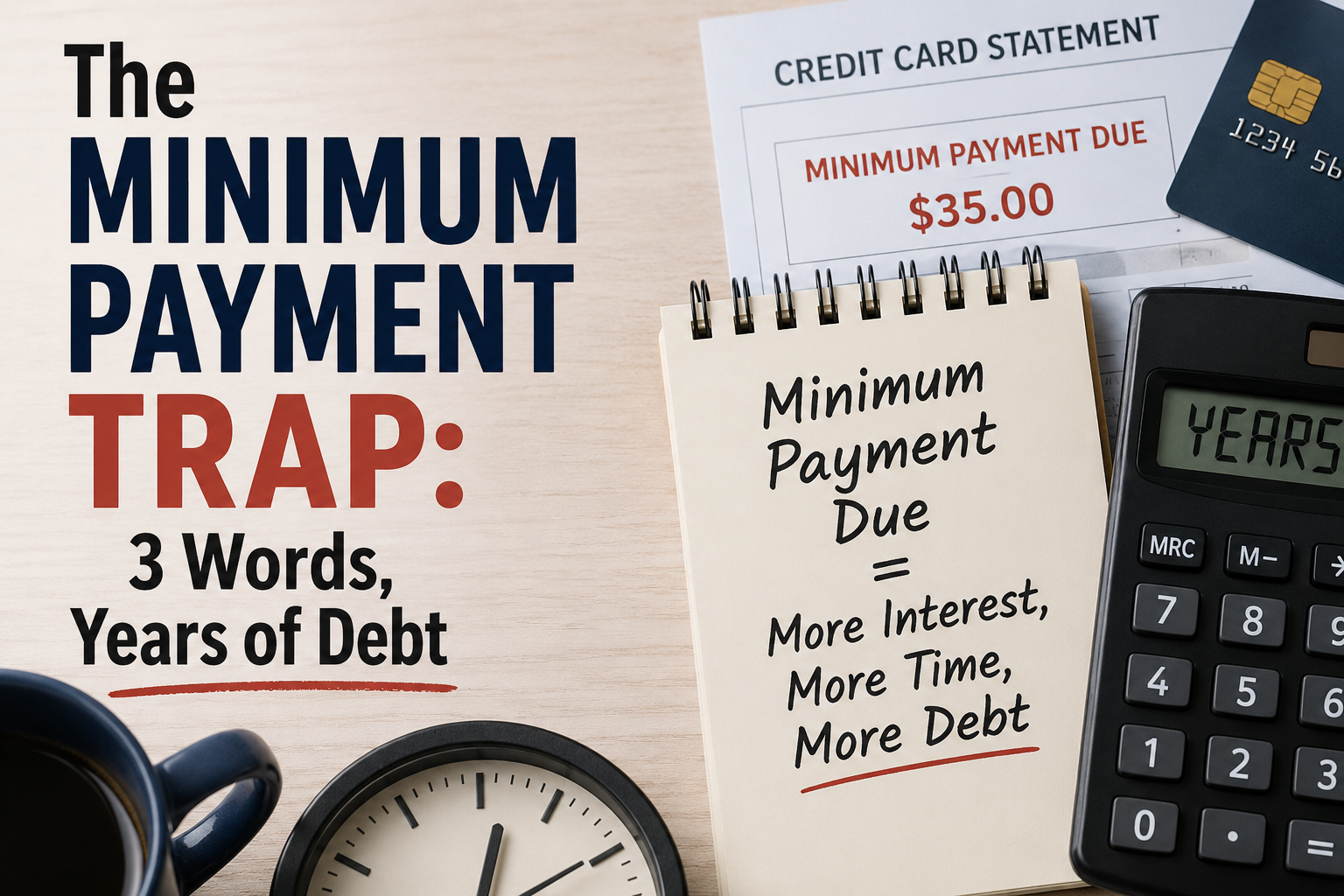
The minimum payment trap usually begins with a moment of relief.
You open your credit card statement, see the words “minimum payment due,” and think, I can manage that. You make the payment on time, avoid a late fee, and move on to the next bill.
That is important when money is tight. Making the minimum keeps the account current. But it can also create the impression that you are making more progress than you really are.
Months pass. Then years. You have sent the credit card company payment after payment, yet the balance seems determined to stick around like a houseguest who missed the hint.
That is the minimum payment trap. You are paying the bill, but the combination of interest and shrinking minimum payments can keep the debt alive far longer than expected.
What Is the Minimum Payment Trap?
The minimum payment is the smallest amount you must pay by the due date to keep the account current. Your card issuer determines how it is calculated, so the formula can vary.
- A percentage of the outstanding balance
- Interest and fees plus a percentage of the principal
- A fixed minimum amount
- A combination of these calculations
The problem is not the existence of a minimum payment. It can be a valuable short-term safety net when your budget is stretched.
The problem begins when that temporary safety net becomes your long-term repayment plan. As your balance declines, your required minimum may also decline. That sounds helpful, but it means less money is going toward the debt each month. The finish line keeps moving farther away.
The Minimum Payment Used to Be Even Worse
There was a time when making the required minimum payment did not necessarily mean your credit card balance would ever decline.
Some card issuers set minimum payments so low that they failed to cover all the interest and fees added during the billing cycle. A person could make every payment on time and still owe more than before. This was known as negative amortization.
Federal banking regulators stepped in during the early 2000s. They directed banks to eliminate prolonged negative amortization by requiring minimum payments that covered accrued interest and recurring fees while also reducing at least part of the principal. The Office of the Comptroller of the Currency explains the 2003 interagency guidance.
Congress later addressed another part of the problem through the Credit CARD Act of 2009. Credit card statements now warn consumers how long repayment could take when making only the minimum and show the amount needed to repay the balance in approximately three years.
Today, assuming you make every required payment, add no new purchases, incur no unexpected fees, and the account terms do not change, the minimum payment should eventually eliminate the balance.
The catch is that “eventually” can still mean many years—and thousands of dollars in interest.
Your Credit Card Statement Is Already Warning You
Your monthly statement contains more than your balance and due date. It should also include a minimum-payment warning showing:
- How long repayment could take if you make only the minimum payment
- The estimated total amount you would pay
- The monthly amount needed to repay the balance in approximately three years
Federal repayment-disclosure rules explain how issuers calculate these estimates. You can review those requirements through the Consumer Financial Protection Bureau.
That little box on your statement may not be exciting reading, but neither is discovering that a purchase from several years ago is still collecting interest.
What the Minimum Payment Trap Can Cost
Consider an illustrative credit card balance of $6,000 at a 24% annual percentage rate.
For this example, assume the minimum payment equals 3% of the remaining balance or $35, whichever is greater. The actual formula used by your card issuer may be different. Also assume that no new purchases are added.
| Repayment approach | Starting monthly payment | Estimated payoff time | Estimated interest paid | Estimated total paid |
|---|---|---|---|---|
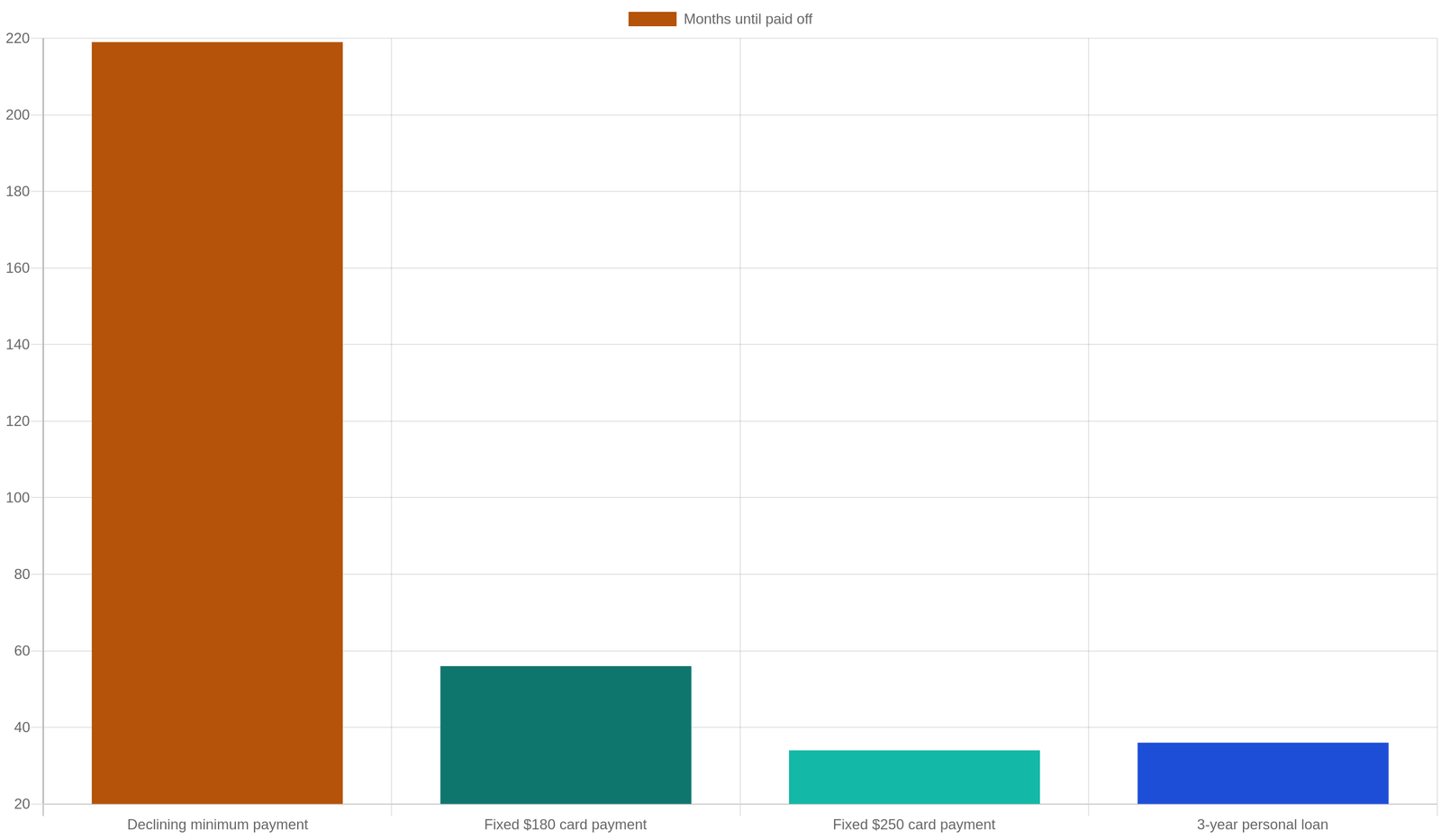
| Declining minimum payment | $180 initially | About 18 years, 3 months | About $10,442 | About $16,442 |
| Fixed $180 payment | $180 | About 4 years, 8 months | About $3,987 | About $9,987 |
| Fixed $250 payment | $250 | About 2 years, 10 months | About $2,256 | About $8,256 |
| Three-year personal loan at 12% | About $199 | 3 years | About $1,174 | About $7,174 |
These are estimates, not loan offers or predictions. Actual results depend on the lender’s calculation method, fees, payment timing, rate changes, and whether additional charges are made.
Still, the example shows why the minimum payment trap is so expensive. The first two credit card options both begin with a $180 payment. The difference is that one payment declines as the balance falls, while the other stays fixed.
Keeping the payment at $180 could eliminate the debt more than 13 years sooner in this illustration.
Why Interest Makes Progress Feel So Slow
Credit card interest is commonly calculated using a daily periodic rate and applied to the balance carried from one billing cycle to the next.
When you make a payment, part of it covers interest and the remainder reduces the balance. If the payment is small, the balance may decline slowly.
Suppose you owe $6,000 at 24% APR. At a simplified monthly rate of 2%, approximately $120 in interest could accrue during the first month. If your payment is $180, only about $60 initially reduces the balance.
You paid $180, but your debt fell by roughly $60.
That is why it can feel as though the balance is barely moving. You are not imagining it. Interest is taking the first bite before much of your payment reaches the amount you originally borrowed.
Credit Card vs. Personal Loan: Would Consolidating Help?
A personal loan may offer a way out of the minimum payment trap, but it is not automatically the better choice.
| Feature | Credit card | Personal loan |
|---|---|---|
| Interest rate | Usually variable | Often fixed |
| Monthly payment | Can change as the balance changes | Usually fixed |
| Payoff date | No fixed date when paying only the minimum | Defined repayment term |
| Ability to borrow again | Available credit can be reused | Generally a one-time loan |
| Common fees | Annual, late, balance-transfer, or cash-advance fees | Origination and late fees |
| Main risk | Minimum payments can keep debt around for years | A long term or high fee can make the loan more expensive |
| Best use | Purchases you can repay quickly | Structured consolidation when the total cost is lower |
A personal loan can help when it provides:
- A lower APR than the credit cards
- A manageable fixed payment
- A clear payoff date
- Reasonable or no origination fees
- No prepayment penalty
- A repayment term that does not unnecessarily stretch the debt
The National Credit Union Administration provides additional information about debt-consolidation options and the terms borrowers should compare.
Compare the Total Cost, Not Just the Payment
Imagine being offered a personal loan that lowers your payment from $300 to $210. That sounds like an immediate improvement.
But why is the payment lower?
It could be because the interest rate is lower. That would be helpful. It could also be because the lender stretched the loan over a much longer period or added a substantial origination fee.
- The loan APR
- The monthly payment
- The repayment term
- The origination fee
- The amount you will actually receive
- The total of all scheduled payments
- Any prepayment penalty
- Whether the rate is fixed or variable
APR is especially useful because it reflects interest and certain loan fees. Compare APR with APR—not an advertised interest rate from one lender against an APR from another.
A Personal Loan Can Rearrange Debt Without Solving It
A personal loan does not erase credit card debt. It moves that debt into a different account with different terms.
That can be a smart move when the new loan lowers the total cost and provides a firm payoff schedule. But there is a major risk.
You use the loan to pay off the credit cards. Suddenly, those cards show zero balances and plenty of available credit. A few unexpected expenses—or a few old spending habits—later, the card balances begin growing again.
Now you have the personal loan and new credit card debt.
Consolidation works best when it is accompanied by a plan to avoid rebuilding the balances. That may mean removing cards from shopping apps, stopping new charges temporarily, reviewing the reasons the debt accumulated, and keeping a small emergency cushion.
A consolidation loan should be part of a debt-payoff plan, not a way to make room for more debt.
What If You Can Only Afford the Minimum Right Now?
Paying only the minimum is better than missing the payment when that is genuinely all your budget allows.
You do not need to feel guilty about using the minimum as a short-term bridge. The goal is to keep it from becoming a permanent arrangement.
- Stop adding new charges when possible. It is difficult to lower a balance while new purchases continue replacing what you pay off.
- Check the warning on your statement. Look at the estimated payoff time, total cost, and three-year payment amount.
- Choose a fixed payment you can sustain. If your minimum is $135 this month, consider continuing to pay at least $135 even when the required minimum declines.
- Add something small when you can. An additional $10 or $25 may not feel dramatic, but it reduces principal and future interest.
- Call the card issuer before missing payments. Ask whether it offers a hardship program, reduced interest rate, or structured repayment option.
- Get reputable help if the numbers no longer work. A nonprofit credit counselor may help you review your budget and available options.
Be cautious about companies promising to erase debt or telling you to stop communicating with creditors. The Federal Trade Commission’s debt guidance explains different forms of debt assistance and warning signs to consider.
Should You Pay the Smallest Balance or Highest Rate First?
Once you can pay more than the minimums, decide where the additional money should go.
The debt avalanche directs extra money toward the highest-interest debt first. It generally saves more interest. The debt snowball targets the smallest balance first. It can provide a quicker emotional victory and help build momentum.
Neither method requires you to stop paying the other accounts. Continue making every required minimum payment, then direct the additional amount toward one priority debt.
You can compare both approaches in Debt Snowball vs. Avalanche: Which Payoff Method Is Better?
Do Not Ignore the Emotional Cost
The minimum payment trap affects more than a spreadsheet. Watching balances decline slowly can create frustration, embarrassment, and the feeling that nothing you do makes a difference.
That emotional pressure can also lead to avoidance. Statements remain unopened. Account balances go unchecked. The debt becomes frightening partly because no one knows exactly what is happening.
If debt is affecting your sleep, relationships, confidence, or ability to make decisions, read The Psychological Effects of Debt and How to Overcome Them.
Knowing the numbers may not make the debt disappear today, but it replaces uncertainty with a starting point.
Build Your Way Out of the Minimum Payment Trap
The minimum payment is not a failure. Sometimes it is what gets you safely through a difficult month.
But it should be treated as a temporary floor—not the amount you automatically pay forever.
Review your statement. Find the payoff disclosure. Choose a fixed payment you can realistically maintain. Compare the total cost of a personal loan before consolidating. Most importantly, avoid creating new balances while paying off the old ones.
For the complete process, read How to Get Out of Debt and Stay Out for Good.
Escaping the minimum payment trap does not require one heroic payment. It requires a payment that moves the balance in the right direction—and a plan that keeps doing it month after month.
For educational purposes only. This article provides general information about credit cards, personal loans, and debt repayment. It is not individualized financial, legal, tax, credit, or lending advice. Loan terms, minimum-payment formulas, eligibility requirements, and borrower circumstances vary.