
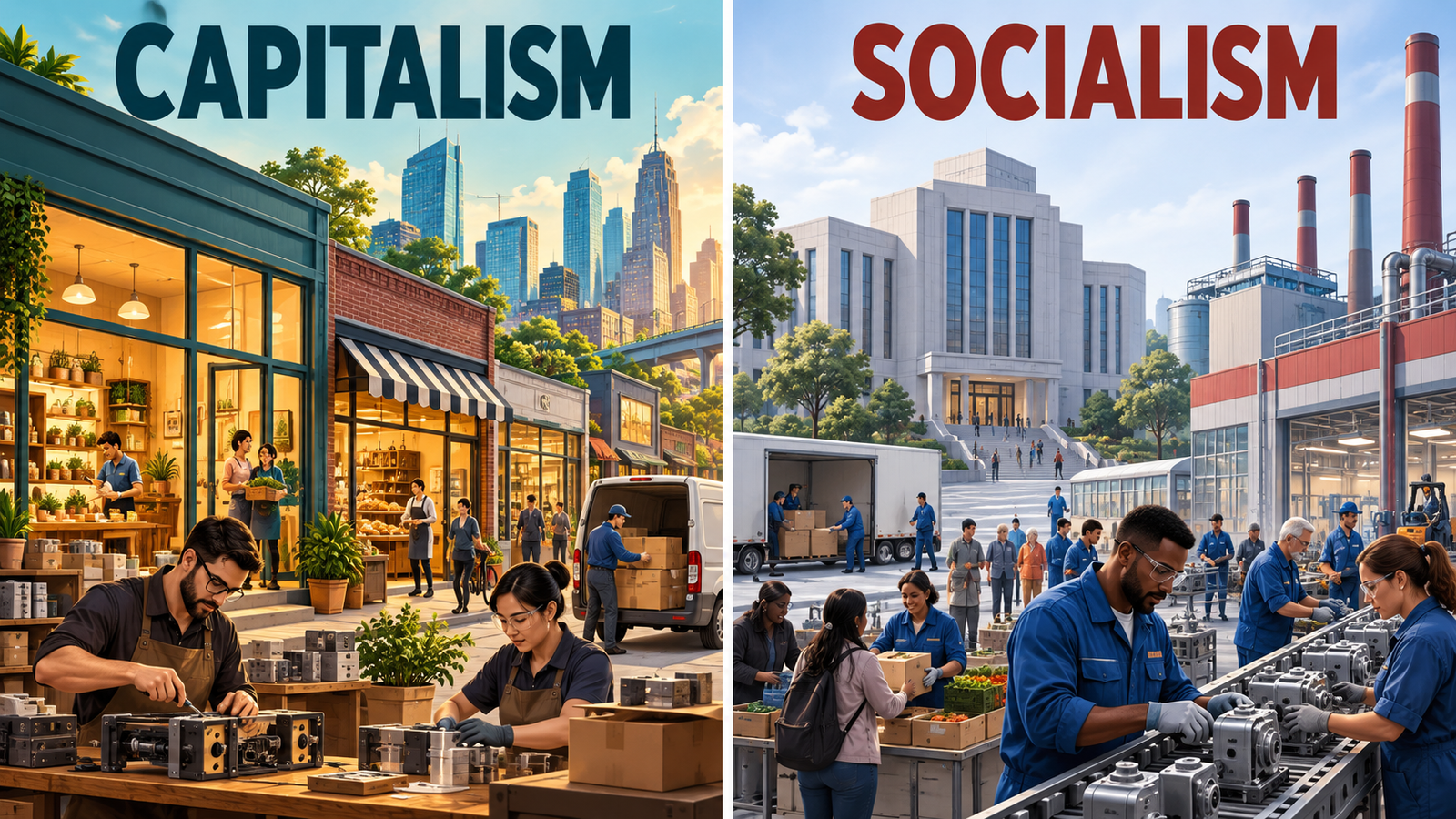
“Tax the rich” sounds simple. But what happens next—to business owners, employees, and the families receiving help?

Photo by Andy Li on Unsplash.
A person earning $500,000 may ask, “I already pay much more in taxes. Why isn’t that enough?” A worker earning far less may ask, “If I accept a promotion and lose my benefits, will my family be worse off?”
Both questions deserve answers. The debate over socialism and capitalism touches both households. A useful discussion of socialism and capitalism should look at the people affected, not just the slogans.
What Are Socialism and Capitalism?
In capitalism, people and companies own most businesses and can keep profits after paying taxes and expenses. In socialism, the public, government, or workers together own or control businesses and productive resources. Different versions have different rules.
Taxes that help fund assistance are redistribution. They can exist within capitalism. They aren’t the same as government taking ownership of businesses. Our wealth redistribution guide explains that distinction.
“Aren’t I Already Paying My Fair Share?”
Generally, someone earning $500,000 pays much more federal income tax than someone earning $50,000 with similar tax circumstances. Higher portions of taxable income are taxed at higher rates. The IRS explains how tax brackets work.
But paying more and paying a “fair share” are different questions. Fairness is a judgment, and people discussing socialism and capitalism often judge it differently. Some people favor the same percentage for everyone. Others believe those who can afford more should pay a higher percentage. Actual tax bills also depend on deductions, credits, filing status, and income type.
A taxpayer can reasonably ask: “How much more should I pay? Who decides? What will the extra money accomplish? How will we know it was spent well?” Saying “you can afford it” does not answer all those questions.
“Do My Higher Taxes Buy Better Services?”
No. Paying more taxes does not entitle someone to faster police or fire service or smoother roads. Public services are shared. Emergency response should depend on the emergency and available resources, not on someone’s tax bill.
Taxes are not a subscription with a premium service level. Someone without children may help fund schools. Someone whose home never catches fire still helps fund the fire department.
Wealthy households and businesses also benefit from those services. But the benefits don’t match, dollar for dollar, what each person pays. Whether that arrangement is fair is part of the debate about socialism and capitalism.
“Will Taking a Better Job Leave My Family Worse Off?”
Sometimes, yes. Suppose a minimum-wage worker receiving SNAP food benefits is offered a supervisor position. The raise may reduce benefits or end eligibility, depending on household circumstances and program rules.
SNAP does not automatically disappear with every raise. Benefits generally account for income and allowed deductions. Household size and state rules matter. Check the USDA eligibility guidance and ask the state agency for help.
Here is a made-up example involving combined assistance, not an actual SNAP calculation: a promotion adds $250 a month in take-home pay but costs the family $300 in support. The family ends up $50 worse off. New travel or child-care expenses could widen that gap.
A sudden loss of support after a small raise is called a benefit cliff. Federal research examines how these rules can make earning more less rewarding. Turning down a promotion in that situation doesn’t prove laziness. It may be a decision about paying this month’s bills.
“Then Why Try to Get Off Assistance?”
A better job can bring experience, future raises, benefits, and more control over your finances. But those future possibilities do not cover an immediate shortfall.
Workers need answers: “Which benefits will I lose? Can they decrease gradually? Will the job provide health coverage? What happens if the job ends?” Before deciding, compare the added take-home pay, lost help, new expenses, and job benefits.
My view is that assistance should make progress easier. Rules that let benefits decrease gradually can help, although the costs and details still matter. People who cannot work may need ongoing support; leaving assistance is not a realistic goal for everyone.
“Why Build Wealth If I Cannot Keep the Reward?”
Imagine risking your savings to open a business. You work long hours and could lose your investment. If success leaves you little better off, you may decide another business or expansion is not worth the trouble.
Profit is a major reason people invest and take risks. The IMF’s introduction to capitalism explains that role. People also work for pride, purpose, and service, but financial rewards matter.
If a system removes nearly all additional gains, it weakens a major incentive to do more. That does not mean every tax increase stops progress. Nor does every socialist system pay everyone equally. Wages, bonuses, and other rewards can still exist. The rules determine how much success is rewarded. That is a central question when comparing socialism and capitalism.
“Tax the Rich”—What About the People Who Depend on Their Businesses?
A business owner may employ workers, buy from suppliers, and hire local contractors. If a tax change affects an expansion decision, the effects can reach non-wealthy people.
Personal and corporate taxes differ, and neither automatically causes layoffs. Still, OECD research explains that owners, workers, or customers can bear parts of a tax’s economic cost.
The extra public spending may also help those people—for example, by funding useful training or child care. When weighing socialism and capitalism, we need to examine both effects. “The owner can afford it” is not a complete economic argument.
“What About Wealthy People Who Give Their Money Away?”
Warren Buffett shows why personal wealth is not the whole story. In a June 2025 Berkshire Hathaway announcement, he reported receiving donations to five foundations worth about $60 billion.
Those gifts were voluntary. Private wealth can support charitable work and personal spending. Giving deserves a place in discussions of socialism and capitalism. Much of a wealthy person’s fortune may also be business ownership, rather than unused cash.
Philanthropy does not settle the tax debate or guarantee that every public need will be met. Tax deductions may reduce the cost of giving. But an honest discussion should recognize the ways wealthy people contribute through charity as well as taxes.
“Why Did Heavily State-Controlled Economies Struggle?”
The Soviet Union put most major businesses under government control. Planners decided much of what factories produced. This led to early industrial growth, but later to slowing growth and shortages.
A factory could meet a government target without making what customers actually wanted. Businesses that performed poorly still had less pressure to improve. Central control did not give officials all the knowledge needed to run an economy well. An IMF account describes these problems.
China offers a different example. Reforms beginning in 1978 gave farm households more control and stronger rewards for increasing output. A World Bank account explains how incentives and access to markets helped rural families. China kept extensive state control, so this change occurred within its system.
These histories are not proof that every socialist policy fails. Soviet collapse had several causes, and moving away from central planning was painful too. But they show why government control alone does not ensure progress. Rewards, competition, and freedom to respond to people’s needs matter.
Socialism and Capitalism: The Question Both Sides Should Ask
My view is that a sound system should help people who need support while preserving a meaningful reward for work, saving, and risk. It should explain to taxpayers what their contributions achieve. It should also avoid making a promotion a financial setback for a working family.
The debate about socialism and capitalism needs that practical test. Does the policy help people move forward, and does it preserve the ability to produce the wealth that funds the help?
Visit our Financial Education guide for more plain-language explanations. When you hear the next proposal, ask what happens to the person paying, the person receiving, and the worker trying to earn more.