
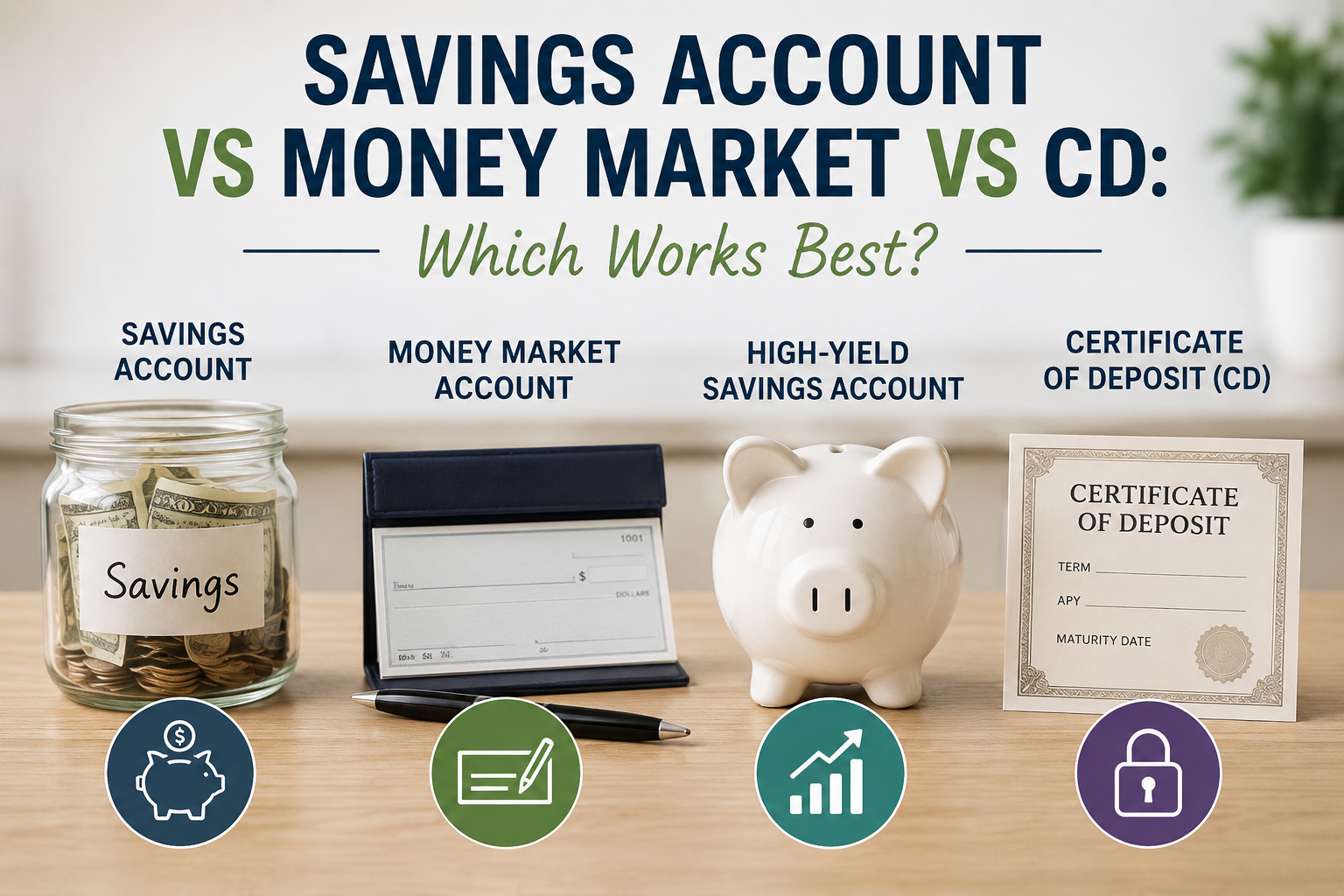
Saving money is one thing. Deciding where to keep it is another.
You might start with a regular savings account because that’s what you’ve always used. Then you hear about high-yield savings accounts paying more interest. Someone mentions a money market account. Your bank advertises a CD with a rate that catches your eye.
Before long, a pretty simple question — where should I keep my savings? — doesn’t feel so simple anymore.
Here’s the thing about the savings account vs money market vs CD debate: none of these is automatically the “winner.” They’re built for different jobs. The right choice depends on what the money is for, how soon you might need it, and how much access you want.
Let’s walk through the savings account vs money market vs CD differences so you can figure out what fits. For the broader basics, visit our Financial Education guide.
Start With What the Money Is For
Before you even glance at interest rates, think about why you’re saving this particular chunk of money.
An emergency fund needs to be there the moment something goes wrong. Money for a vacation next summer needs to stay safe, but you probably won’t touch it for months. Money you’re setting aside for a car two years out has a completely different timeline.
That distinction matters more than people give it credit for. The highest interest rate in the world isn’t much of a deal if getting your money means jumping through hoops right when you actually need it.
Once you know what the money is for, picking where to keep it gets a lot easier. If you’re building a cushion for unexpected costs, read How Much Should You Have in an Emergency Fund? or explore our Money Tools.
Regular Savings Account
A traditional savings account is probably the option you already know.
You deposit money at a bank or credit union, earn a bit of interest, and can get to it when you need to. It’s simple, and that simplicity is exactly why so many people stick with it.
The catch is that some traditional savings accounts pay very little interest. Rates change, so compare the current annual percentage yield (APY), fees, and balance requirements before choosing. APY shows the interest you could earn over a year, including compounding.
That may not sting much when you’re just getting started. If you’ve managed to put away your first few hundred dollars, building the habit of saving matters more than squeezing every last dollar of interest out of it.
But once your balance grows, the rate starts to matter a lot more — and that’s usually the point where the savings account vs money market vs CD question starts to feel real.
High-Yield Savings Account
A high-yield savings account works much like a regular one, just with a much better rate.
You’ll usually find the most competitive high-yield accounts at online banks, though they’re not exclusive to them. Since these banks skip the overhead of physical branches, they can afford to pass more of that back to you in interest.
For many people, this can be a useful home for an emergency fund or savings they’ll need within the next couple of years. Check how you would withdraw the money, though. An online account may require a transfer to your checking account, and that transfer may not arrive immediately. Keep enough money readily available for urgent expenses.
Still, there are trade-offs worth checking before you open one. Some accounts come with minimum balance requirements, fees, or limits on how often you can move money. And that rate isn’t locked in. It can rise or fall as broader interest rates shift.
Still, if you’ve got a decent chunk of change parked in an account earning almost nothing, it’s worth knowing better options are out there.
Money Market Account
A money market account sits between a savings account and a checking account.
Like a savings account, it pays interest. Some money market accounts also offer check writing, a debit card, or ATM access. Those features vary by account, and a money market account does not automatically pay more than a high-yield savings account. Compare current offers and any transaction limits.
That extra flexibility makes a money market account a good fit for savings you want to keep separate but still be able to reach fairly easily.
Some accounts ask for a larger opening deposit or minimum balance, while others don’t bother. Rates and fees vary quite a bit from one bank or credit union to the next, so it pays to shop around.
One quick note: don’t mix up a money market account with a money market fund. Despite the nearly identical names, they’re different animals. A money market fund is an investment product, while a money market account is a deposit account. If you want the full breakdown, I go deeper on this in Money Market Account: What It Is and How It Works.
Certificate of Deposit (CD)
A CD plays by a different set of rules entirely.
With a CD, you agree to leave your money in place for a set term, such as six months, a year, or several years. A standard fixed-rate CD locks in its rate for that term. Compare current offers: a CD does not always pay more than what you’d earn in a regular savings account.
The tradeoff is access.
Say you drop $5,000 into a one-year CD and then need that money back three months later. You’ll likely owe an early-withdrawal penalty to get your hands on it. The exact rules depend on the specific CD.
That’s why a CD generally isn’t where you want money you might need tomorrow.
But say you’re saving for something two years out and you’ve already got a separate emergency fund covered. Locking a portion of that money into a CD might make a lot of sense.
In the savings account vs money market vs CD comparison, this is really where a CD earns its keep: it’s less about which account pays the highest rate and more about matching the account to when you’ll actually need the cash.
Savings Account vs Money Market vs CD at a Glance
Here’s the savings account vs money market vs CD comparison at a glance:
| Regular Savings | High-Yield Savings | Money Market | CD | |
|---|---|---|---|---|
| Earns interest | Yes | Yes | Yes | Yes |
| Easy access | High | High | High to moderate | Limited |
| Rate can change | Yes | Yes | Yes | Usually fixed for the term |
| Money locked up | No | No | No | Generally yes |
| Possible minimum balance | Sometimes | Sometimes | Sometimes | Depends on the CD |
| Good for emergency savings | Yes | Often | Often | Usually not |
| Good when you know your timeline | Yes | Yes | Yes | Often |
When comparing savings account vs money market vs CD options, double-check the account terms. Fees, minimum balances, and withdrawal rules vary by bank or credit union.
What About FDIC Insurance?
Safety is a big reason people trust these accounts with their savings.
FDIC-insured bank deposit accounts are generally insured up to $250,000 per depositor, per bank, per ownership category. Federally insured credit unions offer similar protection through the NCUA, which insures up to $250,000 per member, per credit union, per ownership category.
That doesn’t mean everything a bank sells you is insured, though. Investments like stocks, mutual funds, and money market funds aren’t FDIC-insured just because you bought them through a bank.
For ordinary savings, confirming that your bank or credit union carries federal insurance should be part of your decision, not an afterthought — and it applies no matter which side of the savings account vs money market vs CD split you land on.
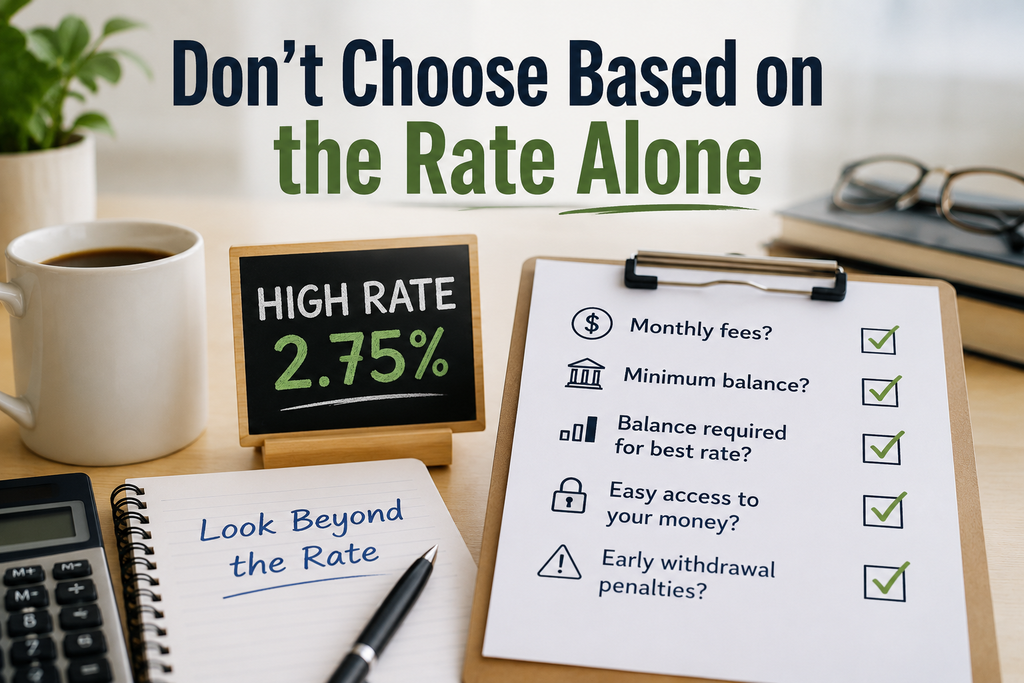
Don’t Choose Based on the Rate Alone
It’s tempting to see a flashy advertised APY and assume you’ve found the winner.
Look a little closer first.
Does the account charge a monthly fee? Is there a minimum balance to worry about? Do you need to keep a certain amount in there just to earn the advertised rate? How easy is it to move money in and out? Is there an early-withdrawal penalty lurking? Is that attractive rate even permanent, or just an introductory teaser?
In a savings account vs money market vs CD comparison, a slightly higher rate doesn’t mean much if the account doesn’t fit how you plan to use the money.
That’s especially true with smaller balances. Building the savings habit and keeping your money somewhere safe and reachable can matter more than chasing every last fraction of a percentage point.
You Don’t Have to Pick Just One
This might be the most useful part of this whole comparison.
You don’t have to treat savings account vs money market vs CD as an either-or choice. Nothing says all your savings has to live in one place.
You could keep a small cushion in a regular savings account linked to your checking for quick access. Your bigger emergency fund could sit in a high-yield savings or money market account where it actually earns something worthwhile. And money you know you won’t touch for a year could go into a CD.
Now every dollar has a job.
That’s usually more useful than hunting for one single account that tries to do everything at once.
Match the Account to the Purpose
The real question in the savings account vs money market vs CD debate isn’t which one wins.
The better question is: what does this money need to do for me?
If you might need it tomorrow, easy access matters most. If it’s going to sit untouched for a while, earning a better return climbs the priority list. And if you already know you won’t need it until a specific date, a CD is worth a serious look.
Once you start giving each pile of savings a purpose, these decisions get a lot less complicated.
And that’s really the point. You don’t need to become a banking expert. You just need to understand these accounts well enough to put your money where it can actually do the job you need it to do.
For educational purposes only. This article provides general information about savings accounts, money market accounts, certificates of deposit, and personal finance. It is not financial, investment, tax, or legal advice. Interest rates, fees, account terms, deposit requirements, and insurance coverage can vary. Review the terms of any financial product before deciding.