
Real passive income sounds almost too good to be true. Build something once, sit back, and watch the money roll in while you sleep.
That’s the sales pitch, anyway.
The reality is a little different.
Passive income can genuinely help you supplement your regular paycheck and build long-term financial security. But most of it demands something upfront: your time, your money, your skills, or all three. And plenty of income streams keep asking for maintenance long after you’ve launched them.
None of that makes passive income a bad idea. It just means you’re better off understanding what you’re signing up for before you chase the promise of effortless money.
So let’s walk through several realistic ways to build passive income, what each one actually requires, and where the risks hide.
What Real Passive Income Actually Means
Passive income is money that doesn’t depend entirely on trading your time for every dollar you earn.
If you’re paid an hourly wage, you generally have to work another hour to earn another hour’s pay. With passive income, you’ve built or bought something that may keep producing income without demanding that same ongoing effort.
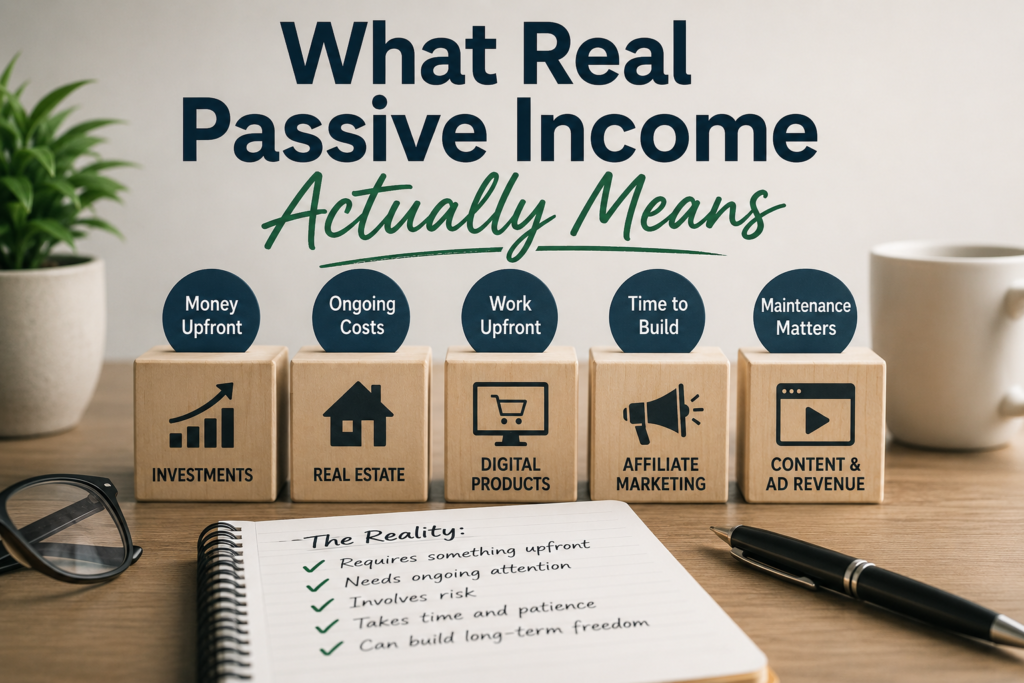
A few common examples:
- Investments that pay dividends or interest
- Rental property
- Royalties
- Digital products
- Affiliate commissions
- Advertising revenue from online content
Notice the word “may.” Passive doesn’t mean automatic, guaranteed, or risk-free. Income can climb, shrink, or vanish entirely, and you need to go in with your eyes open.
Real Passive Income: Investment Returns or an Ongoing Business?
Income from money you invest and income from a business you build can both arrive without an hourly timesheet. But they make different demands on you. Dividends and interest generally require capital at risk or on deposit. A digital product, affiliate website, or advertising business may require substantial work to create and maintain.
Before choosing, ask what supplies the income: money already invested, customers buying a product, or your continuing effort to attract and serve those customers. A business can make sales while you are asleep and still need several hours of work the next day.
Here, “passive” describes the everyday workload, not a tax classification. Tax rules use specific definitions that can differ from marketing language. For tax treatment, consult the applicable rules or qualified guidance rather than assuming all income described here receives the same treatment.
If you need earnings from work you can do now, start with the Extra Income guide. Real passive income projects may need time before producing any usable cash.
Real Passive Income Usually Requires Something Upfront
Before we get into specific strategies, let’s clear up one of the biggest misconceptions floating around out there.
You generally pay for passive income in one of two ways. Sometimes it’s money upfront, since investments and real estate typically require capital before they produce anything. Other times it’s work upfront, because digital products, websites, books, and courses often demand serious time and effort before they earn a dime. And sometimes you need both.
Think of it less like finding a money faucet and more like planting a garden. You put in the work upfront, keep tending to it, and hope it produces something worthwhile over time.
Dividend-Paying Investments
One way to generate income passively is by owning investments that pay dividends.
A dividend is a portion of a company’s profit paid out to shareholders, according to the SEC’s investor education site. Investors may receive those payments on a regular schedule while continuing to hold their shares.
Dividend investing can absolutely provide income, but nothing about it is guaranteed. Companies can cut or eliminate dividends whenever they want, and the value of your investment can rise or fall right along with everything else in the market.
If you’re weighing dividend-paying investments, keep a few things in mind. Research the company instead of choosing it just because the dividend yield looks attractive. Consider spreading your money across several companies rather than concentrating it in just a few. Understand the fees involved, along with how dividends actually get taxed, since ordinary and qualified dividends are treated differently under IRS rules. Decide whether you want to take the dividends as income now or reinvest them for growth later. And keep your overall financial goals and risk tolerance in the picture the whole time.
A high dividend doesn’t automatically make something a good investment.
Rental Property Can Produce Income, But It Isn’t Effort-Free
Real estate gets described as passive income all the time. It can become relatively hands-off eventually, but anyone who’s dealt with a broken water heater at the worst possible moment knows there’s another side to that story.
Rental income can provide steady cash flow, sure. But property owners also face mortgage payments, property taxes, insurance, repairs, vacancies, property management costs, association fees, and whatever legal requirements come with owning a rental in your area.
The rent you collect isn’t the same thing as profit.
Before you buy a rental property, estimate the full cost of ownership and leave room for the expenses that don’t show up every single month. Hiring a property manager can cut down on the day-to-day work, but that convenience eats into your net income too.
Rental real estate can be a genuinely useful investment. Just don’t confuse “less active” with “no work.”
Real Estate Investment Trusts: Property Exposure Without Being the Landlord
A real estate investment trust, or REIT, is a company that owns or finances income-producing real estate. Buying shares can provide property exposure without personally finding tenants or arranging repairs. That reduces direct management work, but it does not remove investment risk.
Publicly traded REIT shares trade on stock exchanges and can fluctuate in price. Non-traded REITs can be difficult to sell and may involve different fees and distribution arrangements. Do not assume every property investment marketed as hands-off is equally accessible or straightforward. Investor.gov explains REIT benefits and risks.
Compare what you would own, ongoing costs, the source of distributions, and how you could sell. For direct ownership, use Buying a Rental Property to examine the costs and responsibilities.
Digital Products
Digital products are another realistic source of passive income, mainly because you can sell the same product over and over without manufacturing or shipping anything physical each time.
Think eBooks, printable worksheets, templates, online courses, digital guides, or software and online tools.
The appeal is easy to understand. Once the product exists, each additional sale might take relatively little extra work.
Getting to that point, though, can take a lot of effort. You have to figure out what people actually need, build something genuinely useful, find an audience, create a way to sell it, and handle customer support when things go sideways.
A digital product nobody’s ever heard of isn’t much of an income stream.
Affiliate Marketing
Affiliate marketing lets you earn a commission when someone buys a product or service through your referral link. It can run through websites, newsletters, social media, videos, or pretty much any content format you can think of.
The startup cost tends to be low, but don’t mistake that for instant passive income.
Successful affiliate marketing usually comes down to creating genuinely useful content, attracting the right audience, and building enough credibility that people trust your recommendations. It also means only recommending products that actually fit your audience, keeping older content and links updated, and clearly disclosing your affiliate relationships. The FTC requires that disclosure whenever there’s a financial connection between you and what you’re promoting, so this isn’t optional housekeeping.
Traffic doesn’t show up just because a website exists. Building an audience takes time, and affiliate programs can change their commission rates, requirements, or terms whenever they feel like it. That’s one more reason not to lean too heavily on a single company or program.
Advertising and Content Income
Websites, newsletters, videos, podcasts, and other content can sometimes generate income through advertising or sponsorships.
This is another spot where the finished product looks a lot more passive than the process behind it. A website might earn advertising revenue around the clock, but someone still had to create the content, attract visitors, maintain the site, and keep everything useful and current.
The same goes for videos, newsletters, and every other content platform out there.
The asset may keep working after you’ve finished today’s work. That doesn’t mean it took no work to build in the first place.
Don’t Try to Build Everything at Once
Once people discover passive income, it’s tempting to launch five things at the same time. A rental property. A blog. Some dividend investing. An online course. Maybe an eBook before lunch.
That’s usually a good way to end up with five unfinished projects instead of one working one.
Ask yourself what resources you already have first. If you’ve got money available to invest, income-based investing might be worth researching further. If you’ve got specialized knowledge but limited capital, a digital product might make more sense. If you already have an audience, affiliate marketing or advertising could be worth exploring.
Your best option really depends on your finances, your skills, your available time, and how much risk you can stomach.
Build One Income Stream Before Adding Another
Diversifying your income can absolutely pay off, but diversification doesn’t mean tackling everything immediately.
Start with one idea. Learn how it actually works. Understand the real costs. Give it enough time to figure out whether it has genuine potential. Then decide whether to improve it, expand it, or move on to something else.
One dependable income stream beats five ideas that never make it past the planning stage.
Watch Out for Passive Income Red Flags
The popularity of passive income has also opened the door to plenty of questionable offers.
Be cautious about promises of unusually high returns with little or no risk, instant profits, secret opportunities, or a business that supposedly runs itself from day one. The FTC’s investment scam guidance explains warning signs. A promise is only as reliable as its terms and whoever stands behind it; do not treat the word “guaranteed” as proof that your money is safe.
The easier someone makes wealth sound, the more carefully you should look at what they’re actually selling.
Legitimate investments and businesses always involve tradeoffs. Risk doesn’t disappear just because somebody slaps the word “passive” on the income.
Real Passive Income Should Support Your Financial Plan
Passive income isn’t a replacement for basic money habits.
Before you put serious money into a new investment or business idea, make sure you’re covering the fundamentals too. Know where your money is going every month. Keep an emergency fund that fits your situation, since the CFPB points out that even a modest cushion helps you avoid unwanted debt when life throws something unexpected at you. Manage high-interest debt before it manages you. Save consistently. Understand an investment before you put a dollar into it. And never risk money you genuinely can’t afford to lose.
Those habits aren’t nearly as exciting as “make money while you sleep.” They’re also a lot harder to sell in an online ad.
But they’re the foundation that makes everything else possible.
For the broader plan, visit Investing and Wealth. Compare approaches in Investment Strategies, or begin with How to Start Investing if you are still learning the account and investment basics.
Choose Real Passive Income With Your Eyes Open
Real passive income can help you build extra income and strengthen your financial future, but it’s never effortless money.
Some strategies need capital. Others need substantial upfront work. Most need ongoing attention. All of them come with some degree of uncertainty.
You don’t need seven income streams to get started. Learn about your options, choose something that fits your situation, and start small enough that you can learn without putting your financial security at unnecessary risk.
Then give it time.
Building another source of income isn’t about getting rich while you sleep. It’s about gradually creating financial assets that don’t depend completely on what you do during every working hour. That’s a much more realistic goal, and honestly, a much better one to build toward.
For educational purposes only. This article provides general financial information and is not individualized financial, investment, tax, or legal advice.