
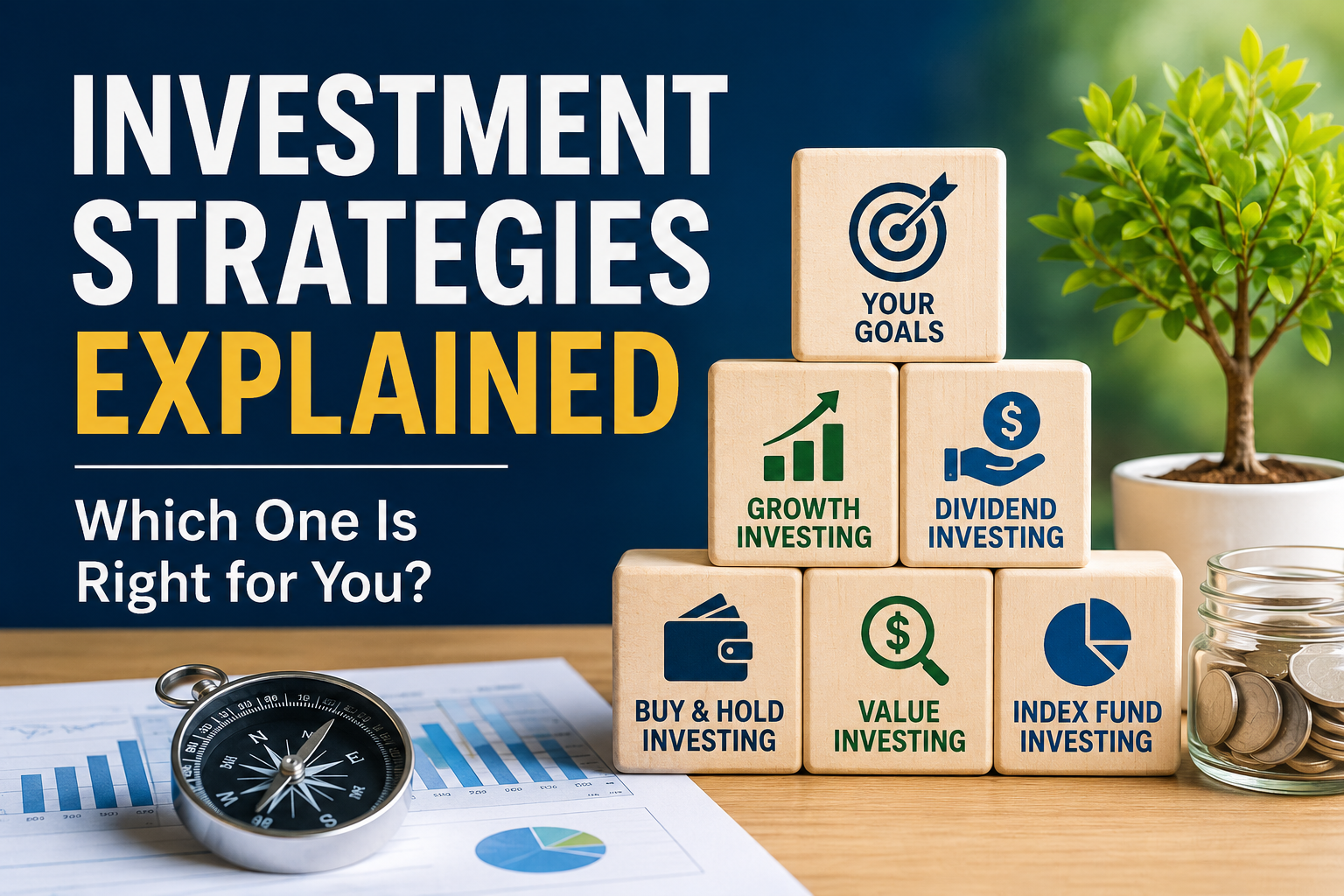
If you’ve ever started learning about investing, you’ve probably discovered something confusing: everyone seems to have a different opinion about their “best” investment strategies.
One person recommends buying individual stocks. Another insists index funds are the only way to invest. Someone else talks about dividends, while another says growth stocks are the future.
The truth is there isn’t one perfect investment strategy. The best approach depends on your financial goals, your comfort with risk, and how involved you want to be in managing your investments.
Let’s look at some of the most common investment strategies and where each one may fit.
1. Buy and Hold Investing
The buy-and-hold strategy is exactly what it sounds like. You invest in quality investments and keep them for many years rather than trying to predict short-term market movements.
This strategy has become popular because it removes much of the emotion from investing. Instead of worrying about daily market swings, you stay focused on long-term growth.
Advantages
- Simple to follow
- Lower trading costs
- Allows compound growth to work over time
- Reduces emotional investing
Potential drawbacks
- Requires patience
- Markets will experience temporary declines
- Not ideal for someone needing the money in the near future
For many long-term investors, buy-and-hold investing provides a solid foundation.
2. Value Investing
Value investing focuses on finding companies whose stock prices appear lower than their true value.
Rather than chasing popular companies, value investors look for businesses that the market may be overlooking.
Advantages
- Potential to buy quality companies at attractive prices
- Can produce strong long-term returns
Potential drawbacks
- Requires research and patience
- Some companies remain undervalued for years
- Not every “cheap” stock is actually a good investment
Value investing rewards careful analysis more than quick decisions.
3. Growth Investing
Growth investors look for companies expected to increase sales and profits faster than average.
These companies often operate in expanding industries such as technology, healthcare, or artificial intelligence.
Advantages
- Higher potential for long-term growth
- Opportunity to benefit from innovative companies
Potential drawbacks
- Greater price volatility
- Higher valuations can increase risk
- Future growth isn’t guaranteed
Growth investing can be rewarding, but it usually comes with a bumpier ride.
4. Index Fund Investing
For many beginning investors, index fund investing offers one of the simplest ways to build wealth.
Rather than trying to pick individual winners, an index fund owns hundreds—or even thousands—of companies that track a market index, such as the S&P 500.
Advantages
- Broad diversification
- Low management costs
- Little ongoing maintenance
- Historically strong long-term performance
Potential drawbacks
- You’ll earn market returns rather than outperforming the market
- You don’t control which individual companies are included
For many people, this strategy provides an excellent balance between simplicity and long-term growth.
5. Dividend Investing
Dividend investing focuses on companies that regularly share a portion of their profits with shareholders.
Many investors appreciate dividends because they provide income while still allowing investments to grow.
Advantages
- Regular income
- Often less volatile than many growth stocks
- Can provide cash flow during retirement
Potential drawbacks
- Dividend payments can change
- High dividend yields sometimes signal financial problems
- May not grow as quickly as some growth-focused investments
Dividend investing is often popular with investors who value steady income alongside long-term growth.
Which Investment Strategy Is Best?
The answer depends on you.
Consider questions such as:
- How many years do you have before you’ll need the money?
- How comfortable are you with market ups and downs?
- Do you want to actively research investments or keep things simple?
- Are you investing primarily for growth, income, or both?
Many successful investors don’t limit themselves to just one strategy. They may use low-cost index funds as the core of their portfolio while adding dividend or value investments to meet specific goals.
One Important Habit
One mistake new investors often make is believing they must find the perfect strategy before investing.
In reality, choosing a reasonable strategy and sticking with it consistently is usually more important than constantly changing approaches.
Successful investing isn’t about predicting tomorrow’s market. It’s about building a plan you can stay committed to for many years.
Final Thoughts
Understanding different investment strategies can help you make more informed financial decisions, but no single approach guarantees success.
Choose a strategy that matches your goals, your risk tolerance, and your time horizon. Then give it time to work.
The investors who often achieve the best long-term results aren’t necessarily the ones with the most complicated strategy—they’re the ones who remain patient, stay diversified, and continue investing consistently through both good markets and bad.