
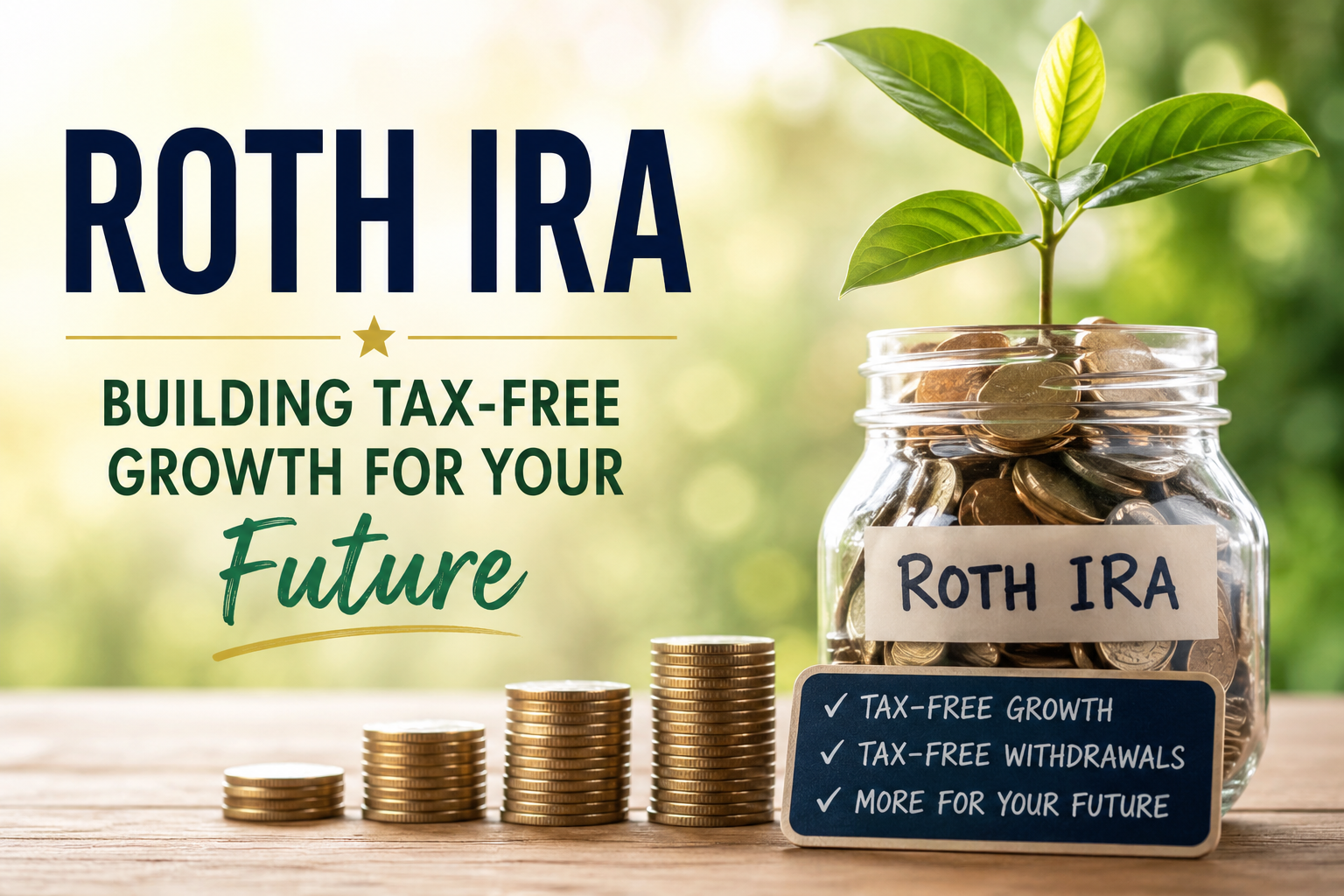
A Roth IRA sounds more complicated than it actually is.
At its core, it’s a retirement account that lets you contribute money you’ve already paid taxes on, invest that money for the future, and — if you follow the rules — withdraw both your contributions and your investment earnings tax-free in retirement. That combination is exactly why the Roth IRA has become such a popular piece of a long-term retirement plan.
But here’s something worth clearing up right away: a Roth IRA isn’t an investment. Think of it as a container. You put money into the account, then decide how to invest it. Let’s walk through how it actually works.
What Is a Roth IRA?
A Roth IRA is an Individual Retirement Arrangement that gets special tax treatment from the IRS.
You typically don’t get a tax deduction for money you put into a Roth IRA. Instead, the real payoff comes later. Your investments grow inside the account without getting taxed year to year, and qualified withdrawals in retirement come out completely tax-free.
That’s the opposite of a traditional IRA, where you may get a deduction up front but generally owe income tax on the money when you pull it out later. Neither one is automatically the “better” account. They just handle taxes at different times.
Why People Use Roth IRAs
A few features make the Roth IRA stand out as a retirement savings tool.
Tax-Free Qualified Withdrawals
Say you contribute money over many years and invest it in a diversified portfolio. If those investments grow substantially, qualified Roth IRA withdrawals generally don’t count as taxable income.
That’s the Roth IRA’s biggest selling point. You pay taxes on the money now, before decades of potential growth happen, instead of paying taxes on a much larger balance when you finally take it out.
No Required Minimum Distributions for the Original Owner
Traditional IRAs come with a catch: the IRS requires account owners to start taking required minimum distributions (RMDs) once they hit a certain age, whether they need the money or not.
A Roth IRA skips that requirement entirely. The original owner never has to take a distribution during their lifetime, which gives you a lot more control over when — or whether — you tap the account in retirement. Just know that the rules change once a Roth IRA passes to a beneficiary, so don’t assume an inherited account works the same way.
Your Contributions Are More Accessible
Here’s another perk worth knowing: because you’ve already paid taxes on the money you put in, you can generally withdraw your regular Roth IRA contributions without extra tax or penalty.
That said, don’t mix up contributions with earnings. The rules around investment earnings, conversions, and what counts as a “qualified” distribution get more complicated fast, and pulling money out early can quietly undermine the long-term growth you’re working to build. So while a Roth IRA does offer some flexibility, it’s still best treated as a retirement account first.
Roth IRA Contribution Limits
The IRS sets the combined limit you can contribute across your traditional and Roth IRAs each year, and it typically adjusts a little for inflation. There’s a standard limit for anyone under 50, plus a higher limit for people 50 and older that includes an extra “catch-up” contribution.
Because those dollar amounts change from year to year, don’t rely on a number you read somewhere online, including here. Go straight to IRS.gov for the current contribution limit before you contribute.
There’s one more limit to keep in mind: you generally can’t contribute more than you actually earned in taxable compensation for the year. And remember, that annual cap applies across all your traditional and Roth IRAs combined. Opening three different IRA accounts doesn’t triple what you’re allowed to put in.
Roth IRA Income Limits
Not everyone qualifies for the full Roth IRA contribution. Your eligibility depends on your modified adjusted gross income (MAGI) and your tax filing status.
The IRS sets phase-out ranges for each filing status, generally single and head-of-household filers, married couples filing jointly, and married filing separately, and those ranges get revised most years too. Rather than anchor on a specific number that may already be outdated by the time you read this, check the current Roth IRA income limits directly on IRS.gov before you plan around them.
That one habit, checking the IRS numbers before you contribute, will save you from accidentally over-contributing or assuming you’re ineligible when you’re not.
How Does a Roth IRA Actually Grow?
Opening a Roth IRA is only step one. This is where many new investors get tripped up: putting $1,000 into a Roth IRA doesn’t mean $1,000 is actually invested yet.
Once you fund the account, you still need to choose your investments. Depending on where you hold the account, your options might include mutual funds, exchange-traded funds (ETFs), individual stocks, bonds, or other permitted investments.
The Roth IRA gives you the tax structure. What you invest in determines how your money grows and how much risk you take on.
Why Starting Earlier Can Make Such a Difference
Time might be the single most valuable advantage an investor has.
Picture someone investing $300 a month at an average annual return of 7%. After 10 years, that could grow to roughly $52,000. After 20 years, roughly $156,000. After 30 years, roughly $366,000.
Those numbers are just illustrations, not guarantees. Markets don’t deliver the same return every year. But they show something real: the longer compounding works, the more work it does for you.
You don’t need to be wealthy to start. Contributing an amount you can comfortably afford and sticking with it probably matters more than waiting around for the “perfect” moment.
Should You Max Out a Roth IRA?
You’ll hear plenty of advice telling you to max out your Roth every year. That’s a fine goal, but it’s not automatically the right move for everyone right now.
Before you funnel every spare dollar into retirement, take stock of the rest of your financial picture. You may also need to build an emergency fund, cover essential bills, pay down high-interest debt, capture an employer retirement match, carry adequate insurance, and save for goals that aren’t decades away.
Personal finance works best when all the pieces work together, not when one goal steamrolls the rest. And if maxing out your contribution isn’t realistic for you right now, that doesn’t mean a Roth IRA isn’t worth having. A smaller, consistent contribution still counts as real progress.
Roth IRA vs. Traditional IRA
One easy way to tell the two apart: ask yourself when you get the tax break.
With a traditional IRA, eligible contributions may lower your taxes today, while withdrawals get taxed later. With a Roth IRA, you skip the deduction now, but qualified withdrawals come out tax-free down the road.
Your income, your current tax bracket versus your expected future one, any workplace retirement benefits, your age, and your broader circumstances all factor into which approach fits best. Plenty of people end up using both.
A Roth IRA Isn’t a Shortcut to Wealth
This is worth saying plainly, because retirement investing sometimes gets marketed like there’s a secret formula hiding somewhere.
There isn’t. A Roth IRA won’t turn a bad investment into a good one; it won’t shield you from market risk, and simply opening the account won’t build your savings on its own.
What it does give you is a tax-advantaged structure for long-term investing. The real work is a lot less exciting: contribute, invest appropriately, stay diversified, watch your costs, give your money time, and repeat. That’s where the habit comes in, and habits move the needle.
The Bottom Line
A Roth IRA can be a genuinely powerful retirement tool, especially if you value the idea of tax-free qualified withdrawals and more flexibility later in life.
But don’t get stuck chasing the maximum contribution right out of the gate. Start by figuring out where a Roth IRA actually fits into your bigger financial picture. If it makes sense for you, pick a contribution you can sustain, put the money to work instead of letting it sit in cash, and build from there.
Retirement security rarely comes down to one brilliant financial decision. It’s built through ordinary decisions, repeated for a very long time.
This article is for educational purposes only and isn’t individualized tax, investment, or financial advice. Tax rules and contribution limits can change. Check current IRS guidance or talk to a qualified financial or tax professional about your specific situation.