
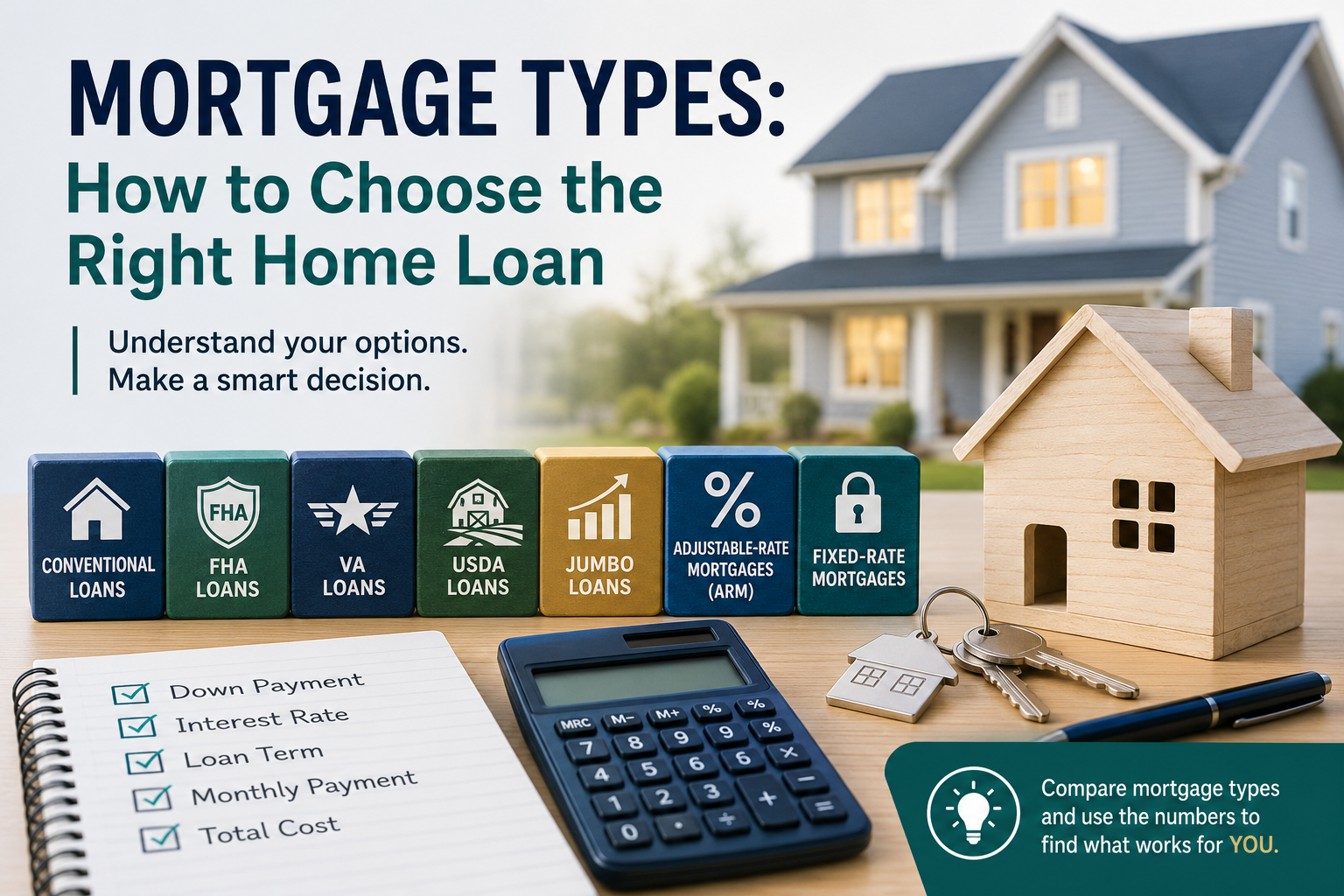
Buying a home already means a hundred decisions — location, price, inspections, insurance, closing costs. On top of that, someone starts throwing around the different mortgage types — FHA, VA, conventional, ARM, jumbo — like you were handed a mortgage dictionary at birth.
Learning the basic mortgage types fixes that. Ultimately, the right mortgage isn’t the one with the flashiest advertised rate or the smallest down payment. Instead, it’s the one that matches your finances, how long you plan to stay in the home, and how much risk you’re actually willing to carry.
So, below are the mortgage types you’ll run into most, and what actually matters about each one.
Conventional Loans
Of all the mortgage types, conventional is the one you’ll hear about most. A conventional mortgage is a home loan not insured or guaranteed by a federal agency. Overall, it’s the largest slice of the mortgage market, and it tends to offer the most flexibility.
Requirements shift by lender and program. Specifically, your credit history, income, debt, down payment, and general financial picture all affect what you qualify for and the terms you’re offered. Also, if you put down less than 20%, you’ll likely pay private mortgage insurance (PMI) too.
A conventional loan is worth a look if:
- Your credit is solid, and your income is steady.
- You can bring a real down payment to the table.
- You want flexibility in how the loan is structured.
- You like the idea of eventually dropping PMI once you qualify.
Even so, don’t assume “conventional” automatically means “cheapest.” Instead, run the total cost against the other mortgage types available to you before deciding.
FHA Loans
Among government-backed mortgage types, FHA loans are the most widely used. They come from approved private lenders but are insured by the Federal Housing Administration.
People associate them with first-time buyers, but you don’t need to be one to use this financing. Rather, FHA loans tend to appeal to borrowers with less cash for a down payment or a credit profile that makes conventional approval harder.
For instance, HUD allows down payments as low as 3.5% for qualifying borrowers. However, the trade-off is mortgage insurance, which you need to factor into the full cost of the loan — not just the low down payment.
In short, FHA can open the door to homeownership sooner. That said, it doesn’t automatically mean you’re paying less over time.
VA Loans
Among the mortgage types tied to military service, the VA loan stands out. If you’re an eligible veteran, active-duty service member, or qualifying surviving spouse, a VA-backed loan deserves a hard look before anything else.
VA loans are backed by the Department of Veterans Affairs, though in most cases they’re issued by private lenders, not the VA directly. Depending on your eligibility and the deal itself, you may be able to buy with no down payment and skip monthly private mortgage insurance entirely.
Still, rates and terms vary lender to lender, so eligibility doesn’t mean you can skip shopping around.
Therefore, if you qualify, compare a VA loan against conventional financing rather than assuming it wins by default. It usually does — but check.
USDA Loans
Next among the lesser-known mortgage types: USDA loans, which aren’t just “mortgages for people who live in the country,” even though that’s the reputation.
Specifically, the USDA Single Family Housing Guaranteed Loan Program helps eligible low- and moderate-income buyers purchase homes in qualifying rural areas. Eligible borrowers can get 100% financing, meaning no down payment at all.
That’s a real advantage. However, both you and the property have to qualify — location matters as much as income here.
So, check the current USDA eligibility maps and income limits for the specific property before assuming you’re in or out.
Jumbo Loans
Jumbo loans round out the major mortgage types by loan size. Most conventional mortgages fall within conforming loan limits set for that market. Borrow more than the limit in your area, and you’re in jumbo territory.
Because the lender is taking on more risk, jumbo loans usually come with tougher qualification standards: stronger credit, larger cash reserves, more documentation, sometimes a bigger down payment.
Keep in mind, conforming loan limits change and vary by location. So, don’t rely on an old number from an article somewhere to figure out whether your loan counts as jumbo — check the current limit for your county.
Mortgage Types by Rate Structure
Beyond how a loan is insured or backed, there’s another major way to sort mortgage types: how the rate behaves over time. That split comes down to two options — fixed-rate and adjustable-rate.
Fixed-Rate Mortgages
A fixed-rate mortgage locks your interest rate in at closing, and it stays there for the life of the loan. As a result, your principal-and-interest payment doesn’t move.
Here’s the part people miss, though: “fixed-rate” doesn’t mean your whole housing payment is frozen. Property taxes climb. Insurance premiums climb. HOA dues climb. In other words, what’s actually fixed is the interest rate and the principal-and-interest portion — nothing else.
Overall, fixed-rate loans make the most sense if you value predictability and plan to stay in the home for years.
Adjustable-Rate Mortgages (ARMs)
By contrast, an ARM starts with a fixed rate for an introductory period, then adjusts based on the loan’s terms once that period ends.
A 5/1 ARM, for example, holds a fixed rate for five years, then adjusts once a year after that. Other ARM structures work on different timelines.
The appeal is a lower starting rate than a comparable fixed loan. Meanwhile, the cost is uncertainty down the road.
The Consumer Financial Protection Bureau’s advice here is worth repeating: know how often your rate can change, how high it can climb, and what caps apply before you sign. And don’t bank on refinancing or selling before the adjustment hits — that’s a hope, not a plan, and rates, home values, and your own finances might not cooperate on your timeline.
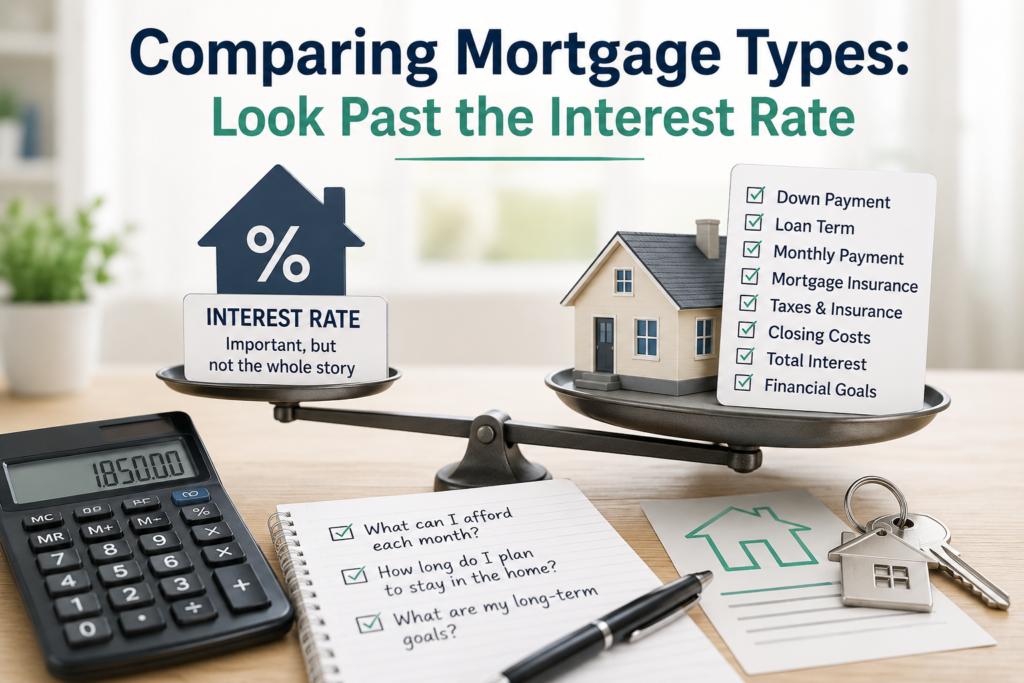
Comparing Mortgage Types: Look Past the Interest Rate
Once you’ve narrowed down the mortgage types that fit your situation, the loan with the lowest rate still isn’t automatically the best deal. Instead, line up the whole picture:
- Down payment
- Interest rate
- Fixed vs. adjustable
- Loan term
- Principal-and-interest payment
- Mortgage insurance
- Closing costs and lender fees
- Points
- Property taxes
- Homeowners insurance
- HOA fees
- Total interest paid over the life of the loan
Pay close attention to loan term. A 15-year mortgage usually means a higher monthly payment but far less interest paid overall. A 30-year loan lowers the monthly hit but costs more in total interest. The CFPB recommends weighing these side by side rather than fixating on the rate alone — and that’s advice worth following.
See These Mortgage Types in Real Numbers
Definitions only get you so far. Eventually, the decision comes down to dollars, and changing a few numbers teaches you more than reading ten more glossary entries.
So, use the Money Habits Mortgage Calculator to test how different mortgage types stack up — plug in home price, down payment, rate, term, taxes, insurance, PMI, and HOA fees against each other.
Try changing one variable at a time. What happens when you bump up the down payment? How far apart is a 15-year payment from a 30-year payment? What’s the total interest over the full term? What does the real monthly cost look like once taxes, insurance, PMI, and HOA fees are all in the mix?
Ultimately, those questions matter more than “what’s the rate.”
Which Mortgage Type Is Right for You?
There’s no universal answer here. A buyer with limited savings weighs these options differently than someone with a large down payment sitting in the bank. Similarly, a veteran has choices most buyers don’t. And someone planning to move in three years should think about an ARM very differently than someone planning to stay for thirty.
Ultimately, the goal isn’t finding whatever loan everyone online calls “best.” Rather, it’s understanding the trade-offs among the various mortgage types well enough to know which one actually fits your situation.
Before you commit to anything, get Loan Estimates from more than one lender. Compare the interest rate, APR, monthly payment, closing costs, mortgage insurance, and total borrowing cost side by side. Both HUD and the CFPB say the same thing: shop around, don’t settle for one offer.
After all, buying a house is a big enough commitment already. Your mortgage shouldn’t be something you finally understand after you’ve already signed.
FAQ
What’s the most common type of mortgage? Conventional loans make up the largest share of the mortgage market, though FHA, VA, and USDA loans are common for buyers who qualify for them.
Is a fixed-rate or adjustable-rate mortgage better? It depends on how long you plan to stay in the home. Fixed-rate loans favor predictability over the long term; ARMs can offer lower initial rates but carry risk once the fixed period ends.
What credit score do I need for a conventional loan? Requirements vary by lender, but conventional loans generally call for stronger credit than FHA loans. Check with individual lenders for their specific minimums.
Can I get a mortgage with no down payment? Yes, in some cases. VA loans and USDA loans can offer 100% financing for eligible borrowers and properties.