
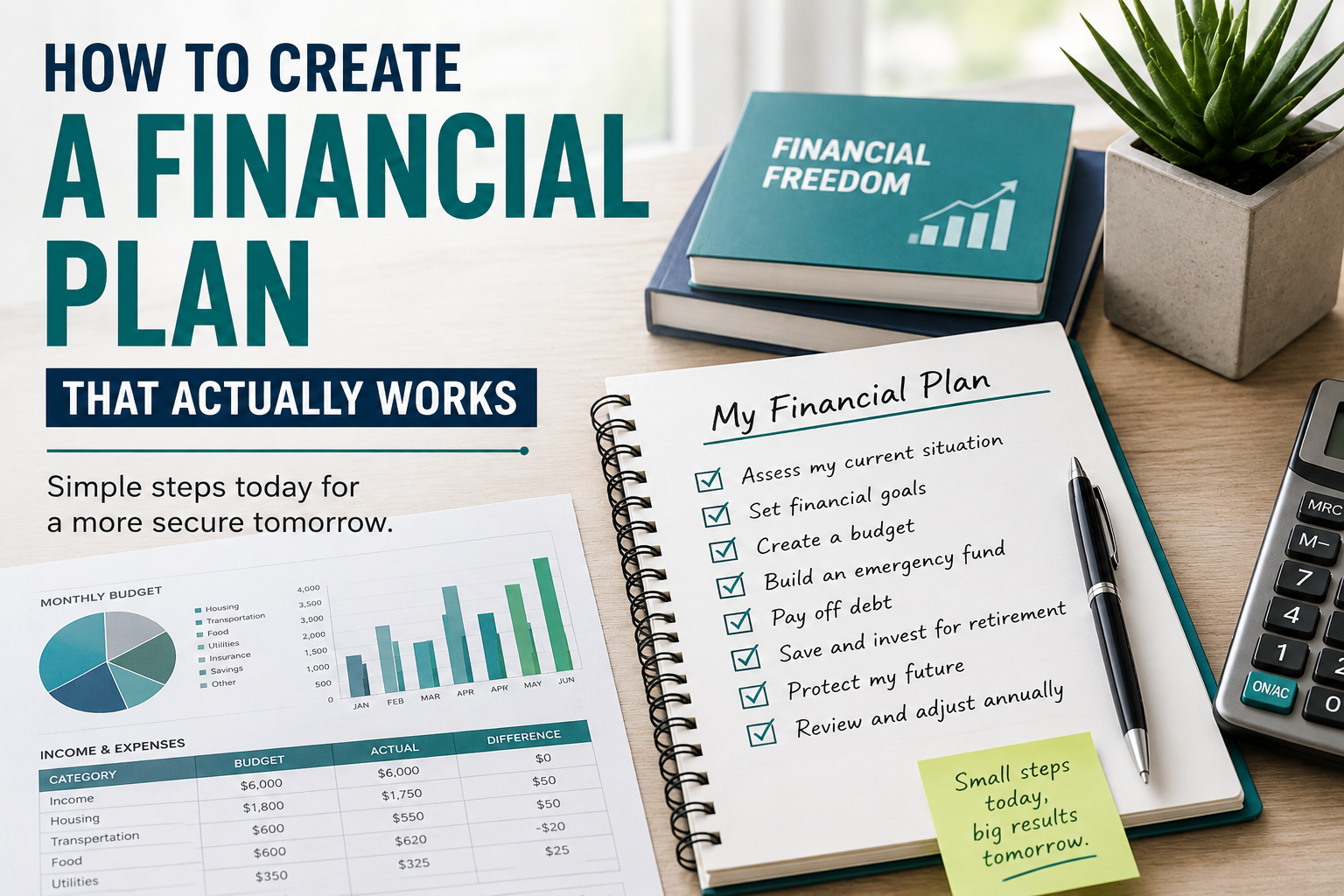
Most people don’t need a complicated financial plan. They need one they can actually follow.
When people hear the words financial plan, they often picture thick binders, investment charts, or meetings with financial advisors. In reality, a financial plan is much simpler than that. It’s a roadmap for your money. It helps you understand where you are today, where you want to go, and what steps will move you in the right direction.
The best financial plans aren’t perfect. They’re practical. They grow and change as your life changes.
Whether you’re just getting started or looking to get back on track, here’s how to create a financial plan that actually works.

Know Where You Stand
Before deciding where your money should go, you need to understand where it is today.
Start by taking an honest look at your financial situation. There’s no judgment involved—only information.
Review:
- monthly income
- monthly expenses
- savings
- investments
- debts
- retirement accounts
A simple net worth calculation can also be helpful. Add everything you own, subtract everything you owe, and you’ll have a snapshot of your current financial position.
Don’t worry if the number isn’t what you hoped. A financial plan isn’t about where you start. It’s about making steady progress.
Set Financial Goals That Matter
Every financial plan should have a purpose.
Ask yourself:
- What do I want my money to accomplish?
- What worries me most about my finances?
- Where will I be in five or ten years?
Your goals might include:
- Building an emergency fund
- Paying off credit card debt
- Buying a home
- Saving for retirement
- Starting a business
- Helping pay for a child’s education
It’s often helpful to divide goals into three time frames:
Short-Term Goals (1–3 Years)
Examples include:
- Building an emergency fund
- Paying off a credit card
- Saving for a vacation
- Replacing an older vehicle
Medium-Term Goals (3–10 Years)
These might include:
- Saving for a home purchase
- Paying off student loans
- Starting a business
- Building investment accounts
Long-Term Goals (10+ Years)
Think about:
- Retirement
- Financial independence
- Leaving an inheritance
- Long-term healthcare planning
Breaking goals into time horizons makes them feel much more manageable.
Create a Spending Plan
A financial plan only works if your spending supports your goals.
Notice that I didn’t say “budget.”
Many people associate budgeting with restrictions. Instead, think of it as giving your money a job before you spend it.
Start by listing your monthly expenses.
Separate them into:
- Housing
- Utilities
- Food
- Transportation
- Insurance
- Debt payments
- Entertainment
- Savings
- Other expenses
Once everything is visible, you’ll usually notice areas where money quietly disappears.
The goal isn’t to eliminate every enjoyable expense. It’s to spend intentionally.
Build an Emergency Fund
Unexpected expenses aren’t unusual.
They’re inevitable.
Cars need repairs.
Appliances stop working.
Medical bills happen.
Jobs change.
Without savings, many people rely on credit cards for emergencies, creating new financial problems while trying to solve old ones.
Start small if necessary.
Even a modest emergency fund can reduce financial stress.
Eventually, work toward saving three to six months of essential living expenses.
The exact amount depends on your income, job stability, and family situation, but consistency matters more than perfection.
One of the easiest ways to save is by setting up automatic transfers every payday.
When saving happens automatically, it becomes a habit instead of a monthly decision.
Pay Down High-Interest Debt
Debt doesn’t automatically mean you’ve made poor financial decisions.
Many people carry mortgages, student loans, or car loans while building successful financial lives.
The challenge is high-interest debt.
Credit cards with double-digit interest rates can make financial progress much harder because so much of each payment goes toward interest instead of reducing the balance.
Two common repayment strategies are:
The Debt Snowball
Pay off the smallest balance first while making minimum payments on everything else.
Each payoff creates momentum.
The Debt Avalanche
Focus on the debt with the highest interest rate first.
This approach usually saves more money over time.
Neither method is universally better.
Choose the one you’re most likely to stick with.
Make Retirement Part of Your Plan
Retirement planning isn’t only for people approaching retirement.
Time is one of the most valuable tools available to investors.
If your employer offers a retirement plan, consider contributing enough to receive any available employer match.
That’s one of the few opportunities where additional money may be available simply by participating.
As your income increases, gradually increase your retirement contributions.
Small increases today can have a meaningful impact over the next twenty or thirty years.
Protect What You’re Building
Growing wealth isn’t only about saving and investing.
It’s also about protecting yourself from setbacks.
Review your insurance regularly.
Consider whether you have appropriate coverage for:
- Health insurance
- Auto insurance
- Homeowners or renters insurance
- Life insurance, if others depend on your income
- Disability insurance, if appropriate
You should also make sure important documents are up to date, including beneficiary designations, a will, and any other estate planning documents that fit your situation.
Review Your Financial Plan Every Year
One mistake people make is believing a financial plan is something they create once.
Life doesn’t work that way.
Careers change.
Families grow.
Income increases—or sometimes decreases.
Goals evolve.
Schedule a yearly financial review to ask questions like:
- Have my goals changed?
- Am I saving enough?
- Has my debt improved?
- Do I need to adjust my spending?
- Is my insurance still appropriate?
- Am I making progress toward retirement?
Even a one-hour annual review can keep your financial plan aligned with your life.
Common Financial Planning Mistakes
Many financial setbacks happen because people overlook simple habits.
Some of the most common mistakes include:
- Trying to change everything at once.
- Living without an emergency fund.
- Ignoring retirement until later.
- Carrying expensive credit card debt for years.
- Never reviewing financial goals.
- Chasing investment trends instead of following a long-term plan.
- Believing financial planning requires perfection.
The truth is that consistency usually beats complexity.
Final Thoughts
Creating a financial plan doesn’t require perfect timing or expert-level financial knowledge.
It simply requires a willingness to pay attention to where your money is going and make intentional decisions about where you want it to go next.
Some years your progress will feel fast.
Other years it may feel slow.
Both are normal.
The important thing is continuing to move forward.
A financial plan isn’t about predicting the future. It’s about preparing for it.
Start with one step today, review your progress regularly, and allow your plan to grow as your life changes. Over time, those small decisions often become the financial habits that create lasting security.
Related Reading: If you’re working on improving your financial habits, you may also enjoy our articles on creating a spending plan, building an emergency fund, paying off debt, and preparing for retirement.