
Most of us think about taxes more seriously once a year.
We gather the forms, file the return, hope we don’t owe too much, and then move on.
But how taxes affect your money is all year long.
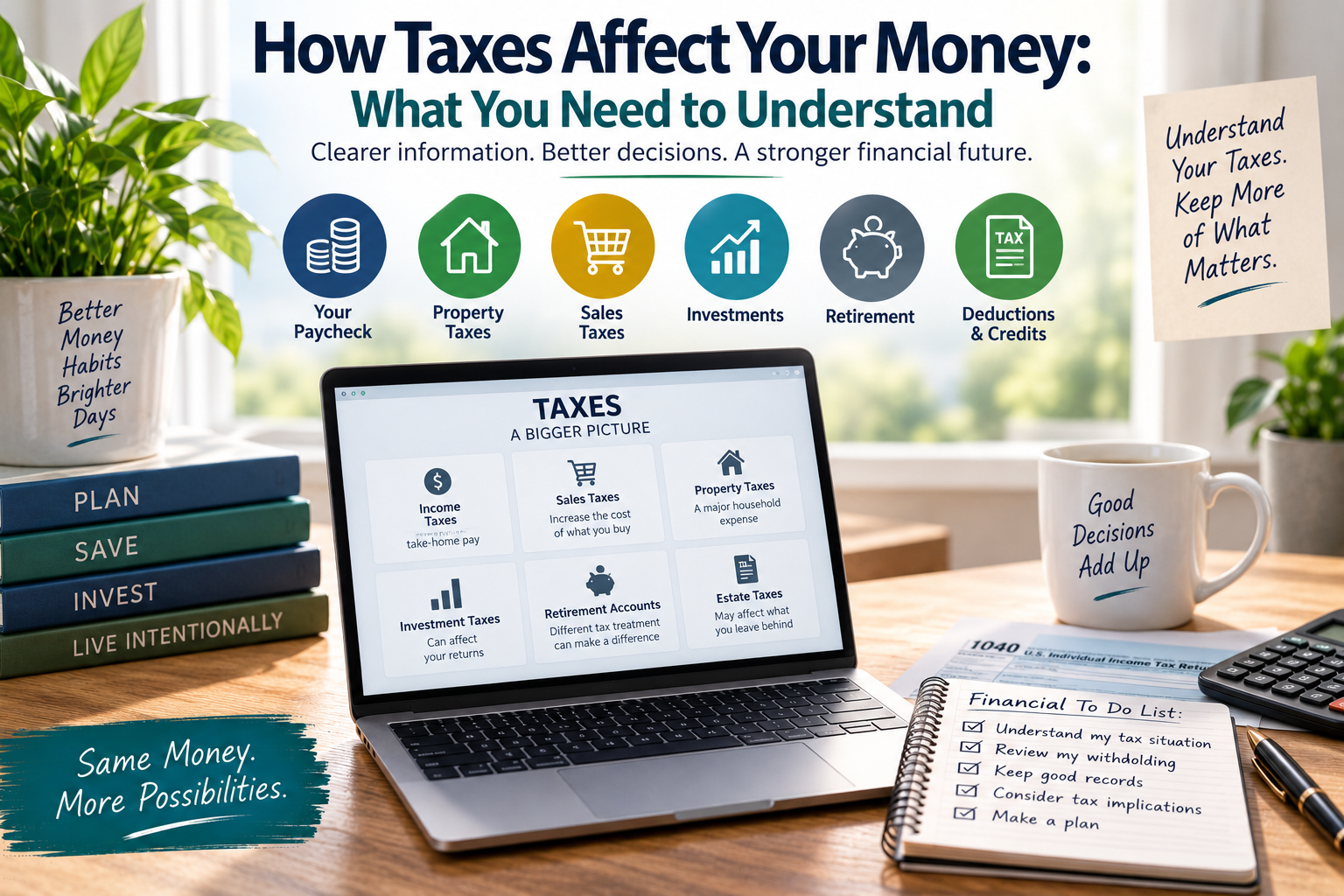
They affect how much of your paycheck reaches your bank account, how some investments are taxed, how retirement accounts work, what you pay when you buy things, and even some of the decisions you make about your home and estate.
You don’t need to become a tax expert.
But understanding how taxes affect your money can help you make better financial decisions throughout the year instead of thinking about taxes only when it’s time to file a return.
Start With the Difference Between What You Earn and What You Keep
Suppose your salary is $70,000.
That doesn’t mean $70,000 arrives in your checking account.
Money may be withheld for federal income taxes, Social Security and Medicare taxes, state or local taxes where applicable, insurance, retirement contributions, and other deductions.
That’s why your gross income and take-home pay can look very different.
For everyday financial planning, the number that matters most is what you actually have available to spend, save, invest, and use to pay your bills.
If you’re building a spending plan, start with the money you actually expect to receive rather than simply looking at your annual salary.
Not All Income Is Treated the Same Way
Your paycheck isn’t necessarily your only source of taxable income.
Depending on your circumstances, taxable income can also include things such as:
- Self-employment or freelance income
- Interest
- Dividends
- Capital gains
- Rental income
- Some retirement distributions
- Some Social Security benefits
- Other forms of income
The tax treatment can differ depending on the type of income and your individual circumstances.
That matters because earning $1,000 doesn’t always mean $1,000 will be taxed the same way, no matter where it came from.
As your finances become more complicated, understanding the tax treatment of different income sources becomes more important.
How Taxes Affect Your Money: Understanding Tax Brackets
One of the most misunderstood parts of federal income taxes is the idea of tax brackets.
The United States uses a marginal federal income tax system.
That means moving into a higher tax bracket doesn’t suddenly tax all of your income at the higher rate.
Different portions of your taxable income can be taxed at different rates.
That’s worth understanding because people sometimes worry that earning a little more money will leave them worse off simply because they’ve “moved into another tax bracket.”
That’s generally not how federal income tax brackets work.
Your marginal tax rate and the percentage of your total income that you ultimately pay in federal income taxes are not necessarily the same thing.
You don’t need to memorize the tax brackets.
You just need to understand how the system works.
Taxes Show Up in More Places Than Your Paycheck
Income taxes tend to get most of the attention, but they’re only one way How Taxes Affect Your Money.
Depending on where you live and what you own, you may encounter:
Sales Taxes
Sales taxes increase the actual cost of many things you buy.
A $1,000 purchase may cost more than $1,000 once sales tax is included.
That matters when you’re planning for larger purchases.
Property Taxes
If you own a home, property taxes can be a significant household expense.
Even if they’re included in your mortgage escrow payment, you’re still paying them.
And they can change over time.
Capital Gains Taxes
Selling an investment or another asset for more than you paid for it may create a taxable capital gain.
How that gain is treated can depend on the asset, how long you owned it, your income, and other circumstances.
Estate and Inheritance Taxes
Estate and inheritance taxes are often discussed as though they’re the same thing.
They aren’t.
An estate tax generally applies to the estate itself, while an inheritance tax may apply to someone receiving inherited property. Whether either applies depends on the circumstances and applicable federal or state law.
For many households, these taxes may never become an issue.
But they can matter in estate planning.
Deductions and Credits Aren’t the Same Thing
This is another distinction worth knowing.
A tax deduction generally reduces the amount of income subject to tax.
A tax credit generally reduces the tax you owe.
Suppose you qualify for a $1,000 deduction. That doesn’t ordinarily mean your tax bill falls by $1,000.
A $1,000 tax credit can have a much more direct effect because it generally reduces the tax you owe by $1,000, subject to the particular rules of that credit.
Eligibility for deductions and credits varies.
That’s why it’s better to understand what you actually qualify for than to assume an expense is “tax deductible” simply because you’ve heard someone describe it that way.
Retirement Accounts and Taxes
How Taxes Affect Your Money also plays an important role in retirement planning.
Different retirement accounts can receive different tax treatment.
With some traditional retirement accounts, eligible contributions may provide a current tax benefit, and you generally pay taxes when you withdraw money later.
With Roth accounts, you generally contribute money that has already been taxed, while qualified withdrawals can be tax-free.
Neither approach is automatically better for everyone.
Your income, age, tax situation, retirement plans, and other factors can affect which approach makes more sense.
The important thing is recognizing that when you choose a retirement account, you’re also making decisions about when taxes may be paid.
How Taxes Affect Your Money Can Affect Investment Decisions
Taxes shouldn’t necessarily drive every investment decision, but you shouldn’t ignore them either.
Interest, dividends, and investment gains can have different tax consequences.
Where you hold certain investments can matter too.
For example, investments held inside certain retirement accounts may receive different tax treatment from investments held in a regular taxable brokerage account.
That doesn’t mean you should choose an investment simply because it has a tax advantage.
A poor investment doesn’t suddenly become a good one because of its tax treatment.
Taxes are one part of the decision.
Don’t Confuse a Tax Refund With Free Money
Getting a large tax refund can feel pretty good.
But a refund generally means you paid more during the year than was ultimately required for your income tax liability, or you qualified for refundable credits or other payments.
It isn’t automatically a government-created financial windfall.
If your withholding is consistently much higher than necessary, you may want to review it.
On the other hand, some people prefer receiving a refund rather than risking a balance due.
The important thing is understanding what’s happening, not judging your tax situation by the size of the refund.
How Taxes Affect Your Money and Major Life Changes
Taxes don’t exist separately from the rest of your life.
Getting married can change your filing situation.
Having or adopting a child may affect your eligibility for certain tax benefits.
Buying or selling a home can create tax considerations.
Starting a side business introduces another set of issues.
Retirement changes where your income comes from.
Selling investments can create gains or losses.
Even changing jobs can affect withholding.
When something significant changes financially, taxes should be one of the things you think about.
You don’t have to wait until tax season to discover How Taxes Affect Your Money.
Keep Good Records
One of the simplest tax habits is also one of the least exciting:
Keep your records organized.
That may include:
- Income documents
- Tax forms
- Records related to deductible expenses when applicable
- Investment purchase and sale information
- Business records if you’re self-employed
- Records related to property
- Retirement contribution information
- Prior tax returns
You don’t necessarily need a filing cabinet overflowing with paper.
Digital records can make this considerably easier.
The important thing is being able to find what you need when you need it.
Know When to Get Help
Many people can handle relatively straightforward tax returns on their own.
But finances don’t always stay straightforward.
Owning a business, receiving significant investment income, selling property, dealing with an inheritance, moving between states, or making certain retirement decisions can make taxes more complicated.
That’s when professional tax help may be worth considering.
The point isn’t to pay someone simply because taxes seem intimidating.
It’s recognizing when the consequences of getting something wrong are large enough that knowledgeable help may be valuable.
And be careful about taking tax advice from social media, friends, coworkers, or someone who says, “I deduct it every year.”
Their tax situation isn’t necessarily yours.
For current federal tax information, the IRS should be your starting point.
Don’t Let Taxes Drive Every Financial Decision
Saving money on taxes can be useful.
But avoiding taxes shouldn’t become the goal of every financial decision.
Don’t spend $1 simply because it might save you 20 cents in taxes.
Don’t hold a bad investment solely because you’re afraid of creating a taxable gain.
And don’t make a major financial decision based only on the possible tax benefit.
Start with the larger question:
Does this decision make financial sense for me?
Then consider the tax consequences as part of the answer.
Understanding Taxes Is Part of Understanding Your Money
You don’t need to memorize the tax code.
Most people never will.
What matters is understanding the basics well enough to recognize when taxes affect a financial decision.
Know the difference between gross income and what you actually take home.
Understand that different kinds of income can receive different tax treatment.
Know the difference between deductions and credits.
Recognize the role taxes play in retirement and investing.
Keep good records.
And when your situation becomes complicated, know when it’s time to ask for help.
How taxes affect your money may be unavoidable.
Being completely surprised by how they affect your money doesn’t have to be.
The more you understand about where your money goes, the better prepared you are to decide what to do with what remains.