
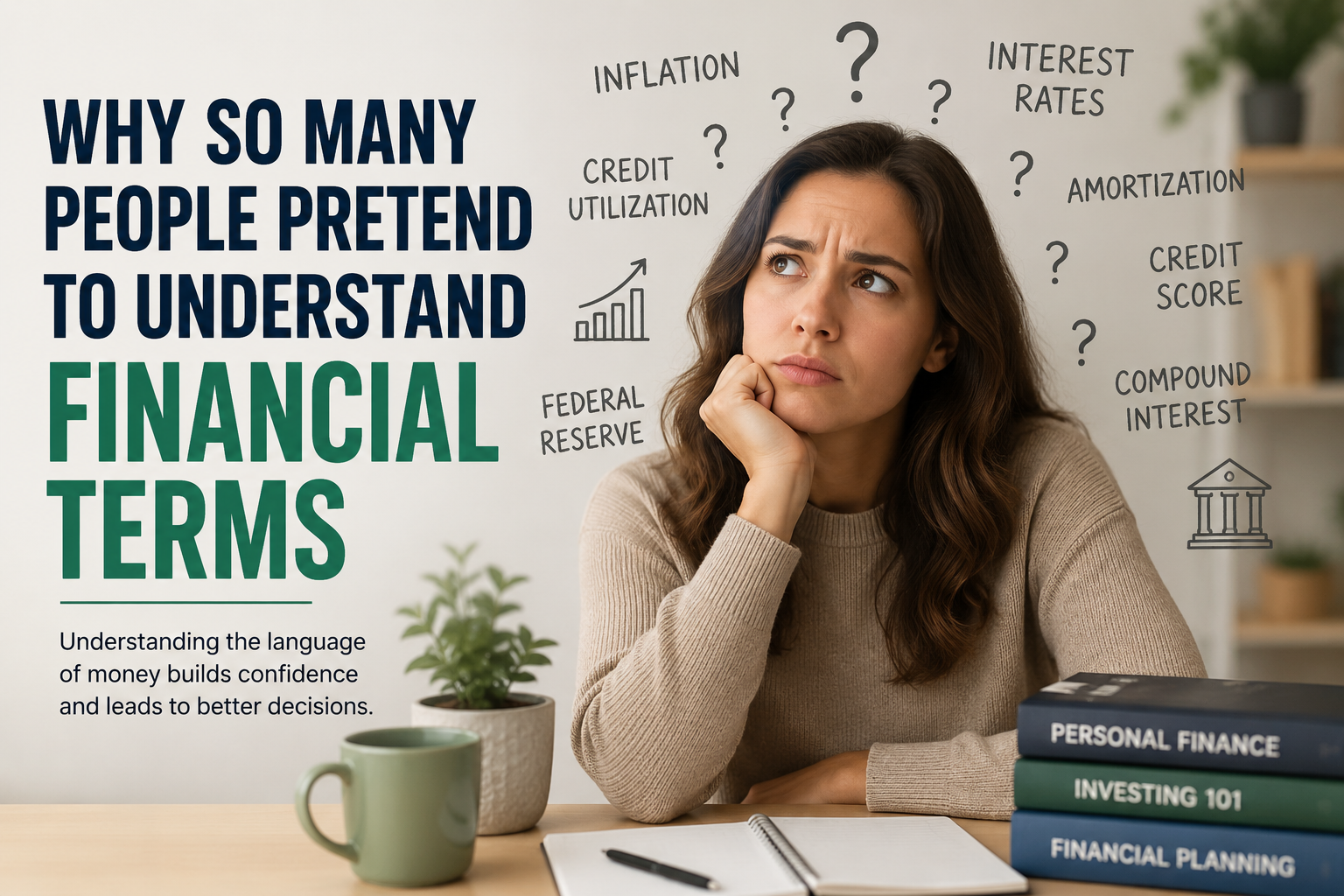
You’re watching the news, listening to a podcast, sitting in a meeting, or talking with friends when someone casually mentions inflation, interest rates, amortization, credit utilization, or the Federal Reserve. Everyone around you seems to understand exactly what is being discussed. The conversation keeps moving, and nobody asks any questions. Meanwhile, you’re trying to decide whether you actually understand these financial terms or whether you’re simply recognizing the words.
The truth is that many people quietly pretend to understand financial conversations every day. It is not because they lack intelligence or interest. It is because nobody ever took the time to explain the language of money in a way that felt practical, approachable, and easy to understand.
Over the years, I have noticed something interesting about personal finance. Most people are not struggling because they are incapable of managing money. Many are struggling because they feel excluded from the conversation. Financial topics often come wrapped in unfamiliar terminology, technical explanations, and assumptions that everyone already knows what is being discussed. After a while, it becomes easier to nod along than admit you are not completely sure what a particular term means.
That hesitation creates a problem. When people feel uncomfortable with financial language, they often avoid financial information altogether. They stop reading articles, tune out financial news, and postpone important decisions because they are worried about making a mistake. The issue is no longer about understanding a single definition. It becomes a barrier to building confidence with money.
Why Financial Language Feels More Complicated Than It Is
One reason financial terminology feels intimidating is that most of us were never formally taught it. Schools spend years teaching mathematics, science, and history, yet many people graduate without ever learning the difference between a credit score and a credit report, how compound interest works, or why the Federal Reserve receives so much attention whenever the economy changes.
As adults, we are expected to make decisions involving mortgages, retirement plans, investments, insurance policies, and taxes while simultaneously learning an entirely new vocabulary. It is a little like being handed the keys to a car before anyone explains what the warning lights on the dashboard mean.
The result is predictable. People hear terms repeatedly, assume they should already understand them, and become increasingly reluctant to ask questions. Unfortunately, avoiding the question rarely improves understanding.
The Cost of Pretending to Understand Financial Terms
Not understanding financial language affects more than casual conversations. It can influence the decisions people make with their money.
Consider someone shopping for a loan. If they do not fully understand interest rates, loan terms, or amortization, they may focus only on the monthly payment while overlooking the total cost of borrowing. Someone who does not understand compound interest may underestimate the long-term value of saving and investing early. A person unfamiliar with credit utilization may unknowingly damage their credit score while believing they are using credit responsibly.
These situations are common because financial decisions are often connected directly to financial terminology. When the language feels confusing, the decisions become more difficult.
The good news is that most financial concepts are far less complicated than they initially appear. Once someone explains them in plain English, many people find themselves wondering why nobody explained them that way years ago.
Financial Confidence Starts With Understanding
One of the biggest myths in personal finance is that you need to become an expert before you can make good decisions. In reality, most people simply need a basic understanding of the concepts they encounter every day.
Inflation is not a mysterious economic force. It simply refers to prices rising over time.
A mortgage is a loan used to purchase a home.
Compound interest is interest earned on previous interest.
The Federal Reserve is the central banking system of the United States.
When these concepts are explained clearly, they become much less intimidating. More importantly, they become useful. Financial news starts making sense. Conversations become easier to follow. Decisions feel less overwhelming.
Confidence grows because understanding grows.
Why I Wrote Financial Terms People Pretend to Understand
While writing about personal finance and interacting with readers, I kept noticing the same pattern. People were interested in improving their financial knowledge, but many felt frustrated by the terminology used in everyday financial discussions. They were not looking for advanced investment strategies or complex economic theories. They simply wanted straightforward explanations that helped them understand what everyone else seemed to be talking about.
That observation became the foundation for my new book, Financial Terms People Pretend to Understand.
The goal of the book is simple. It explains common financial terms in plain English so readers can follow money conversations with greater confidence and make more informed financial decisions. Rather than overwhelming readers with technical language, it focuses on practical explanations that connect directly to everyday life.
If you have ever heard a financial term and quietly wondered what it actually meant, you are not alone. In fact, you are exactly the type of reader I had in mind while writing the book.
Final Thoughts
Many people spend years pretending to understand financial conversations because they believe everyone else has already figured it out. The reality is that far more people are confused than most would ever admit.
There is nothing wrong with not knowing a financial term. The only mistake is believing you cannot learn it.
Financial confidence is not built by memorizing complicated definitions. It is built by understanding one concept at a time and gradually becoming more comfortable with the language of money. Once that happens, financial conversations become less intimidating, financial decisions become easier, and managing money feels much less overwhelming.