
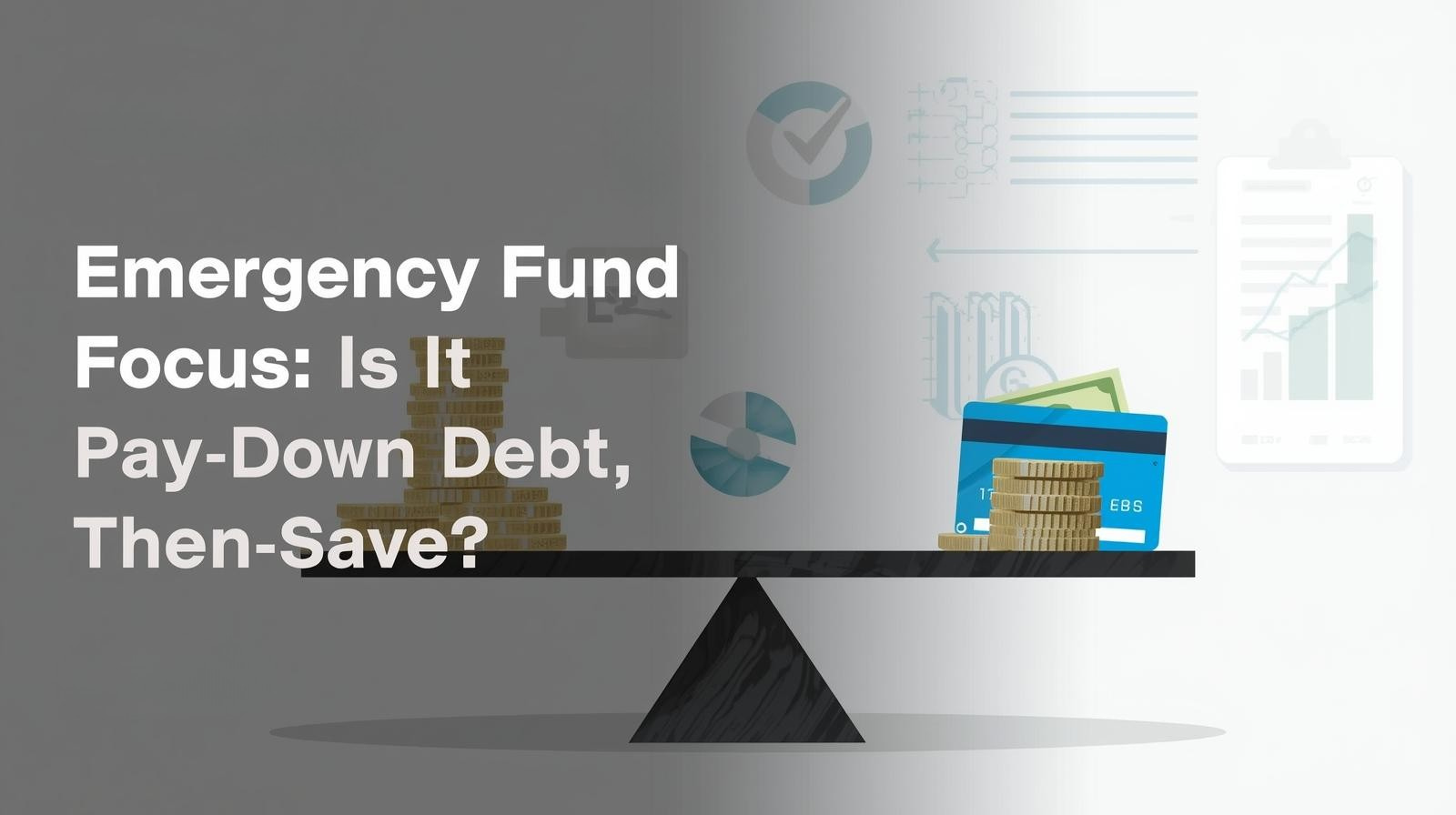
Emergency fund or debt—which should you prioritize when you finally have a little extra money left at the end of the month?
It sounds like a simple choice until you look at the tradeoff.
Put everything toward debt, and an unexpected car repair may go right back on the credit card. Put everything into savings, and high-interest debt keeps growing in the background.
For most people, the answer is not one or the other. It is finding the right order—and adjusting that order as your situation improves.
In this guide, we’ll walk through how to balance an emergency fund and debt without trying to solve everything at once.
The Short Answer: Build a Small Cushion, Then Attack Expensive Debt
If you have no emergency savings, start by building a small financial cushion while making the required minimum payment on every debt.
Once that starter fund is in place, direct most of your extra money toward high-interest debt. Continue adding a smaller amount to savings so the habit—and your protection—keeps growing.
After the high-interest debt is under control, shift more money toward building a complete emergency fund.
When balancing an emergency fund or debt, the general order looks like this:
- Stay current on essential bills and minimum debt payments.
- Build a starter emergency fund.
- Pay down high-interest debt aggressively.
- Continue making smaller contributions to emergency savings.
- Build your full emergency fund after expensive debt is controlled.
That is the basic framework. Your income, household responsibilities, insurance deductibles, and job stability will determine how quickly you move through it.
Emergency Fund or Debt: Why Paying Off Debt First Can Backfire
Let’s say someone has $4,000 in credit card debt and no savings.
They receive a $1,000 tax refund and put all of it toward the credit card. That feels productive—and it is. The balance drops to $3,000.
Two weeks later, the car needs an $850 repair.
Without emergency savings, that repair goes right back on the credit card. After interest and a few related expenses, the person may be almost exactly where they started.
The problem was not paying down debt. The problem was doing it without leaving any room for real life.
An emergency fund helps break that cycle. It gives you a place to get money when something goes wrong besides reaching for the credit card again.
The Consumer Financial Protection Bureau defines an emergency fund as cash reserved for unplanned expenses such as car repairs, home repairs, medical bills, or lost income. It does not have to be fully funded before it becomes useful.
Even a modest amount can keep a setback from becoming new debt.
Emergency Fund or Debt: Why Saving Everything Can Also Cost You
The other extreme is building a large savings balance while making only minimum payments on high-interest credit cards.
Having money in the bank feels secure. However, the numbers may be moving against you.
Suppose your savings account earns 4%, but your credit card charges 24%. Keeping thousands of extra dollars in savings while carrying that balance means you are earning a little interest on one side while paying considerably more on the other.
That does not mean draining your savings to zero. It means recognizing that high-interest debt is expensive and deserves priority once you have some protection in place.
The goal is not to choose between financial safety and debt reduction. It is to create enough safety that your debt-reduction progress has a chance to stick.
How Much Should Your Starter Emergency Fund Be?
You may have heard that everyone should start with exactly $1,000. It is a familiar target, but it is not a magic number.
For some households, $1,000 would cover a common emergency. For others, it would barely cover an insurance deductible.
A better starter goal is based on the expenses most likely to knock your spending plan off course.
Consider:
- Your health, auto, and homeowners insurance deductibles
- The likely cost of an essential car repair
- An urgent home or appliance repair
- One month of essential bills
- The stability of your household income
- Whether other people depend on your income
- Whether you have reliable transportation or backup support
Your starter emergency fund might be $500, $1,000, $1,500, or one month of essential expenses. Choose an amount that could prevent a realistic financial surprise from immediately going onto a credit card.
If you need help estimating a longer-term target, use the Emergency Fund Calculator.
Emergency Fund or Debt: A Simple Decision Guide
When deciding between an emergency fund or debt, your priorities should reflect the kind of debt you have and how financially exposed you are.
Prioritize a Starter Emergency Fund When:
- You currently have no emergency savings.
- Your income changes from month to month.
- Your job feels uncertain.
- You rely on an older vehicle for work.
- You have a high insurance deductible.
- You own a home with possible repair expenses.
- Other people depend on your income.
- A small unexpected expense would have to go on a credit card.
Continue making minimum debt payments, but direct most available extra money toward establishing your starter cushion.
Prioritize High-Interest Debt When:
- You already have a reasonable starter emergency fund.
- Your income is stable.
- Your credit cards carry high interest rates.
- Interest charges are making it difficult to reduce the balance.
- You are no longer regularly adding new charges.
- You have enough cash to cover a likely short-term setback.
In this situation, keep the starter fund intact and concentrate most of your extra money on the expensive debt.
Build More Savings Before Accelerating Debt When:
- A layoff or reduction in hours appears likely.
- You know an essential expense is approaching.
- You are preparing for unpaid leave.
- Your household relies on one income.
- You have a medical, home, or transportation expense that could create new debt.
- Your current emergency fund would not cover your most likely financial risk.
Personal finance is personal for a reason. A mathematically efficient plan is not very helpful if one ordinary setback can knock it over.
How to Divide Extra Money Between Savings and Debt
When dividing money between an emergency fund or debt, there is no universal percentage that works for everyone. However, starting with a simple split can help you move forward.
Imagine that you have $300 per month available after paying regular bills and all minimum debt payments.
Stage One: No Emergency Savings
You might temporarily divide the $300 this way:
- $225 toward a starter emergency fund
- $75 in additional debt payments
This allows you to build protection quickly without stopping debt progress entirely.
Stage Two: Starter Fund Established
Once you reach your starter target, you might reverse the split:
- $50 toward emergency savings
- $250 in additional payments on high-interest debt
Your emergency fund continues growing, but eliminating expensive debt becomes the main priority.
Stage Three: High-Interest Debt Paid Off
When the credit card balance is gone, redirect the money you were paying toward debt:
- $250 or more toward the full emergency fund
- The remaining amount toward another financial goal
These figures are examples, not rules. If your income is unpredictable or your household risk is higher, you may want a larger savings contribution. If you have stable income and extremely expensive debt, you may put more toward debt after establishing the starter fund.
Which Debt Should You Pay First?
After establishing a starter emergency fund, decide where your extra debt payment will have the most impact.
Two common approaches are:
The Debt Avalanche
With the debt avalanche, you pay minimums on everything and put your extra money toward the debt with the highest interest rate.
This method generally reduces the total amount of interest you pay.
The Debt Snowball
With the debt snowball, you pay minimums on everything and put your extra money toward the smallest balance.
You may pay more interest than you would with the avalanche method, but eliminating a small debt quickly can give you momentum.
Neither method works if you abandon it. Choose the one you are most likely to follow consistently.
Should You Use Savings to Pay Off Debt?
Sometimes—but do not automatically empty your emergency fund to pay a credit card.
Before using savings, ask:
- How much cash would remain?
- What expense is most likely to happen next?
- How stable is my income?
- Would I have to use the card again if something went wrong?
- How much interest would this payment save?
- Is the money truly emergency savings, or is part of it available for debt?
If paying off a balance would leave you with no financial cushion, consider keeping your starter fund and using only the amount above it.
For example, if your starter target is $1,500 and you have $2,300 saved, you might keep the $1,500 and apply the remaining $800 to high-interest debt.
The exact decision depends on your circumstances, but leaving yourself completely exposed can recreate the debt you just paid.
Don’t Overlook These Priorities
The emergency fund or debt question does not exist in isolation.
Before making extra payments, make sure you can cover:
- Housing
- Utilities
- Food
- Transportation
- Insurance
- Required minimum debt payments
- Essential medications and healthcare expenses
If your employer offers a retirement-plan match, consider contributing enough to receive the full match when your spending plan allows it. Otherwise, you may be giving up part of your compensation.
If you are behind on payments, facing collection activity, or struggling to cover necessities, your first step may be stabilizing the household rather than accelerating either savings or debt payoff.
Keep Emergency Savings Separate
Your emergency fund should be easy to reach but not so easy that it becomes part of everyday spending.
A separate savings account can create a useful boundary between emergency money and money available for groceries, entertainment, or routine bills.
You do not need to chase complicated investments with this money. Its job is to be available when you need it.
For a broader look at setting the goal and deciding what qualifies as an emergency, read Emergency Fund: Why It Matters and How to Build One.
What Counts as an Emergency?
An emergency is usually:
- Necessary
- Unexpected
- Urgent
A broken furnace during winter may qualify. A routine annual insurance premium does not—it is predictable and should be included in your spending plan or a sinking fund.
A medical deductible might qualify. A planned vacation does not.
Keeping this distinction clear protects your savings for the moments when you genuinely need it.
Review the Plan as Your Life Changes
Your answer to the emergency fund or debt question can change as your life changes.
You may need to temporarily emphasize savings when:
- Your employer announces layoffs.
- Your household moves from two incomes to one.
- A major home repair appears likely.
- Your car becomes less reliable.
- You are approaching retirement.
- A family member begins depending on you financially.
You can return to aggressive debt payments after the immediate risk passes.
Changing the allocation is not abandoning the plan. It is adapting the plan to real life.
Frequently Asked Questions
Should I pay off credit cards before building an emergency fund?
Usually, you should first establish a modest emergency cushion while making every required minimum payment. Then direct most extra money toward high-interest credit card debt while continuing smaller savings contributions.
Is $1,000 enough for an emergency fund?
It may be enough for a starter fund, but it is not the right target for everyone. Base your initial goal on likely emergencies, deductibles, household needs, and income stability.
Should I keep saving while paying off debt?
A small, automatic contribution can help your emergency fund continue growing while you concentrate on debt. The amount depends on your financial risks and the interest rate on your debt.
Can I use my emergency fund to pay off a credit card?
You can use savings above your starter emergency-fund target. Be cautious about draining the account completely because the next unexpected expense may send you back into debt.
What if I can only save a small amount?
Start with what fits. Twenty-five dollars saved is more useful than waiting for the month when you can suddenly save hundreds. A small automatic transfer helps turn saving into a regular money habit.
The Bottom Line
If paying down debt is your next step, see our guide to getting out of debt and staying out for good for a practical plan you can use alongside your emergency savings.
When deciding between an emergency fund or debt, you do not need to choose one goal and ignore the other.
Start with enough savings to protect yourself from a realistic setback. Then use most of your available extra money to reduce high-interest debt while allowing your emergency fund to keep growing.
Once the expensive debt is gone, redirect that payment toward building your full safety net.
The plan may not move both goals at the same speed, but both should move in the right direction. That is what makes the progress more likely to last.