
Not long ago, managing a budget usually meant choosing between a notebook, a spreadsheet, or one of the growing number of budgeting apps.
Today, there’s another option: artificial intelligence.
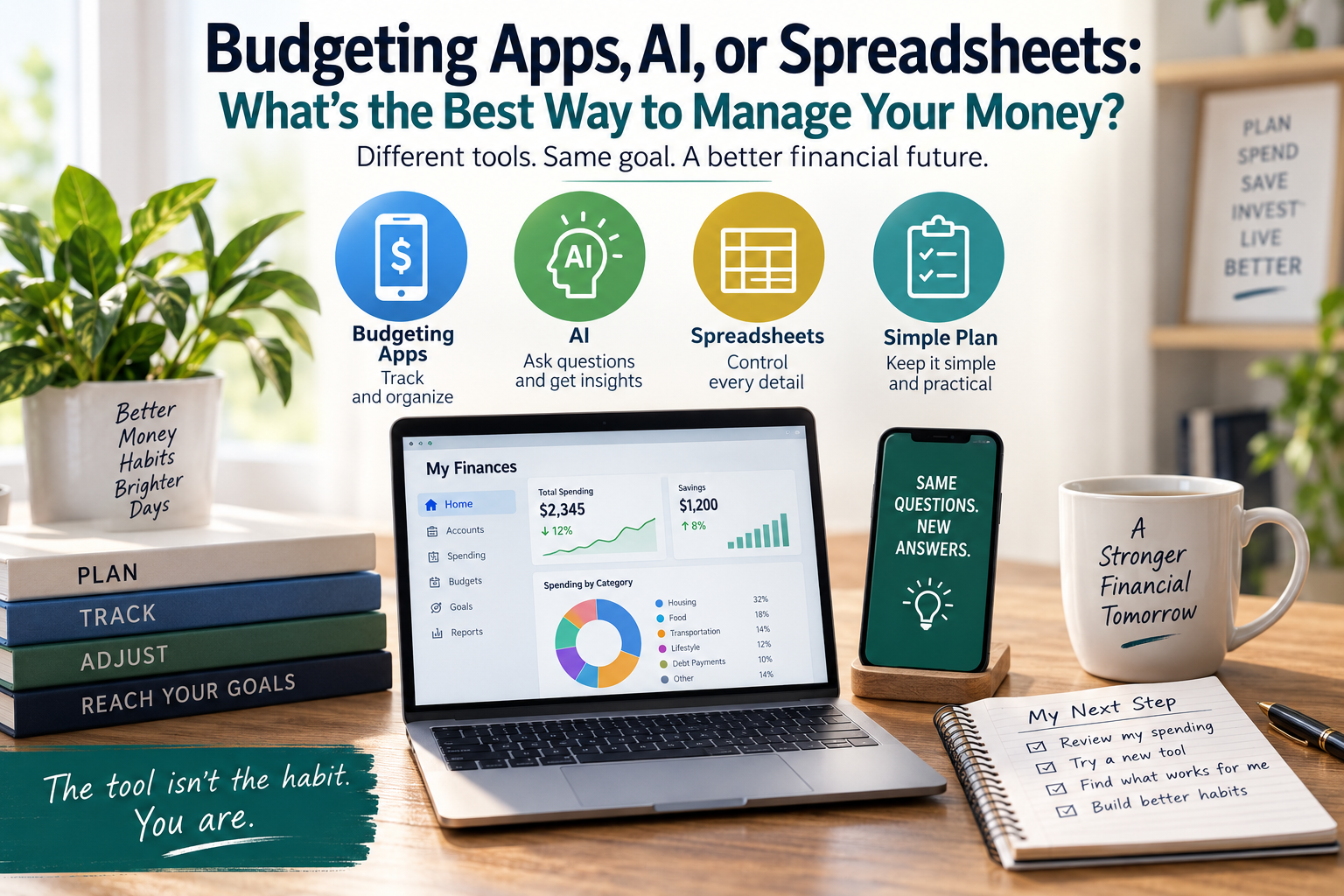
You can still use an app to categorize transactions and track spending. You can build your own spreadsheet and control every number yourself. Or you can use AI to help analyze spending, ask questions, explore different scenarios, and build a spending plan.
With all these choices, which one is best?
Maybe that’s the wrong question.
The better question might be:
Which one will you actually use?
Because the most sophisticated financial tool in the world won’t improve your finances if you stop using it after three weeks.
What Do You Really Need From a Budgeting Tool?
Before choosing budgeting apps, spreadsheets, or AI tools, think about what you’re actually trying to accomplish.
Do you want to know where your money is going?
Are you trying to stop overspending?
Do you need help planning your bills around your paychecks?
Are you trying to pay down debt?
Do you want to save more?
Or do you already have a decent handle on your finances and simply want an easier way to keep track of everything?
Those aren’t necessarily the same problem.
Someone who needs help controlling everyday spending may benefit from a very different tool than someone who simply wants a dashboard showing all their accounts.
That’s one reason I’m hesitant to call any particular budgeting app the “best.”
The best tool depends on what you need it to do.
Budgeting Apps: Good at Keeping Track of the Numbers
Budgeting apps remain a popular way to manage money because they can take much of the routine work out of tracking spending.
Depending on the app and the features you choose, you may be able to connect bank accounts and credit cards, automatically categorize transactions, set spending limits, monitor bills, establish savings goals, and see where your money went during the month.
Apps such as YNAB, Monarch Money, PocketGuard, and Goodbudget take different approaches, but they all aim to make managing your money easier.
If you don’t want to enter every transaction manually, that can be extremely useful.
But there’s a catch.
An app can tell you that you spent $640 dining out last month.
It can’t make you care.
You still have to decide whether $640 is reasonable for your situation and, if it isn’t, what you’ll do differently this month.
That’s where budgeting stops being about software and starts being about behavior.
AI Is Changing the Conversation
Artificial intelligence adds something different to personal finance.
Instead of simply looking at charts and categories, you can increasingly interact with financial information by asking questions.
You might ask:
“Where am I spending more than I realize?”
Or:
“Help me find $200 a month that I could put toward my credit card.”
Or:
“If I increase my retirement contribution by $100 a month, where could I adjust my spending?”
That makes AI potentially useful because most people don’t think about their finances in terms of charts and categories.
They think in questions.
Can I afford this?
Why am I always short before payday?
Should I pay this debt faster or save the money?
What happens if I retire two years earlier?
AI can help you think through those questions and explore different possibilities. For practical prompts, a budget example, and privacy precautions, see our guide to AI for personal finance.
Some budgeting apps are also adding their own AI features, so the line between a traditional budgeting app and an AI financial tool is already beginning to blur.
But AI has limitations too.
It can misunderstand information. It can make mistakes. And the quality of the answer depends heavily on the information you provide.
Privacy is also a concern.
Before connecting financial accounts or sharing detailed financial information with any service, understand what information you’re providing, how it will be used, and what security and privacy protections the service offers.
AI can be a useful financial assistant.
It shouldn’t become a substitute for your own judgment.
Don’t Count Out the Spreadsheet
With all this technology available, spreadsheets can seem a little old-fashioned.
I wouldn’t dismiss them.
For some people, a spreadsheet is still one of the best money-management tools available.
You decide exactly what you want to track. You aren’t limited to somebody else’s categories. You don’t have to learn a company’s budgeting philosophy. And you can make the system as simple or detailed as you want.
There can also be value in entering the numbers yourself.
Automatic tracking is convenient, but convenience sometimes makes spending almost invisible.
When you personally enter $87 for dinner, $52 for another meal out, and $34 for takeout, you may notice the pattern before a colorful chart tells you about it at the end of the month.
The downside is obvious.
Spreadsheets require work.
If you hate entering transactions and know you won’t keep doing it, then the theoretical advantages don’t matter very much.
Again, the best system is the one you’ll actually use.
You May Not Need Budgeting Apps at All
Another possibility often gets overlooked.
Maybe you don’t need another app.
If your finances aren’t especially complicated, a simple spending plan may be enough.
Start with the money coming in.
List what needs to go out.
Include savings and debt payments.
Leave room for the things you enjoy.
Then see whether the numbers work.
If you want some help putting those numbers together, the Budget Calculator on Money Habits can help you build a basic spending plan and see how your income and expenses fit together.
You don’t necessarily need graphs, alerts, artificial intelligence, or a monthly subscription to discover that you’re spending $400 more than you’re bringing in.
Sometimes the simplest tool gives you exactly the information you need.
The challenge is acting on that information.
So Which Approach Is Right for You?
There isn’t one answer, but there are some reasonable starting points.
Consider budgeting apps if: you want transactions tracked automatically, everything organized in one place, and help monitoring spending and goals.
Consider AI if: you want to ask questions about your finances, explore different choices, look for patterns, or work through “what if” situations.
Consider a spreadsheet if: you like having control over your numbers, want to customize how you track money, and don’t mind doing some of the work yourself.
Consider a simple spending plan if: you mainly need to understand what’s coming in, what’s going out, and what needs to change.
And you don’t have to choose only one.
You might use an app to track transactions, a spreadsheet for a specific goal, and AI when you want help thinking through a decision.
The tools can complement each other.
If you’re not sure where to begin, try the Money Checkup. It walks you through a few questions about where you are financially and can help point you toward a practical next step.
A Practical Checklist Before Choosing a Budgeting App
Test the features you actually need: a budgeting method you understand, categories you can adjust, clear transaction records, useful reports, and a way to export your data. If you share finances, check whether both people can use the account appropriately.
Account connections are optional, not a requirement for good budgeting. If you want them, check whether your institutions are supported and review the provider’s privacy, security, and account-access arrangements. Automatic imports can still need correction; check for missing, duplicated, or miscategorized transactions.
Before paying, check the current price, trial end date, renewal terms, cancellation process, and support options on the provider’s own website. Try a real task, such as reconciling a week of spending. A tool that looks impressive but takes more effort than you can maintain is unlikely to help.
Be Careful About Adding Another Subscription
There’s a little irony in paying for a budgeting tool you don’t use.
Before signing up for a paid service, ask yourself what you’re getting for the money.
Will automatic transaction tracking save you time?
Will the reports actually help you make decisions?
Will you use the planning features?
Or are you signing up because the app makes getting your finances under control feel easier than actually changing your habits?
Free trials can be useful, but give yourself a real test.
Use the tool.
If you’re still actively using it after several weeks and it is helping you make better decisions, the subscription may be worthwhile.
If you’ve stopped opening it, cancel it.
You don’t need a budgeting app sitting quietly in your list of monthly expenses reminding you that you were supposed to be budgeting.
Technology Can’t Make the Decision for You
This may be the most important part.
A budgeting app can identify your spending.
A spreadsheet can organize it.
AI can help analyze it.
None of them can make you change it.
Suppose every tool you use tells you that you’re spending more than you can afford.
Eventually, you have to decide what you’re going to do about it.
That’s the part of personal finance that technology can’t automate.
That’s also why constantly searching for a better tool can become a distraction.
You don’t necessarily need another app.
You may need a better habit.
The Tool Isn’t the Habit
People managed money before smartphones, spreadsheets, and artificial intelligence existed.
Some did it well. Some didn’t.
Technology has made financial information easier to collect, organize, and understand. AI may make it even easier to interact with that information.
That’s progress.
But knowing more about your money doesn’t automatically change what you do with it.
That’s also the idea behind The Habit Gap: understanding money matters, but lasting improvement comes from what you consistently do with that knowledge.
You can download one of the most popular budgeting apps and ignore it.
You can build the perfect spreadsheet and stop updating it.
You can ask AI exactly where your money is going and then keep spending the same way.
Or you can use a very simple system, pay attention to what it’s telling you, and gradually make better decisions.
The best budgeting tool isn’t necessarily the one with the most features.
It’s the one that helps you understand your money well enough to do something differently.
Because in the end, the tool isn’t the habit.
Using what you learn from it is.