
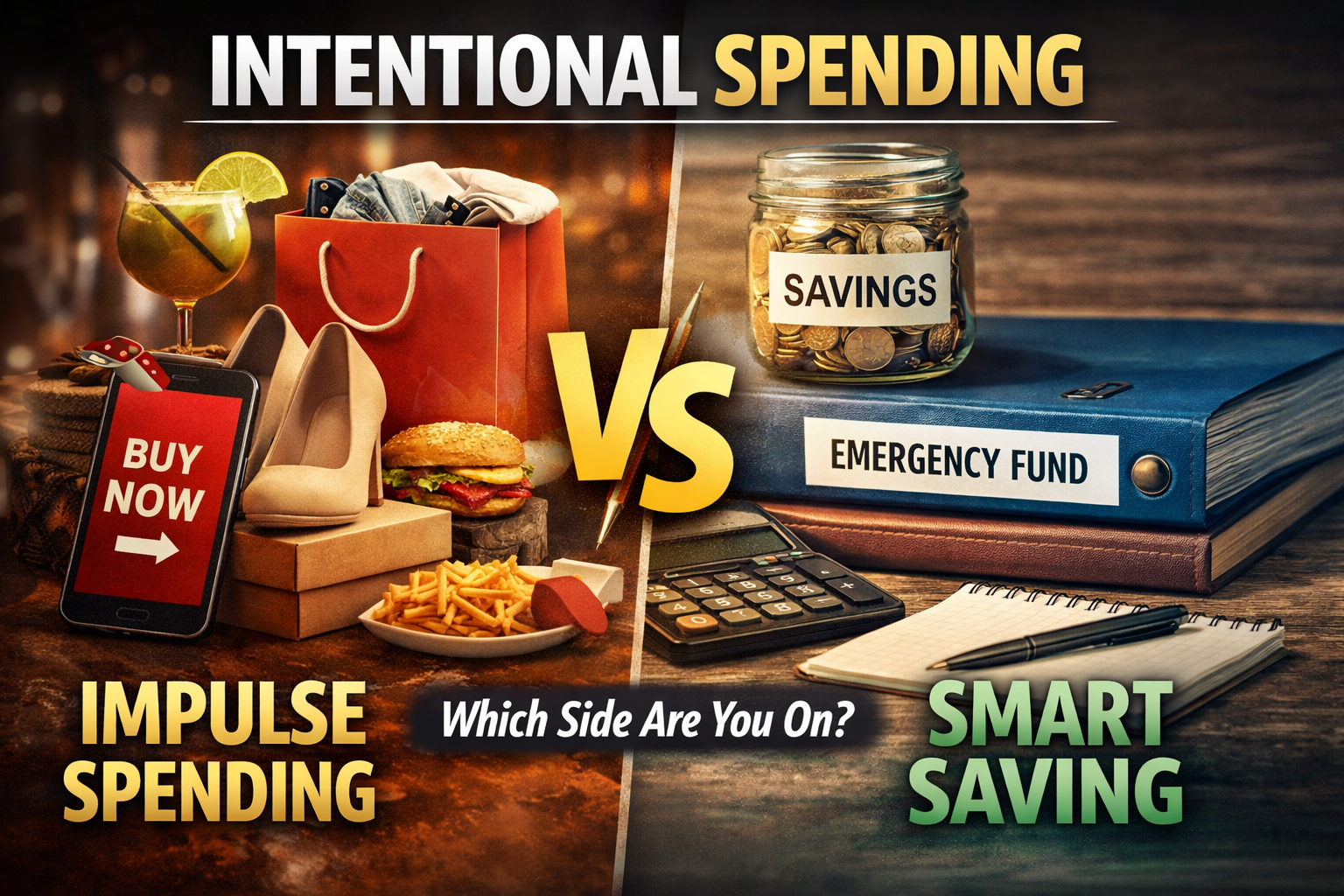
Have you ever bought something you genuinely enjoyed and then felt guilty about spending the money?
Now turn that around. Have you ever bought something you barely used and wondered later why you wanted it so badly?
The price may have been exactly the same. The difference was not necessarily whether the purchase was affordable. It was whether the spending matched what actually mattered to you.
That is the idea behind intentional spending. It is not about feeling guilty every time you buy something enjoyable. It is about spending deliberately so that your money supports your needs, priorities, and goals—instead of disappearing through a series of decisions you hardly remember making.
What Is Intentional Spending?
Intentional spending means deciding what deserves your money before convenience, habit, advertising, or impulse makes the decision for you.
The usual spending question is:
Can I afford this?
That is an important question, but it does not go far enough. A purchase can fit in your checking account today and still interfere with something more important tomorrow.
Intentional spending asks:
Is this how I want to use this money?
That small change moves the decision away from permission and toward purpose.
You are no longer asking only whether the money is available. You are asking whether the purchase is worth the tradeoff.
The Difference Between Affording Something and Choosing It
Suppose you have $75 available after paying your bills.
You could use it for:
- Dinner with someone you have not seen in months
- A shirt that caught your attention while browsing
- An additional credit-card payment
- Tickets to a local event
- Several takeout meals
- A contribution toward an upcoming vacation
You may be able to afford any one of those choices. You probably cannot choose all of them with the same $75.
That is where intentional spending becomes useful. It helps you recognize that spending money is not simply saying yes to one thing. It is also saying no—or at least “not yet”—to something else.
The goal is not to make the “financially responsible” choice every time. The goal is to make the choice knowingly.
Dinner with an old friend may be worth more to you than an additional $75 in savings that month. That is not financial failure. It is a deliberate decision based on what matters to you.
The problem begins when the $75 disappears through purchases you would not choose again.
Intentional Spending Is Not the Same as Frugality
Frugality generally focuses on using money and other resources carefully. It may involve comparing prices, avoiding waste, repairing items, or finding less expensive alternatives.
Intentional spending focuses on alignment.
A frugal shopper might buy the least expensive shoes that meet the need. An intentional shopper might spend more on a comfortable pair that will be worn several times a week.
Sometimes the frugal and intentional choices are the same. Sometimes they are not.
The cheapest option is not automatically the best use of your money. Neither is the most expensive option. The better choice is the one that delivers the value you actually want at a cost your budget can support.
Intentional Spending Is Not a No-Buy Challenge
A no-buy challenge temporarily limits selected purchases so you can interrupt habits, recognize triggers, and reset your spending.
Intentional spending is an ongoing practice.
You do not stop buying things. You become more selective about what earns a yes.
A no-buy challenge might help you discover that you shop online when you are bored. Intentional spending helps you decide what to do with that knowledge after the challenge ends.
The two approaches can work together, but they solve different problems.
Start With What Matters to You
It is difficult to spend according to your priorities if you have never named them.
Your list does not need to sound profound. It simply needs to be honest.
You may value:
- Time with family
- Travel
- A comfortable home
- Financial security
- Hobbies
- Convenience
- Education
- Health and fitness
- Helping other people
- Reducing debt
- Preparing for retirement
Two people with the same income may build completely different spending plans because they value different things.
Someone who enjoys cooking may spend more on groceries and very little on restaurants. Someone with a demanding schedule may gladly pay for occasional meal delivery because the convenience creates time and reduces stress.
Neither choice is automatically right or wrong.
A budget works better when it reflects the person living with it. If you are still building that foundation, start with How to Make a Budget That Actually Works for You.
Use This Four-Question Spending Test
You do not need to conduct a congressional hearing every time you buy toothpaste. Use this test for discretionary purchases that were not already included in your plan.
1. Do I genuinely want this?
Ask whether you want the item itself or the feeling surrounding it.
Are you buying because:
- You need it
- You expect to use it
- It supports something important to you
- You are bored
- You are stressed
- It is on sale
- Someone else has it
- You do not want to miss out
There is nothing wrong with buying something simply because you enjoy it. The point is to recognize the reason instead of dressing an impulse up as a necessity.
2. Will I actually use it?
Try to picture the purchase in your ordinary life—not the imaginary version of your life the advertisement is selling.
That home exercise equipment may be useful if you already exercise at home. It may become an expensive clothes rack if you are hoping the purchase will create an entirely new personality by Tuesday.
Ask:
- When will I use it?
- How often?
- Do I own something that already serves the same purpose?
- Where will I keep it?
- Have I bought something similar before?
A specific answer is usually a good sign. “Someday” deserves another look.
3. What am I giving up to buy it?
Every purchase has an opportunity cost: the other use of the money you are choosing not to make.
The tradeoff might be:
- Less money for another category
- A smaller savings transfer
- A longer credit-card payoff
- Less flexibility before payday
- Delaying another purchase
- Giving up nothing because the expense was already planned
This question is not meant to create guilt. It makes the full decision visible.
4. Would I still choose it tomorrow?
Urgency has a way of making ordinary purchases feel unusually important.
For an unplanned purchase, wait:
- 24 hours for a smaller expense
- Several days for a moderate expense
- A week or longer for a major purchase
You may still want it later. If so, you can buy it with more confidence.
If the desire disappears, you have saved money without feeling deprived. You did not deny yourself something important. You simply gave the impulse time to pass.
Planned Enjoyment Is Part of a Good Budget
Some budgets fail because they treat enjoyment as a problem that needs to be eliminated.
The plan covers housing, utilities, groceries, transportation, debt, and savings. Then it assumes the person following it will spend nothing on fun, convenience, celebrations, or ordinary life.
That may work beautifully—right up until Friday night.
Intentional spending gives enjoyable purchases a legitimate place in the budget. You might create room for:
- Dining out
- Entertainment
- Hobbies
- Travel
- Gifts
- Personal spending
- Small conveniences
Once the amount is planned, you do not need to feel guilty every time you use it.
Guilt does not make a budget more responsible. Clear limits do.
Spend the money on what you deliberately chose, enjoy it, and stop putting yourself on trial afterward.
Watch for Spending That Pretends to Be Intentional
We are surprisingly good at explaining purchases after we make them.
“I deserve it.”
“It was a bargain.”
“I’ll use it eventually.”
“It saves time.”
“Everyone needs one.”
Any of those statements could be true. They can also be convenient stories we tell ourselves after an impulse has already taken control.
Look for repeated patterns:
- Buying sale items that were never on your list
- Ordering takeout because deciding what to cook feels tiring
- Upgrading products that still work
- Shopping as entertainment
- Paying for convenience and then wasting the time it saved
- Keeping subscriptions because you may use them again
The individual purchase may not be the problem. The repeating pattern is what deserves attention.
The Consumer Credit Counselling Society offers another useful explanation of what it means to be intentional with spending.
Intentional Spending in Everyday Life
The idea becomes clearer when you apply it to real choices.
Dining Out
Unintentional spending: Ordering food several times because no dinner plan was made.
Intentional spending: Planning one meal out because you enjoy it and deciding what nights you will cook.
Convenience
Unintentional spending: Paying delivery fees out of habit without considering another option.
Intentional spending: Paying for delivery during an unusually busy week because the saved time genuinely helps.
Hobbies
Unintentional spending: Buying supplies for a new hobby before knowing whether you enjoy it.
Intentional spending: Borrowing, renting, or buying a basic version first and upgrading after the hobby becomes part of your life.
Travel
Unintentional spending: Booking a trip because the promotion says the deal ends tonight.
Intentional spending: Creating a vacation fund, comparing the full cost, and choosing a trip you can enjoy without bringing the debt home.
Family and Social Spending
Unintentional spending: Agreeing to every invitation because saying no feels uncomfortable.
Intentional spending: Choosing the events that matter most and using loud budgeting when something does not fit your priorities.
Track What You Regret—and What You Value
Traditional spending reviews focus on categories and totals. Those are important, but they do not tell the whole story.
During your weekly review, mark discretionary purchases as:
- Worth it
- Neutral
- Not worth it
After several weeks, look for patterns.
Maybe restaurant spending is higher than expected, but the meals were meaningful and fit your plan. You may decide that category deserves its place.
Perhaps several online purchases received a “not worth it” rating. That tells you where a waiting period, removed shopping app, or lower spending limit might help.
This approach makes tracking your spending more useful. You are not only discovering where the money went. You are learning which purchases improved your life and which ones merely occupied a moment.
Build Intentional Spending Into Your Budget
Once you know what matters, reflect it in your spending plan.
Try this:
- Cover essential obligations.
- Include savings and debt goals.
- Choose a realistic amount for flexible spending.
- Give important priorities their own categories.
- Reduce categories that repeatedly feel unimportant.
- Automate the priorities that should happen first.
- Review and adjust the plan each month.
You can use budget autopilot to move money toward savings and planned expenses before routine spending absorbs it.
The purpose is not to control every dollar so tightly that life becomes miserable. It is to make sure your best intentions have some protection.
What If Income Really Is the Problem?
Sometimes careful spending cannot solve the entire problem.
If essential expenses consume nearly all your income, the issue may not be thoughtless spending. The numbers may genuinely be too tight.
Intentional spending can still help you protect priorities and avoid unnecessary pressure, but it cannot manufacture money that is not there.
You may need to explore:
- Reducing or negotiating major bills
- Applying for available assistance
- Adjusting debt payments
- Increasing income where practical
- Making larger housing or transportation decisions
- Getting help before accounts become seriously overdue
That is not a personal failure. A spending habit and an income shortage are different problems, and they require different solutions.
A Simple Weekly Intentional-Spending Review
Set aside ten minutes once a week and ask:
- What did I buy that was worth it?
- What did I buy that I would not choose again?
- Did any purchase interfere with something more important?
- What triggered my unplanned spending?
- Is there one adjustment I want to make next week?
Do not use the review to scold yourself. Use it to collect information.
A budget improves when you learn from what actually happened rather than repeatedly promising to become a completely different person next month.
The Bottom Line
Intentional spending is not about buying less simply for the sake of buying less. It is about spending with enough awareness that your money reflects what matters to you.
Sometimes the intentional choice will be saving.
Sometimes it will be paying down debt.
Sometimes it will be buying concert tickets, taking your family to dinner, or paying for a convenience that makes a difficult week easier.
The question is not whether every purchase looks financially perfect to someone else.
The question is whether you understand the tradeoff and would willingly make the same choice again.
Before your next unplanned purchase, pause and ask:
Do I truly want this, will I use it, what am I giving up, and would I still choose it tomorrow?
That short pause can turn spending from something that happens to you into something you decide.