
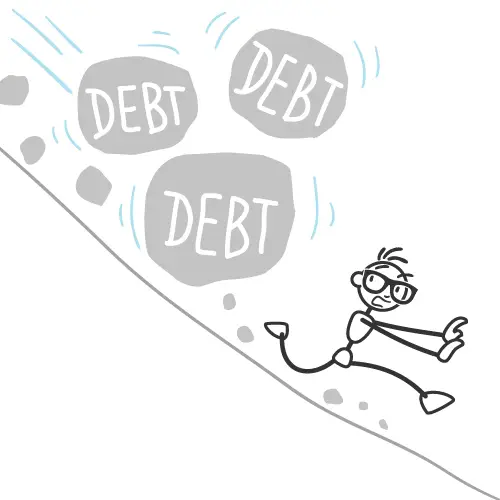
Debt snowball vs. avalanche sounds like a choice between two bad weather forecasts. Fortunately, both are simply ways to decide which debt you pay first with your extra payment.
The debt snowball starts with your smallest balance. The debt avalanche starts with your highest interest rate.
One method may give you a faster emotional win. The other will generally save more money. The right choice depends on more than mathematics because a repayment plan only works if you can stick with it.
Let’s look at how each method works, compare them using the same debts, and help you decide which approach fits you best.

Start With the Part Both Methods Share
Before debating debt snowball vs. avalanche, you need three things:
- A list of every debt
- Enough income to cover the minimum payments
- A consistent amount available for extra payments
For each debt, write down the current balance, interest rate, minimum payment, and payment due date.
Continue making the minimum payment on every debt. Then direct all your extra repayment money toward one target debt.
Once you pay off that debt, its payment rolls into the next debt. Your total monthly debt payment stays the same, but more money reaches the account you are targeting.
If you can’t cover your minimum payments, choosing between the snowball and avalanche methods isn’t the immediate problem. Contact your creditors and ask about hardship options before you miss payments.
For a complete debt-repayment foundation, start with How to Get Out of Debt and Stay Out for Good.
How the Debt Snowball Method Works
The debt snowball method orders your debts from the smallest balance to the largest. Interest rates do not determine the order.
- Make the minimum payment on every debt.
- Send all extra repayment money to the smallest balance.
- Pay off that debt completely.
- Add its old payment to the amount going toward the next-smallest debt.
- Continue until every balance is paid.
Why call it a snowball?
Imagine rolling a small snowball across the ground. It becomes larger as it picks up more snow. Your debt payment works the same way. Every account you eliminate frees up another payment that you can add to the next debt.
The Main Advantage of the Debt Snowball
The snowball can provide a relatively quick victory.
Eliminating an account gives you:
- One fewer bill
- One fewer due date
- One less minimum payment
- Visible evidence that your plan is working
Don’t dismiss that psychological boost. Debt repayment can take years, and progress is difficult to feel when every account remains open.
The Main Disadvantage of the Debt Snowball
The smallest balance may not be your most expensive debt.
While you focus on a small lower-rate balance, a larger credit card with a high interest rate may continue accumulating substantial interest. That can increase the total cost and possibly extend your payoff schedule.
How the Debt Avalanche Method Works
The debt avalanche method ranks your debts from the highest interest rate to the lowest. Balances do not determine the order.
- Make the minimum payment on every debt.
- Send all extra repayment money to the debt with the highest interest rate.
- Pay off that debt completely.
- Move to the debt with the next-highest interest rate.
- Continue until every balance is paid.
The avalanche attacks the debt costing you the most money.
The Main Advantage of the Debt Avalanche
The avalanche generally minimizes the interest you pay compared with other repayment orders using the same monthly payment.
This method can make particular sense when you have:
- High-interest credit card debt
- A large difference between your highest and lowest rates
- Enough motivation to continue without an early payoff
- A strong preference for reducing the mathematical cost
The Main Disadvantage of the Debt Avalanche
Your highest-interest debt could also have a large balance.
You might make progress for months without completely eliminating an account. The numbers are improving, but it may not feel like much has changed.
That is where a mathematically efficient plan can run into a very human problem: motivation.
Debt Snowball vs. Avalanche Using the Same Debts
Let’s compare the methods with three hypothetical debts:
| Debt | Balance | Interest Rate | Minimum Payment |
|---|---|---|---|
| Store card | $1,800 | 18% | $60 |
| Credit card | $6,500 | 27% | $200 |
| Personal loan | $9,200 | 10.5% | $240 |
| Total | $17,500 | — | $500 |
The minimum payments total $500. We will assume the borrower can add another $300 each month, creating a total debt-payment budget of $800.
The borrower does not add new debt, interest rates remain unchanged, and every payment freed by eliminating an account is redirected toward the next target.
These are simplified estimates. Actual results will vary based on how each lender calculates interest, payment timing, fees, and changing minimum payments.
Payoff Order Using the Debt Snowball
The snowball orders the accounts by balance:
| Payoff Order | Debt | Starting Balance | Interest Rate |
|---|---|---|---|
| 1 | Store card | $1,800 | 18% |
| 2 | Credit card | $6,500 | 27% |
| 3 | Personal loan | $9,200 | 10.5% |
Under this example, the store card is eliminated in approximately six months. That gives the borrower an early victory and frees its monthly payment for the next debt.
Payoff Order Using the Debt Avalanche
The avalanche orders the accounts by interest rate:
| Payoff Order | Debt | Starting Balance | Interest Rate |
|---|---|---|---|
| 1 | Credit card | $6,500 | 27% |
| 2 | Store card | $1,800 | 18% |
| 3 | Personal loan | $9,200 | 10.5% |
The borrower waits longer to eliminate the first account, but immediately attacks the most expensive interest rate.
Estimated Results Side by Side
| Comparison | Debt Snowball | Debt Avalanche |
|---|---|---|
| First debt eliminated | Approximately month 6 | Approximately month 16 |
| All debts paid | Approximately 27 months | Approximately 26 months |
| Estimated interest paid | About $3,320 | About $3,125 |
| Main advantage | Faster first victory | Lower estimated interest |
In this example, the avalanche pays everything off about one month sooner and saves approximately $195 in interest. The snowball eliminates the first account about ten months sooner.
That is the real debt snowball vs. avalanche decision. Are the additional savings worth waiting longer for your first payoff, or would an early victory make you more likely to keep going?
The Mathematically Best Method Is Not Always the Practical Winner
If every borrower followed every repayment plan perfectly, the avalanche would usually win.
People are not spreadsheets, however.
Someone who starts with the avalanche but stops making extra payments after six months may accomplish less than someone who follows the snowball for the full 27 months.
The best plan is not merely the one that looks best on the first day. It is the one you can stick with through an expensive car repair, a difficult month, or the point when the initial excitement wears off.
This does not mean the numbers are unimportant. It means behavior is part of the calculation.
The Consumer Financial Protection Bureau’s reducing-debt worksheet recognizes both the highest-interest-rate method and the snowball method. Each has a legitimate tradeoff.
When the Debt Snowball May Work Better
Consider the snowball if:
- You have several small balances you can eliminate quickly.
- Managing many monthly payments feels overwhelming.
- You have struggled to stay with previous repayment plans.
- Visible progress helps you remain motivated.
- The interest rates on your debts are relatively close.
The snowball can also simplify your finances quickly. Paying off two or three small accounts reduces the number of payments you must track every month.
When the Debt Avalanche May Work Better
Consider the avalanche if:
- One or more debts have especially high interest rates.
- The difference between your interest rates is substantial.
- You are comfortable waiting longer for the first payoff.
- Saving the most interest is your main priority.
- You are disciplined about following a long-term plan.
The avalanche becomes especially valuable when an expensive credit card balance would otherwise remain open for years.
What About a Hybrid Method?
You do not have to treat debt snowball vs. avalanche as an all-or-nothing decision.
A hybrid approach might begin by eliminating one small balance for a quick win. After that, you could switch to the highest-interest debt.
Using our example, the hybrid order would look like this:
| Payoff Order | Debt | Reason |
|---|---|---|
| 1 | Store card | Creates an early victory |
| 2 | Credit card | Targets the highest interest rate |
| 3 | Personal loan | Finishes with the remaining debt |
This approach may not produce the absolute lowest interest cost, but it provides an early victory while still addressing the most expensive debt relatively quickly.
There is no prize for following a method with perfect purity. The purpose is to create a repayment order that keeps you moving.
When You Should Change Methods
Your first choice does not have to be permanent.
Consider switching when:
- You are losing motivation.
- A promotional interest rate expires.
- A variable rate increases.
- One balance becomes small enough to eliminate quickly.
- Your income or required expenses change.
- A creditor changes your payment terms.
- You receive money that could alter the payoff order.
Changing methods is not failure. Continuing to use a plan that no longer works just because you chose it months ago makes less sense.
Before switching, compare the new order using your current balances—not the amounts you originally owed.
Mistakes That Can Undermine Either Method
Adding New Balances
Paying extra while charging the same amount back to the accounts doesn’t move you forward.
If possible, stop using the accounts you are paying down. Build a small emergency cushion so an unexpected expense doesn’t immediately go back to a credit card.
Skipping Other Minimum Payments
Your extra payment should go to one target debt, but every other account still requires its minimum payment.
Missing those payments can lead to fees, credit damage, higher rates, or collection activity.
Using an Unrealistic Monthly Amount
A plan that leaves nothing for irregular expenses may collapse the first time something goes wrong.
Choose an extra payment you can make consistently. You can always add more during a good month.
Failing to Roll Payments Forward
When you pay off an account, don’t let its old payment disappear into everyday spending.
Move that entire payment to the next debt. That rollover is what creates momentum under both methods.
Ignoring the Interest Rates Completely
Even if you choose the snowball, continue monitoring your rates. A major rate increase or expiring promotional offer may justify changing the order.
How to Choose Between Debt Snowball and Avalanche
Ask yourself:
- Do I need an early victory to remain motivated?
- How different are my interest rates?
- How long will it take to eliminate the first debt under each method?
- Have I abandoned repayment plans before?
- Would fewer monthly accounts reduce my stress?
- How much interest would the avalanche actually save?
- Which payment order feels sustainable for the next year?
Don’t assume the avalanche will save thousands or that the snowball will transform your motivation. Run your own numbers.
Use the Debt Payoff Calculator to switch between the snowball and avalanche methods and compare your estimated payoff order, interest, and debt-free date.
Frequently Asked Questions
Is the debt avalanche always faster?
Not necessarily. It generally reduces interest, but the final payoff date depends on your balances, rates, minimum payments, and monthly payment amount. With some debt combinations, both methods may finish at nearly the same time.
Does the debt snowball hurt your credit?
The repayment order itself does not harm your credit. Continue making every required payment on time. Credit scores can also be affected by balances, credit utilization, account age, new applications, and other factors.
Should I include my mortgage in the snowball or avalanche?
Many people use these methods primarily for consumer debt such as credit cards, personal loans, medical debt, and auto loans. A mortgage is usually handled separately because of its size, term, rate, and connection to your housing.
What if my smallest debt also has the highest interest rate?
Then both methods begin with the same debt. After paying it off, compare the remaining accounts again. The methods may produce different orders later.
Can I use the methods in a debt management plan?
If you are enrolled in a formal debt management plan, follow the payment arrangement established with the counseling agency. Ask before sending extra payments because creditors and program rules may determine how those payments are handled.
The Best Method Is the One You Will Finish
The debt avalanche generally wins the mathematical comparison because it targets expensive interest first.
The debt snowball may win the behavioral comparison because it can provide faster visible progress.
A hybrid can give you some of both.
Choose a method, automate the minimum payments, direct every extra dollar toward the target debt, and track your balances each month. If the plan stops working, adjust it rather than abandoning the goal.
The decision between debt snowball vs. avalanche matters. But the bigger decision is committing to a consistent payment and continuing until the final balance reaches zero.