
A credit card interest cap sounds welcome when you make payments every month and the balance barely moves. Following an election, promises of lower borrowing costs can offer something many households could use: a little breathing room. But before building next month’s budget around a headline, it helps to understand what has been proposed, what would need to happen, and what a lower rate could actually accomplish.
High interest makes debt harder to repay. Reducing that cost could make a meaningful difference. The practical question is how to respond today while lawmakers debate what might happen tomorrow.
What Is a Credit Card Interest Cap?
A credit card interest cap sets a maximum rate that lenders may charge on covered card borrowing. The annual percentage rate, or APR, expresses the borrowing rate annually. A cap would limit that rate according to the terms of the law that creates it.
That last detail matters. A proposal might be temporary, apply to specific transactions, include rules about fees, or take effect months after passage. The headline percentage is only one part of the story. Cardholders would need to understand which accounts and balances are covered and when any change begins.
Real bills back the discussion. Senator Bernie Sanders and Senator Josh Hawley introduced the 10 Percent Credit Card Interest Rate Cap Act, S. 381, in February 2025. A House counterpart, H.R. 1944, was introduced by Representative Alexandria Ocasio-Cortez with Representative Anna Paulina Luna in March 2025.
The introduced Senate text proposes a 10% limit, inclusive of finance charges; includes provisions intended to prevent evasion through other fees; and includes a January 1, 2031 sunset. Those are features of the introduced bill, not a description of a benefit readers should assume is already available. Other public calls for a credit card interest cap may describe a different duration or approach.
Credit Card Interest Cap Promises and Your Statement.
An election can change priorities, committee leadership, and the chances that an idea receives attention. It does not, by itself, change the interest rate on your credit card. Individual lawmakers can support a proposal without Congress agreeing to the final legislation.
The official bill records linked above identify introduced legislation and committee referrals. Don’t treat those records as evidence of an enacted nationwide cap. Until an applicable law takes effect or your issuer changes your terms, the rate and payment obligations on your account remain the figures to plan around.
Several questions are worth asking when the next headline appears. Has legislation passed both chambers? Has it become law? When would it take effect? Does it cover existing balances? How does it address fees? These details determine whether a political announcement becomes a change in your household finances.
Editorial note: Legislative developments can change quickly. Verify the latest actions and any effective dates immediately before publication. The proposal details above refer to the introduced 2025 bill texts reviewed for this draft.
What a Credit Card Interest Cap Could Save
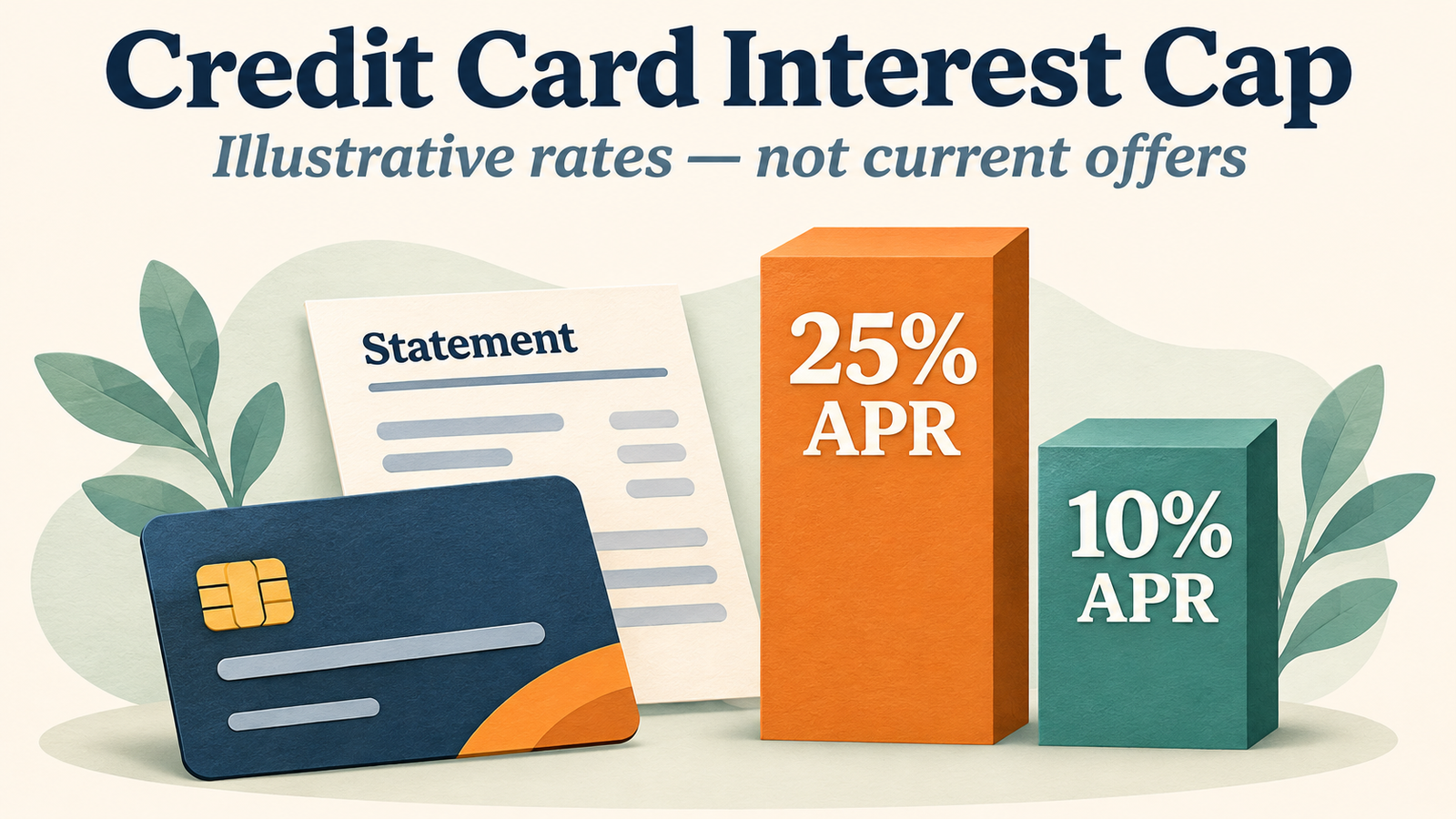
Consider a hypothetical $5,000 balance. To illustrate the difference, multiply that balance by the annual rate and divide by 12. This gives a rough monthly interest estimate, assuming the balance stays constant for the comparison.
| Illustrative APR | Approximate interest for one month |
|---|---|
| 25% | $104.17 |
| 10% | $41.67 |
| Difference | $62.50 |
That is meaningful money. If a household continued making the same payment, a lower interest charge could allow more of it to reduce the balance. Someone who has watched interest consume much of a payment would have good reason to welcome that relief.
This is an illustration, not a statement of calculation or payoff forecast. Actual charges depend on the issuer’s calculation method, daily balances, billing-cycle length, transaction types, payments, and applicable account terms. The 25% rate is an example, not a claim about the current national average.
Lower Interest Still Leaves a Balance to Repay
A lower APR reduces the cost of carrying debt. It does not erase the purchases already charged. A $5,000 balance still needs to be repaid, and new purchases can keep erasing progress through payments.
Imagine that a lower rate frees up part of your monthly payment. Keeping that payment steady could help you move forward faster, as long as it remains affordable after essential expenses. Reducing the payment and adding new charges could keep you in debt much longer than expected. Relief works best when it supports a repayment plan.
For a broader approach to reviewing balances, protecting essential expenses, and choosing a manageable repayment method, read How to Get Out of Debt and Stay Out for Good. A rate change would be one useful input into that plan. Your income, expenses, and ability to avoid new debt would still matter.
What Remains Uncertain About a Cap
The debate also involves how lenders might respond. A tighter limit on interest could affect decisions about approvals, credit limits, account pricing, or rewards. The extent of any response would depend on the final law, enforcement, competition, and each lender’s business decisions.
These are possible effects, not guaranteed outcomes. It would be misleading to promise that every borrower would retain identical access to credit at a lower price. It would be equally misleading to insist that a cap must cause every lender to close accounts or eliminate rewards. Readers deserve a clear separation between the bill’s actual provisions and predictions about what companies might do.
Fees deserve particular attention. The introduced Senate bill includes restrictions intended to prevent lenders from using certain fees to evade the limit. That means we should read the text before assuming that a lender could simply replace all lost interest revenue with unrestricted new charges.
What You Can Do While Lawmakers Debate
Start with your latest statement. Write down the balance, purchase APR, minimum payment, due date, and any promotional-rate expiration. If the account has different rates for purchases, transfers, or cash advances, record those separately. This gives you a usable starting point for any decision about repayment or a new offer.
If payments are becoming difficult, contact the issuer and ask what assistance is available. Ask whether a hardship arrangement could change the interest rate or required payment, how long the arrangement would last, and what it would mean for use of the account. Request the terms in writing before relying on them. Assistance varies, and a request does not guarantee approval.
The Consumer Financial Protection Bureau recommends contacting your card company promptly when you cannot pay. Explain what you can afford and how long you expect the difficulty to continue. The agency also points consumers to credit counseling when they need additional help; ask about services and fees before enrolling.
Be careful with advertisements promising immediate access to a government debt program or a guaranteed new rate. A reference to a proposal does not establish that you qualify for anything. Check the program, the company, and the written terms rather than letting a political headline do the selling.
Give Any Future Relief a Purpose
If a credit card interest cap eventually applies to your account, review the first affected statement carefully. Confirm the new rate, the interest charge, any account changes, and the required payment. Then decide how to use the breathing room based on your household’s actual needs.
For one household, that may mean keeping an affordable payment steady to reduce debt faster. For another, it may mean restoring room for groceries, medication, or overdue essential bills. The right use of relief depends on whether the immediate problem is slow repayment or a household budget that cannot cover necessities.
For now, take one practical step: find the APR on your statement and identify how much interest you were charged last month. That number gives you a concrete starting point, no matter what happens in Washington. What would a lower rate help you accomplish first?