
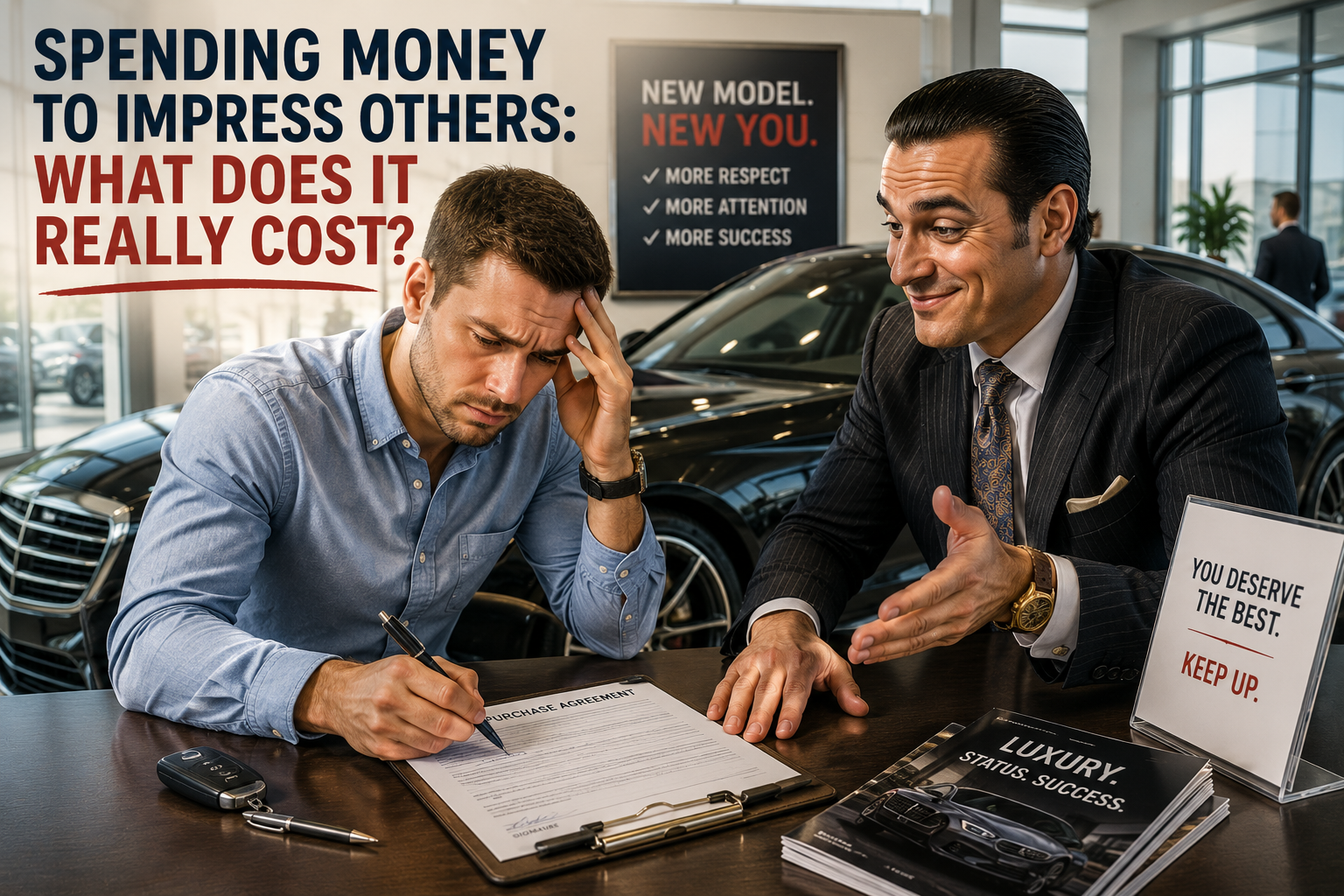
Have you ever bought something partly because you imagined what other people would think when they saw it?
Most of us probably have. Maybe it was a nicer car than you really needed. A more expensive vacation. Designer clothes. The newest phone. A bigger house. Or something much smaller that simply made you feel like you were keeping up.
There’s nothing inherently wrong with owning nice things. The problem starts when spending money to impress others becomes more important than what you want or can comfortably afford. That’s when a purchase ends up costing considerably more than the number on the price tag.
Would You Still Buy It If Nobody Knew?
Here’s a simple question worth asking before an expensive purchase: would I still buy this if nobody else ever knew I owned it?
Suppose you’re considering a new car. You love the car. You can afford the payment without sacrificing savings or other financial goals. You’ve researched it, and driving it would genuinely make you happy. Great.
Now consider a different situation. Your current car works perfectly well, but a coworker just bought something nicer. The neighbor has upgraded. Your friends seem to be driving newer vehicles. Suddenly your perfectly good car doesn’t feel quite as good.
The car didn’t change. Your comparison did. That’s worth noticing.
How Spending Money to Impress Others Sneaks In
When we think about spending money to impress people, we might picture someone buying an exotic sports car or walking around covered in designer labels. Usually, it’s subtler than that.
Status spending can sound like “someone in my position should drive a nicer car,” or “everyone is remodeling their kitchen,” or “we can’t be the only family that doesn’t take a big vacation this year,” or “my phone is three years old,” or “we need a bigger house.” Notice how often the language involves should, everyone, or need.
Sometimes those statements reflect genuine needs. Other times they’re expectations picked up from the people around us, advertising, social media, or our own assumptions about what success is supposed to look like.
Social Media Gave Us Millions of New Neighbors
Keeping up with the Joneses isn’t new — researchers have studied how income inequality and visible consumption drive borrowing for years. What’s different now is the size of the neighborhood.
You no longer compare yourself only with friends, relatives, coworkers, and the people living down the street. Your comparison group can include thousands of people you’ve never met. Scroll for a few minutes, and you’ll see new houses, cars, restaurants, vacations, clothes, gadgets, home renovations, and celebrations.
What you generally won’t see is the financing. The photo of the new SUV doesn’t show the monthly payment. The vacation pictures don’t show the credit card statement. The remodeled kitchen doesn’t tell you whether it was paid for with cash, financed for years, or comfortably affordable. You’re seeing the purchase. You’re not seeing the financial circumstances behind it. Trying to match someone else’s visible lifestyle without knowing their invisible finances is a pretty difficult game to win.
The Real Cost of Spending Money to Impress Others
Suppose you take on an additional $500 monthly expense largely because you want a lifestyle upgrade. That’s $6,000 a year. Over five years, you’ve committed $30,000 before even considering interest, investment growth you might have earned, or other costs tied to the purchase.
That’s not automatically a bad decision. Maybe that $500 buys something you genuinely value, and you’ve deliberately chosen to spend it there. But $500 a month could also have gone toward building an emergency fund, paying down high-interest debt, increasing retirement contributions, saving for a home, funding travel you actually care about, helping family, or simply creating more financial breathing room.
That’s the real tradeoff. Every dollar can only be used once. When you’re spending money to impress someone else, you’re giving up the chance to use that same money on something that may matter a lot more to you.
Financing Can Make Spending Money to Impress Even More Expensive
Credit makes it easy to separate the pleasure of buying something from the pain of paying for it. Instead of asking, “Do I want to spend $45,000 on this?” we start asking, “Can I handle the monthly payment?” Those aren’t the same question.
A payment can make an expensive purchase feel manageable while committing future income for months or years. Credit cards can make the problem worse when you carry a balance and interest adds to the cost. For national borrowing trends, see the Federal Reserve Bank of New York’s Household Debt and Credit Report. Your own balance, interest rate, and repayment plan are the numbers to check before adding another purchase.
The item may have impressed somebody for five minutes. The payments can stick around considerably longer. Before financing a lifestyle purchase, look at the total cost, not simply whether the monthly payment fits.
A Raise Doesn’t Require a Lifestyle Upgrade
One of the easiest times for status spending to creep into your finances is right after an income increase. You get promoted. You receive a substantial raise. And somewhere in the back of your mind comes the thought: “I make good money now. I should have something to show for it.”
There’s nothing wrong with enjoying some of your success. The trouble starts when every increase in income automatically raises your lifestyle. A larger paycheck becomes a larger car payment. Then a larger house. Then more expensive vacations. Then more expensive everything. Eventually, you’re earning much more but don’t feel any more financially secure.
This connects directly with What Does Enough Money Look Like for You? More income gives you more choices. It doesn’t require you to prove anything to anybody.

Buying Nice Things Isn’t the Problem
This distinction matters. Personal finance sometimes makes it sound as though the goal is to spend as little as humanly possible. That’s not much of a life.
If you’ve always wanted a particular car, you’ve planned for it, you can comfortably afford it, and owning it brings you genuine enjoyment, buy the car. If travel is one of the things you value most, spend money traveling. If you love your home and want to improve it, that’s a perfectly reasonable use of money.
The question isn’t “is this purchase expensive?” It’s “why am I buying it, and what am I giving up to have it?” That’s a much better financial test.
Check the Numbers Before You Check the Neighbors
Feelings matter when you spend money, but numbers have an annoying habit of sticking around after the excitement wears off.
Before taking on a substantial new expense, put it into your actual spending plan. What happens to your monthly surplus? Can you still save? Can you continue contributing toward retirement? Can you handle an unexpected expense? Will you need to carry credit card debt? Are you giving up something more important?
Our Budget/Spending Plan Calculator can help you see your income, needs, wants, savings, and monthly surplus or shortfall in one place. A purchase can look very different once you see what it does to the rest of your financial picture.
Give Yourself a Pause Before Buying
Status purchases often depend on emotion. You see something. You imagine owning it. You picture how you’ll feel, or how other people might react. And you want it now.
For larger discretionary purchases, create some distance between the feeling and the decision. Wait a day. For something particularly expensive, wait longer. Then ask yourself whether you’d still buy it if nobody else saw it, whether you genuinely want it, whether you can comfortably afford the total cost, what financial goal will get less money because of it, and whether you’ll still be happy with the decision six months from now.
You’re not trying to talk yourself out of every purchase. You’re giving yourself enough time to figure out whose decision you’re actually making.
Knowing Better Doesn’t Always Mean Doing Better
Most people understand that buying things they can’t afford to impress other people isn’t a great financial strategy. Yet people still do it. That’s because financial knowledge and financial behavior aren’t the same thing. We make decisions based on emotion, habit, convenience, comparison, and social pressure, not just math.
That’s part of what I explore in the Habit Gap — the distance between knowing what makes financial sense and consistently putting that knowledge into practice. Closing that gap usually doesn’t require knowing another hundred financial facts. It requires building habits that make the better decision easier to repeat. A simple waiting period before major purchases can be one of those habits.
Spend for Your Life, Not Someone Else’s
There’s nothing wrong with wanting more. There’s nothing wrong with enjoying your money. And there’s certainly nothing wrong with buying something nice simply because you like it.
But spending money to impress others is an expensive way to seek approval. The person you’re trying to impress may notice your purchase for a moment. You’re the one who lives with the payment.
So before the next big purchase, try that one question again: would I still buy this if nobody else ever knew I owned it? If the answer is yes, and the numbers work, you’ve probably learned something useful about what you genuinely value. If the answer is no, you’ve learned something even more valuable. Keep the money for something that actually matters to you.
To turn your next step into a routine you can repeat, read Money Habits: Small Changes That Can Transform Your Life.