

Living paycheck to paycheck can feel like running on a treadmill that never shuts off. You get paid. The bills get paid. Groceries, gas, utilities, insurance, debt payments, and everything else take their share. Then you look at what’s left and wonder how you’re supposed to save anything.
Sometimes there isn’t much left. And if that sounds familiar, you’re in good company. According to the Federal Reserve’s most recent Report on the Economic Well-Being of U.S. Households, 37% of adults couldn’t cover a surprise $400 expense with cash or its equivalent. That’s not a personal failing. That’s a lot of households running the exact same treadmill.
So the answer isn’t another lecture telling you to stop buying coffee or magically save 20% of your income. When the numbers are already tight, advice like that isn’t particularly helpful. The better place to start is much smaller: create a little breathing room. You don’t need to transform your finances overnight. You just need to start putting some distance between your paycheck and the next financial surprise.
Here’s how.
What Does Living Paycheck to Paycheck Really Mean?
Living paycheck to paycheck generally means you use most or all of your income to cover regular expenses before the next paycheck arrives. You may pay every bill on time and still live paycheck to paycheck. The real problem usually shows up when something unexpected happens.
The car needs a $400 repair. The air conditioner stops working. You have an unexpected medical expense. Suddenly, you don’t have enough cash on hand to cover it.
Without savings, the credit card often becomes the emergency fund. You handle the unexpected expense today, but now you’ve created another monthly payment for tomorrow. That’s how a tight financial situation turns into a cycle. The goal is to start breaking it.
First, Find Out Where Your Money Is Actually Going
Before you cut anything, get a clear picture of what’s happening. Pull up the last couple of months of bank and credit card statements and sort your spending into broad categories: housing, utilities, food, transportation, insurance, healthcare, debt payments, savings, personal and discretionary spending, subscriptions, and irregular expenses.
Don’t worry about building a perfect budget yet. You’re looking for one number: how much money is actually left after your regular expenses?
You may find you’re spending more in a particular category than you realized. You may also discover something equally important: your spending isn’t the entire problem. Sometimes the numbers are simply tight. That’s useful information too. You can’t fix a problem until you know what the problem actually is.
Don’t Start With a Huge Savings Goal
One of the most discouraging pieces of financial advice is being told you need three to six months of expenses in an emergency fund when you currently have almost nothing saved. Eventually, a larger emergency fund may be an excellent goal. It just doesn’t have to be your first one.
If you’re living paycheck to paycheck, start smaller. Maybe your first target is $100. Then $250. Then $500. Those amounts won’t replace several months of income, and that’s not what you’re trying to accomplish yet. You’re building your first layer of protection.
Say a tire needs replacing and it costs $175. With no savings, that expense probably lands on a credit card. With a $250 cushion, you pay for the tire yourself. Your savings account takes a temporary hit, but you haven’t created new debt. That’s progress.
Look for Your First $25
Now comes the harder question: where will the money come from? Don’t start by hunting for hundreds of dollars. Look for the first $25.
Go through your spending and ask what you could change without making your life miserable. Maybe it’s a subscription you barely use. Maybe you can renegotiate a service. Maybe takeout is costing more than you realized, or two grocery trips a week are quietly turning into four, with another $20 or $30 disappearing each time. Or maybe you’ve got a little overtime, a rebate, a tax refund, a gift, or some other money coming in outside your normal paycheck.
You don’t need one big expense to cut. Five small changes can add up to the same thing.
And if you genuinely can’t find $25? Don’t pretend you can. That suggests the problem may call for a different solution: increasing income, cutting a major fixed expense, restructuring debt, changing bill timing, or getting outside help. A spending problem and an income problem aren’t the same thing, and they don’t get solved the same way.
Pay Attention to Timing, Not Just Spending
Here’s something that’s easy to miss. Sometimes you have enough income to cover your monthly expenses, but the timing works against you. Your mortgage or rent, car payment, utilities, and credit card payments might all hit during the same stretch of the month, and the next paycheck doesn’t arrive until after the damage is already done. That’s a cash-flow problem, not a spending problem.
Look at when your income lands and when your bills are due. Some creditors and service providers will let you shift a payment due date. Moving a bill from the first week of the month to the third week won’t change what you owe, but it can make your money a lot easier to manage. Sometimes getting ahead isn’t about spending less. It’s about making your income and expenses work together, not against each other.
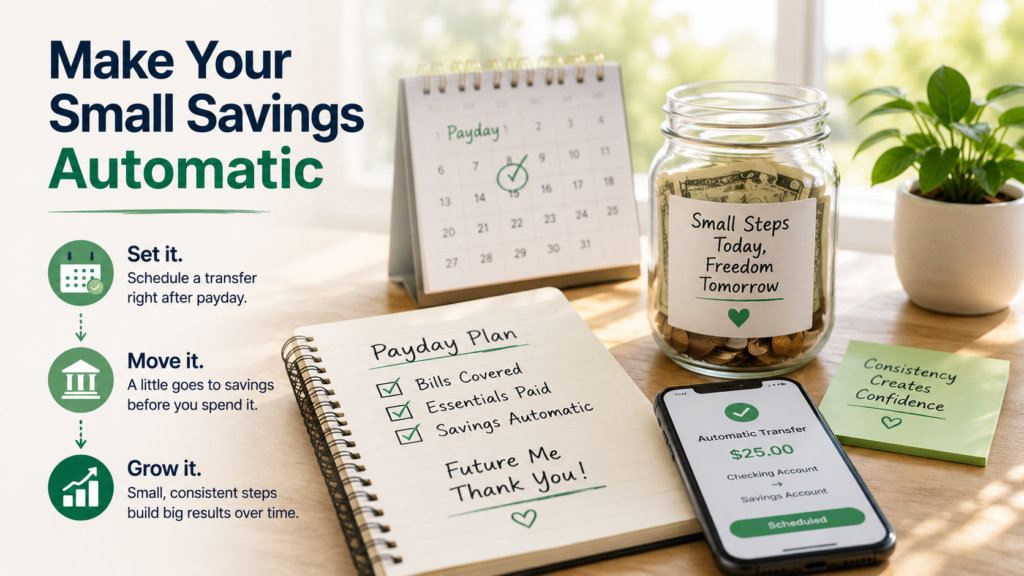
Make Your Small Savings Automatic
Once you’ve found an amount you can consistently save, automate it. And yes, it can be small. If $10 per paycheck is what works right now, start there. The point isn’t to impress anyone. It’s to build the habit.
If you have to decide every payday whether to transfer money into savings, it’s easy to say “I’ll do it next time.” Automatic transfers take that decision away entirely. The money moves before you get the chance to give it another job. As your situation improves, you can increase the amount.
Keep Your Cushion Separate
Where you can, keep your emergency savings separate from the checking account you use for everyday spending. Why? Because money sitting in your regular checking account has a funny way of looking available. You see an extra $300 and think, “We’re doing pretty well this month.” Then $75 disappears here, $40 disappears there, and the cushion isn’t a cushion anymore.
A separate savings account creates a little friction. The money is still there when you genuinely need it, but it’s less likely to get mixed into ordinary spending.
Decide What Counts as an Emergency
Building savings is only half the job. You also need to decide when you’re actually willing to use it. A genuine emergency might include an urgent car repair, an unexpected medical bill, a necessary home repair, a temporary loss of income, emergency travel, or another expense you couldn’t reasonably plan for.
A sale on a new television isn’t an emergency. Neither is a vacation that costs more than expected. But don’t get so protective of the money that you’re afraid to use it for its actual purpose. If your car needs a $350 repair so you can get to work, and you’ve got $500 set aside, that’s exactly why you saved it. Use it. Then start rebuilding.
Watch Out for Expenses That Aren’t Really Emergencies
Some expenses feel unexpected because they don’t happen every month. But they’re actually predictable: car registration, annual insurance premiums, holiday spending, routine car maintenance, school expenses, property taxes depending on how you pay them.
These aren’t emergencies. They’re irregular expenses. Once you spot them, divide the annual cost by 12 and start setting a little aside each month. If car registration runs $240 a year, setting aside $20 a month turns next year’s $240 “surprise” into an expense you’ve already covered. That’s one less thing competing for your emergency savings.
Be Careful About Saving While Creating New Credit Card Debt
This one deserves special attention. Say you’re proudly moving $100 a month into savings while charging $300 of groceries and everyday expenses to a credit card because your checking account is running short. You aren’t really getting ahead. You’re just moving money into one pocket while creating debt in another.
Saving matters, but so does cash flow. If your attempt to save is pushing ordinary living expenses onto high-interest debt, scale it back. Maybe $100 isn’t realistic yet. Maybe $25 is. Build from a number your finances can actually support.
What If There Really Isn’t Any Money Left?
This is where personal finance advice sometimes gets unrealistic. Some households can cut every subscription, eat out less, and shop more carefully and still not solve the problem. Housing may cost too much. Debt payments may eat up too much income. Healthcare costs may be high. Income may simply fall short of covering essential expenses.
If that’s where you are, don’t spend months hunting for another $4.99 subscription to cancel. Look at the big numbers instead. Could you increase your income, pick up extra hours temporarily, negotiate a raise, or find better-paying work? Could you reduce a major housing or transportation expense, renegotiate a bill, restructure high-interest debt, or ask a creditor about a hardship program? Could you sell something you no longer need, or direct part of a tax refund or other windfall toward your cushion?
Small spending changes help when the gap is small. Big financial gaps usually need bigger changes.
When Living Paycheck to Paycheck, Don’t Let a Raise Disappear
Eventually, something good happens. You get a raise. You pay off a loan. A car payment ends. A child-care expense drops. A credit card balance disappears. That’s your opening.
If a $300 monthly payment goes away, resist the urge to immediately put the full $300 to use. Capture some of it. Maybe $100 of it automatically starts going into savings. You’ve improved your financial position without cutting anything else from your current lifestyle. It’s one of the easiest ways to move from living paycheck to paycheck toward having real breathing room.
Getting Ahead Happens in Stages
There’s no magic number where everything suddenly feels easy. Think of getting ahead as a progression. First, you make it through the month without running short. Then you build $100 of breathing room. Then $250. Then $500. Eventually, maybe $1,000.
From there, you can work toward a larger emergency fund based on your actual expenses and circumstances. At the same time, you can start addressing other goals: paying down expensive debt, boosting retirement contributions, saving for a major purchase, or investing for the future. But don’t dismiss those first few hundred dollars. That’s where the change actually begins.
You Don’t Need to Fix Everything Today
If you’re living paycheck to paycheck, the goal isn’t financial independence by next Tuesday. It’s making your next paycheck slightly less important than the last one.
Know where your money is going. Find a little breathing room. Build your first cushion. Prepare for irregular expenses. Avoid creating new debt when you can. And when your situation improves, capture part of that improvement instead of letting every new dollar disappear into higher spending.
Eventually, something important starts to happen. The next unexpected bill becomes inconvenient instead of a crisis. You stop counting the days until payday quite so closely. And your money starts giving you choices instead of just handing you bills.
That’s what getting ahead really looks like. It doesn’t usually happen with one dramatic financial decision. It happens one small money habit at a time.