Financial education for adults sounds like something you should’ve already checked off — a high school elective, not a decade or two into your career. But the numbers say otherwise, and honestly, you’re in good company if this topic still feels a little fuzzy. Most adults are walking around with real gaps in what they know about money, and those gaps quietly cost real dollars.
So let’s actually look at where things stand, instead of assuming you’re the only one who feels behind.
Why Financial Education for Adults Matters Right Now
Here’s a number worth sitting with: U.S. adults answered just 49% of questions correctly on the TIAA Institute-GFLEC Personal Finance Index in 2025. That’s basically a coin flip. And it’s the same score we had eight years ago — we haven’t budged.
The weak spots aren’t spread evenly, either. Risk comprehension is the area people struggle with most, and only 36% get those questions right. If your financial literacy is on the lower end, you’re five times more likely to have zero emergency savings and three times more likely to feel financially fragile day to day.
It’s not just a knowledge problem, either — it’s showing up in real bank accounts. The FINRA Investor Education Foundation’s National Financial Capability Study found that after more than a decade of steady progress, many households — middle-income families especially — are now struggling to make ends meet and save for emergencies. And it’s not because paychecks shrank. Rising costs are simply eating into what used to feel like enough.
So no, this isn’t just a “young people” or “low-income” problem. It’s everywhere. And it’s expensive — poor financial literacy cost Americans an estimated $246 billion in 2025 alone.
What Financial Education for Adults Actually Covers
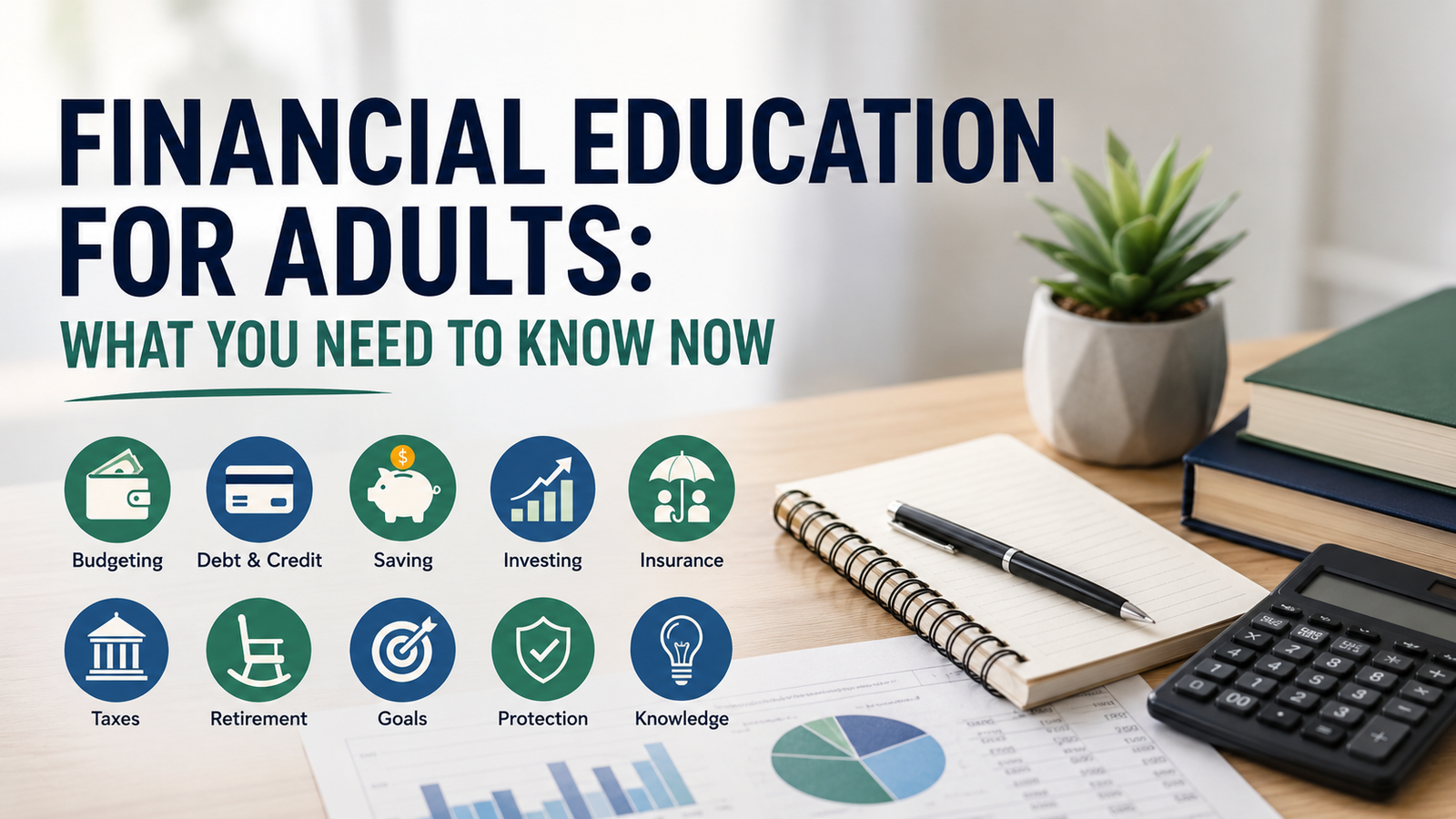
“Financial education” is one of those phrases that sounds important but vague, so let’s make it concrete. In practice, it covers things like:
- Budgeting and cash flow management
- Building and maintaining an emergency fund
- Understanding credit reports and credit scores
- Managing and paying down debt
- Saving and investing basics, including retirement accounts
- Recognizing fraud and financial scams
- Understanding loans, mortgages, and interest rates
- Insurance and risk management
None of this is about picking hot stocks or becoming your own tax accountant. It’s about the everyday decisions — the ones you make on autopilot — that quietly decide whether your money works for you or against you.
Where the Gaps Are Widest
Not everyone is starting from the same place, and that’s exactly why financial education for adults can’t be one-size-fits-all.
Men correctly answered about 53% of P-Fin Index questions, compared to 45% for women. Age matters too: Baby Boomers scored highest at 59%, while Gen Z came in lowest at 38%. Race and ethnicity tell a similar story — White adults (53%) and Asian adults (55%) scored well above Black adults (38%) and Hispanic adults (39%).
These aren’t just abstract percentages. They show up in people’s bank accounts. The median American has just $600 in emergency savings, and 21% have nothing saved at all. Only 46% could actually cover three months of expenses if something went sideways. And the median retirement balance across all ages sits around $87,000 — a number that gets a lot thinner the younger you look.
If any of that hits close to home, take a breath. It’s not a personal failing. It’s what happens in a country where nobody consistently teaches, funds, or reinforces this stuff past high school.
Free Financial Education Resources for Adults
Here’s the part that should feel like good news: you don’t need to pay for a class or hire an advisor to start closing these gaps. A handful of solid, free resources already exist, built specifically for adults.
- CFPB Adult Financial Education — Tools, worksheets, and guides on credit, debt, fraud, housing, and money management from the Consumer Financial Protection Bureau.
- FDIC Money Smart for Adults — A free 14-module curriculum covering the basics of banking, credit, and money management, available online, by mail, or in a classroom setting.
- MyMoney.gov — A federal clearinghouse pulling together financial education resources from more than 20 government agencies in one place.
Worth checking, too: a lot of employers, credit unions, and local libraries quietly offer free financial coaching or workshops. Ask before assuming you have to figure this out solo.
How to Start Your Own Financial Education Plan
Good news — you don’t need a total life overhaul here. A few small, consistent habits do most of the work.
Start by pulling your credit report and actually reading it. Each bureau owes you a free copy every year, and most people have genuinely never looked at theirs.
Then build even a tiny emergency fund. Remember, the median American only has $600 saved — so going from zero to even a few hundred dollars already puts you ahead of a lot of people.
Next, take the time to understand how your retirement accounts actually work: contribution limits, employer matches, and the difference between traditional and Roth. These feel like small details now, but they compound hard over decades.
And finally, keep coming back to it. Financial rules and products change constantly, so treat this like an ongoing habit — not a box you check once and forget about.
Signs You Need to Level Up Your Financial Education Now
Some warning signs are easier to brush off than others. If any of these sound familiar, it’s probably time to prioritize financial education for adults sooner rather than later:
- You couldn’t cover a $400 emergency expense without borrowing.
- Your current credit score isn’t something you could name off the top of your head.
- No money is going toward a retirement account, or you’re unsure whether your employer matches what you put in.
- A full credit report has never made it onto your radar for errors or fraud.
- Credit card debt keeps growing while you pay only the minimum each month.
None of that makes you unusual — plenty of people check two or three of these boxes. But noticing it is genuinely the first step toward changing it.
The Bottom Line
Financial education for adults isn’t some remedial topic you should’ve outgrown by now. National scores have been flat for eight years, and household financial stress keeps climbing even when income doesn’t drop. That tells you this is an ongoing need, not a phase people simply age out of.
The resources are out there, and they’re free. The hardest part is usually just starting. Everything after that is just showing up consistently.
FAQ
What is financial education for adults? It’s the ongoing process of learning to manage money well — budgeting, credit, debt, saving, investing, and fraud protection — beyond what most people were ever taught in school.
Why do so many adults struggle with financial literacy? Schools don’t consistently require or reinforce financial education after graduation, and money rules keep changing anyway. National scores have stayed flat at 49% for eight years, so this gap clearly isn’t closing on its own.
Where can I get free financial education as an adult? The CFPB, FDIC’s Money Smart program, and MyMoney.gov all offer free courses, tools, and worksheets. Many employers, credit unions, and libraries also offer free financial coaching — it’s worth asking.
How much should I have in emergency savings? Experts generally recommend three to six months of expenses. Right now, only 46% of Americans have enough saved to cover even three months.