
The car makes a noise it definitely was not making yesterday. The air conditioner stops working during the hottest week of the year. A dental problem cannot wait until your next paycheck.
None of these expenses asked whether this was a convenient time.
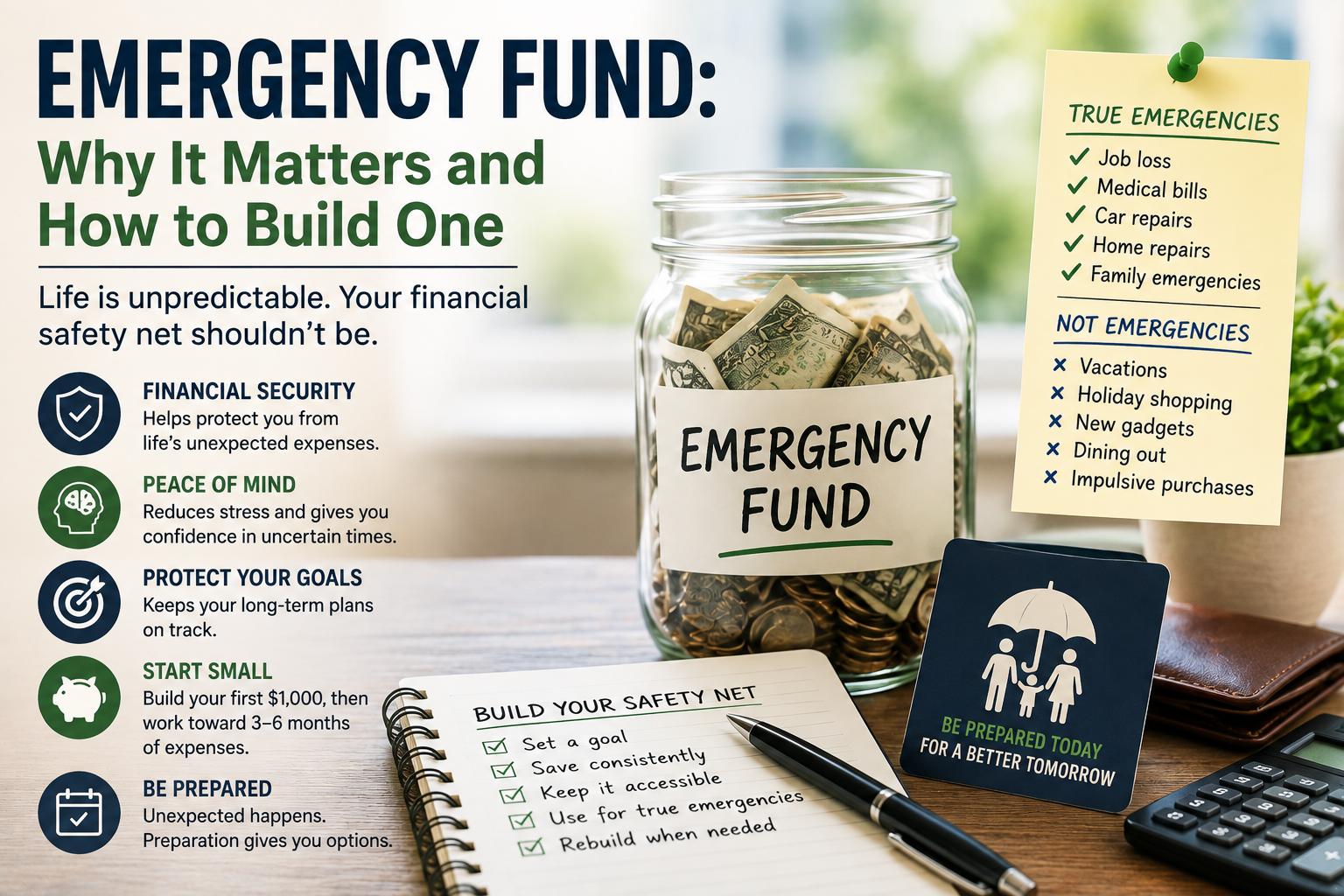
That is why an emergency fund matters. It gives you money to handle an unexpected expense without immediately reaching for a credit card, borrowing from someone, or deciding which regular bill will have to wait.
An emergency fund will not prevent life from happening. It can prevent an ordinary setback from becoming a much larger financial problem.
What Is an Emergency Fund?
An emergency fund is money set aside specifically for unplanned, necessary expenses or a temporary loss of income.
The Consumer Financial Protection Bureau describes it as a cash reserve for financial emergencies such as car repairs, home repairs, medical bills, or lost income. Its emergency-fund guide also emphasizes that even a small amount can provide some financial security.
This money has one job: to help protect your household when something important goes wrong.
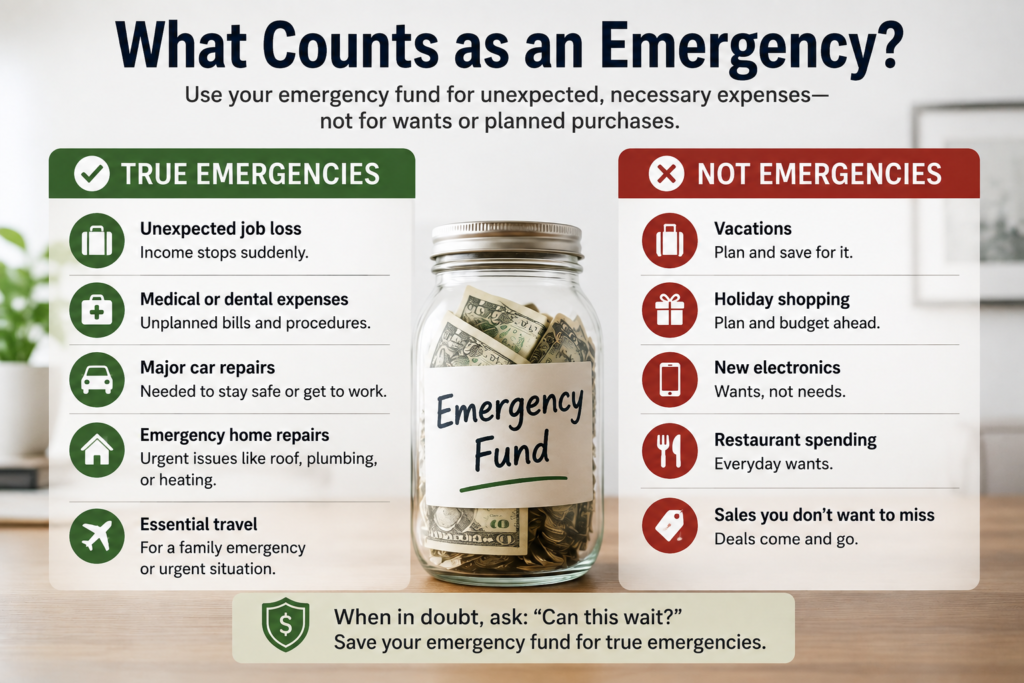
It is not meant for:
- Vacations
- Holiday shopping
- Routine car maintenance
- Annual insurance premiums
- A new phone
- A sale that ends tonight
- Expenses you knew were coming
Those costs belong in your regular budget or a separate sinking fund. An emergency fund is reserved for expenses you could not reasonably plan for—or a serious change that affects your ability to pay essential bills.
Why an Emergency Fund Matters
Without emergency savings, an unexpected expense often lands on a credit card.
A $700 repair is difficult enough. When it becomes a revolving balance with interest, it can remain in the budget long after the car is back on the road.
An emergency fund can help you:
- Avoid adding high-interest debt
- Keep essential bills current
- Protect retirement and other long-term savings
- Handle repairs before they become more expensive
- Make decisions without as much financial pressure
- Recover more quickly after a setback
The benefit is not only financial.
When you know some money is available, you have room to think. You can compare repair estimates, ask questions about a bill, or take a little time to decide what comes next. Without that cushion, urgency often makes the decision for you.
What Counts as a Real Emergency?
A useful test is to ask three questions:
- Is the expense unexpected?
- Is it necessary?
- Does it need to be handled soon?
If the answer to all three is yes, it may be an appropriate use of your emergency fund.
Examples of emergencies
- Losing a job or experiencing a temporary income interruption
- An urgent car repair needed for work or essential transportation
- A home repair involving safety, plumbing, electricity, or weather damage
- An unplanned medical or dental expense
- Emergency travel involving a close family member
- Replacing an essential household appliance that suddenly stops working
- Paying an insurance deductible after a covered loss
Examples of expenses that are not emergencies
- Holiday gifts
- A planned vacation
- Routine vehicle registration
- Annual property taxes
- Replacing a working television
- A last-minute social event
- An expense you forgot to include in the budget
- A limited-time bargain
Forgetting that an annual bill was coming does not turn it into an emergency. It means the bill needs a place in next month’s spending plan.
That distinction matters because using emergency savings for predictable expenses prevents the money from being available when a true emergency arrives.
Start With a Goal You Can Reach
The phrase “three to six months of expenses” can make an emergency fund sound impossible before you begin.
If your essential expenses are $4,000 per month, even the lower end would be $12,000. Looking at that number when you have nothing saved can feel like standing at the bottom of a mountain in dress shoes.
Do not begin with the mountain. Begin with the first useful milestone.
Your first goal could be:
- $250
- $500
- $1,000
- One insurance deductible
- The cost of a common car or home repair
- One week of essential expenses
Choose a number that would help with the type of surprise your household is most likely to face.
Once you reach that goal, build toward one month of essential expenses. After that, you can work toward a larger cushion based on your income stability, dependents, insurance coverage, housing responsibilities, and other risks.
For a detailed way to choose the final number, use Emergency Fund: How Much Is the Right Amount?.
Calculate Your Essential Monthly Expenses
Your emergency-fund target should be based on what your household needs—not everything you currently spend.
Start with expenses you would still need to pay during an income interruption:
- Rent or mortgage
- Basic utilities
- Groceries
- Insurance
- Transportation
- Prescriptions and necessary healthcare
- Minimum debt payments
- Childcare or dependent care
- Essential phone and internet service
Leave out spending that could reasonably be reduced or paused, such as entertainment, optional shopping, restaurant meals, and some subscriptions.
Suppose your usual monthly spending is $5,200, but your essential expenses total $3,800. Your emergency-fund calculation would begin with $3,800 rather than the full $5,200.
That difference can make the goal more accurate and less intimidating.
How to Build an Emergency Fund
Knowing you need emergency savings is the easy part. Finding room for it is where real life joins the conversation.
The best approach is usually a combination of small recurring deposits and occasional larger additions.
1. Give the fund its own account
Keep your emergency fund separate from the checking account you use for everyday spending.
If the money sits beside your grocery and entertainment money, it is easier to borrow from it for something that is not really an emergency.
A separate account creates a small but useful pause. The money remains available, but it does not look like part of your normal spending balance.
2. Choose an amount that fits your current budget
Review your budget and select an amount you can contribute consistently.
That might be:
- $10 each week
- $25 every payday
- $50 each month
- One percent of every deposit
- Whatever remains from a specific spending category
The amount can increase later. The first goal is to make saving regular.
Twenty-five dollars a week becomes $1,300 over a year. That may not cover several months of expenses, but it could prevent a common repair from becoming new credit-card debt.
3. Automate the transfer
Schedule the transfer shortly after your income arrives, when possible.
Waiting until the end of the month to save whatever is left often produces the same result: there is not much left.
The transfer should be realistic. If automatically moving $100 causes you to pull $75 back every month, reduce it. A smaller amount that stays in savings is more useful than an impressive transfer that repeatedly creates trouble.
If you need help coordinating transfers with your bills, see How to Put Your Budget on Autopilot Without Losing Control.
4. Use part of unexpected income
Occasional money can accelerate your progress.
Consider depositing part of:
- A tax refund
- A work bonus
- A cash gift
- Overtime income
- Proceeds from selling unused items
- A rebate or refund
- Money left after paying off another obligation
You do not have to save the entire amount. Splitting unexpected income between the emergency fund and something you enjoy can make the habit easier to maintain.
5. Redirect money from completed payments
When you pay off a loan, cancel an unused subscription, or finish paying for something, redirect part of that payment before it disappears into general spending.
If a $60 monthly payment ends, you might send $40 to your emergency fund and keep $20 available elsewhere in the budget.
Your lifestyle still gets a little breathing room, and your savings begin growing without requiring an entirely new sacrifice.
6. Save small leftovers on purpose
Money left in a category at the end of the week or month can be transferred into emergency savings.
The important part is making the transfer intentionally. If the money simply remains in checking, it may gradually blend into other spending.
Small amounts count. An emergency fund is built with dollars, not dramatic gestures.
Building Emergency Savings While Paying Off Debt
This is one of the hardest questions: should you save money while carrying credit-card debt?
There is no single answer that fits every household, but having no emergency savings at all can keep the debt cycle going.
You make progress on the credit card. Then a tire needs replacing, and the cost goes right back on the card.
A practical approach may be:
- Build a small starter emergency fund.
- Continue making required debt payments.
- Direct more available money toward high-interest debt.
- Rebuild the starter fund whenever you use it.
- Expand the emergency fund after the most expensive debt is under better control.
The starter amount will not protect you from every possible emergency. It gives you a chance to handle smaller problems without reversing your debt progress.
Avoid putting so much into savings that you miss minimum payments or fall behind on essential bills. The plan needs to improve your stability, not create a different shortage.
Where Should You Keep Your Emergency Fund?
Emergency savings should be:
- Safe
- Easy to access
- Separate from routine spending
- Free from unnecessary withdrawal penalties
- Earning some interest when possible
A savings account or money market deposit account at an insured financial institution may work well.
The FDIC suggests keeping emergency savings in a separate FDIC-insured savings account so it remains available while being less tempting to spend. You can review its guidance on saving for unexpected expenses.
A federally insured credit union can provide similar deposit protection through the National Credit Union Administration.
For help comparing account types, see Savings Account vs. Money Market vs. CD: Which Works Best?.
What about certificates of deposit?
A certificate of deposit may earn a competitive rate, but early-withdrawal penalties and access restrictions can make it less convenient during an emergency.
Some people use a CD ladder for a portion of a larger fund. However, your first layer of emergency savings should generally be easy to reach without penalties.
What about stocks?
Money needed for emergencies usually should not depend on the stock market.
If the market falls at the same time you lose income, you may be forced to sell investments at a loss. Emergency savings prioritizes stability and access over long-term growth.
When Should You Use the Money?
Before withdrawing from your emergency fund, ask:
- Is this expense necessary?
- Was it genuinely unexpected?
- Does it need to be handled now?
- Can any part be covered by insurance?
- Is there a safe, less expensive solution?
- Would delaying it make the problem worse?
You do not need to feel guilty about using the fund for a legitimate emergency. That is why you built it.
The money has not been “lost.” It performed its job.
Paying for a necessary repair with savings may not feel exciting, but it is far better than paying for the repair—and then paying interest on it for the next two years.
How to Rebuild After Using It
Using emergency savings is only half the process. The next step is replenishing it.
Start by asking:
- How much was withdrawn?
- Did the emergency change my regular expenses?
- Can I resume the previous automatic transfer?
- Is the original savings target still appropriate?
- Did this experience reveal another expense I should plan for?
If you used $800 for a repair, you do not need to replace it immediately. Resume your regular contributions and add extra money when practical.
The emergency may also teach you something useful. A routine future expense might need a separate sinking fund, or your starter goal may need to be slightly larger.
An emergency fund improves through experience. Each time you use and rebuild it, you learn more about what your household actually needs.
Common Emergency-Fund Mistakes
Watch for these problems:
Waiting until you can save a large amount
Starting with $20 is better than waiting six months for the perfect opportunity to save $500.
Keeping the money in everyday checking
If it looks available for spending, it often becomes available for spending.
Investing money you may need soon
Emergency savings should not be exposed to short-term market losses.
Treating every inconvenience as an emergency
Wanting something now does not necessarily make it urgent.
Using one fixed target forever
Your needs can change when your housing, employment, family responsibilities, insurance, or retirement status changes.
Refusing to use the fund for a genuine emergency
Some people become so protective of their savings that they put a necessary expense on a credit card instead. If the expense meets your emergency test, use the money for its intended purpose.
A Simple Emergency-Fund Plan
If you are ready to begin, follow these steps:
- Choose a separate savings account.
- Set your first reachable goal.
- Calculate one month of essential expenses.
- Schedule a realistic automatic transfer.
- Add part of windfalls and unexpected income.
- Define what qualifies as an emergency.
- Review your target whenever life changes.
- Rebuild the fund after using it.
You do not need to complete every step today.
Open the account. Make the first transfer. Let the habit begin.
The Bottom Line
An emergency fund is not there to make you wealthy. It is there to protect the financial progress you are already making.
It turns some emergencies into expenses you can handle. It gives you options when life becomes unpredictable. Most importantly, it can keep one difficult week from becoming several difficult months.
Do not let the three-to-six-month recommendation stop you from starting.
Choose the first amount that would make a real difference in your household—$250, $500, $1,000, or one common repair—and begin there.
The first goal is not perfection. It is having more protection next month than you have today.