
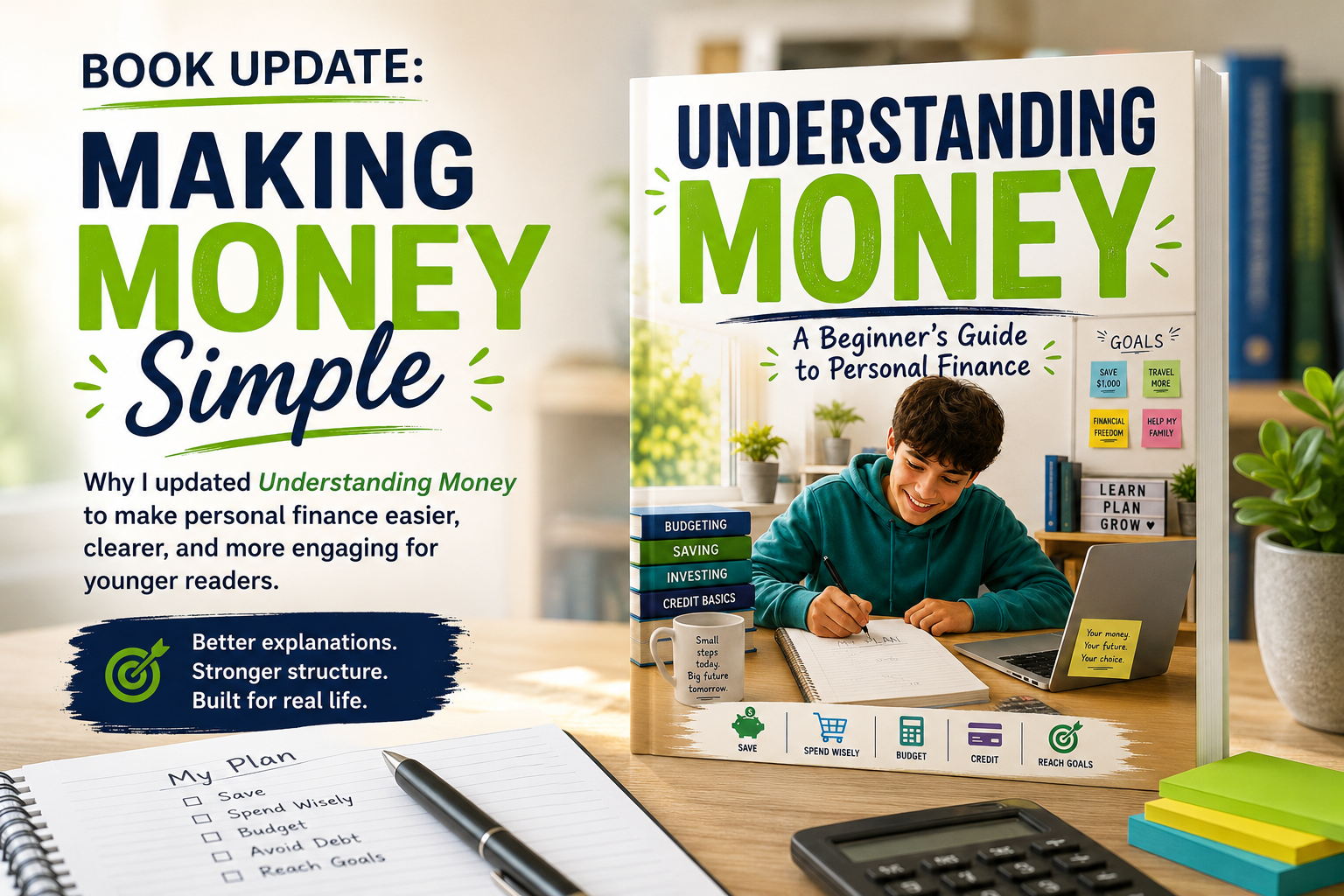
When I first published Understanding Money: A Beginner’s Guide to Personal Finance, my goal was simple. I wanted to create a practical introduction to money for younger readers who may not have been taught these concepts clearly in school or everyday life.
A lot of financial advice online overwhelms people with technical language or targets adults who already understand the basics. I never wrote this book for that audience.
I wrote this book to explain personal finance in plain language by covering topics like budgeting, saving, banking, credit, spending, and protecting personal information in a way that feels approachable instead of intimidating.
But after spending more time reviewing the original version, I realized something important.
Good educational content usually improves through revision.
Why I Decided to Update Understanding Money
As I reread the original version, I found areas where I could improve the flow and tighten sections where ideas repeated too closely together. Although the book explained the concepts accurately, I did not always guide younger readers through the material as naturally and clearly as I wanted.
That happens more often than people think when writing educational material.
Explaining money concepts is not only about accuracy. It is also about structure, pacing, readability, and keeping readers engaged while learning topics that can sometimes feel dry or confusing.
Instead of ignoring those issues, I decided to rebuild and improve the book.
The updated version includes clearer formatting, refined chapter organization, improved transitions between topics, updated visuals, and smoother explanations, all designed specifically for younger readers learning personal finance for the first time.
Teaching Personal Finance to Younger Readers Is Different
One thing I gained a greater appreciation for during this process is how different it is to write for younger audiences.
Adults can often fill in gaps using life experience. Younger readers usually cannot, which is exactly why starting financial literacy early matters so much. If a concept is unclear, repetitive, or disconnected from real-life situations, they may lose interest quickly.
That means every chapter has to work harder.
The material needs to feel practical and understandable without sounding overly simplified or childish. It also needs to explain financial habits in a way that feels realistic for everyday life.
That balance took more revision than I originally expected.
The Goal of Understanding Money
The purpose of Understanding Money: A Beginner’s Guide to Personal Finance has always been to help readers build a stronger foundation for everyday financial decisions.
The book focuses on practical areas such as:
- budgeting and tracking money
- saving and financial habits
- banking basics
- understanding credit
- responsible spending
- protecting personal information
- building long-term financial awareness
These are topics many people wish they had learned earlier in life.
The updated version is designed to make those lessons clearer, more organized, and easier to follow from beginning to end.
Improving the Work Matters
One thing I have learned through this process is that publishing something does not mean it can never improve.
Sometimes, creators feel pressure to leave things alone once they are released publicly. But educational content should evolve when better ways to explain the material become available.
In many ways, this update reflects the same financial principle discussed throughout the book: small improvements over time can lead to stronger long-term results.
That applies to writing too.
Final Thoughts
I am proud of the work that went into improving Understanding Money: A Beginner’s Guide to Personal Finance, and I believe the updated version provides a better experience for younger readers who are beginning to learn about personal finance.
Financial literacy does not need to feel overwhelming. Sometimes the best place to start is simply to learn the basics clearly and build from there.
If the updated version helps even a few readers feel more confident about understanding money, then the revision process was worth it.
You can learn more about the updated book on Amazon.
If you want to keep building on these basics beyond the book, our free 7-Day Money Habits Challenge walks you through one simple step a day.