
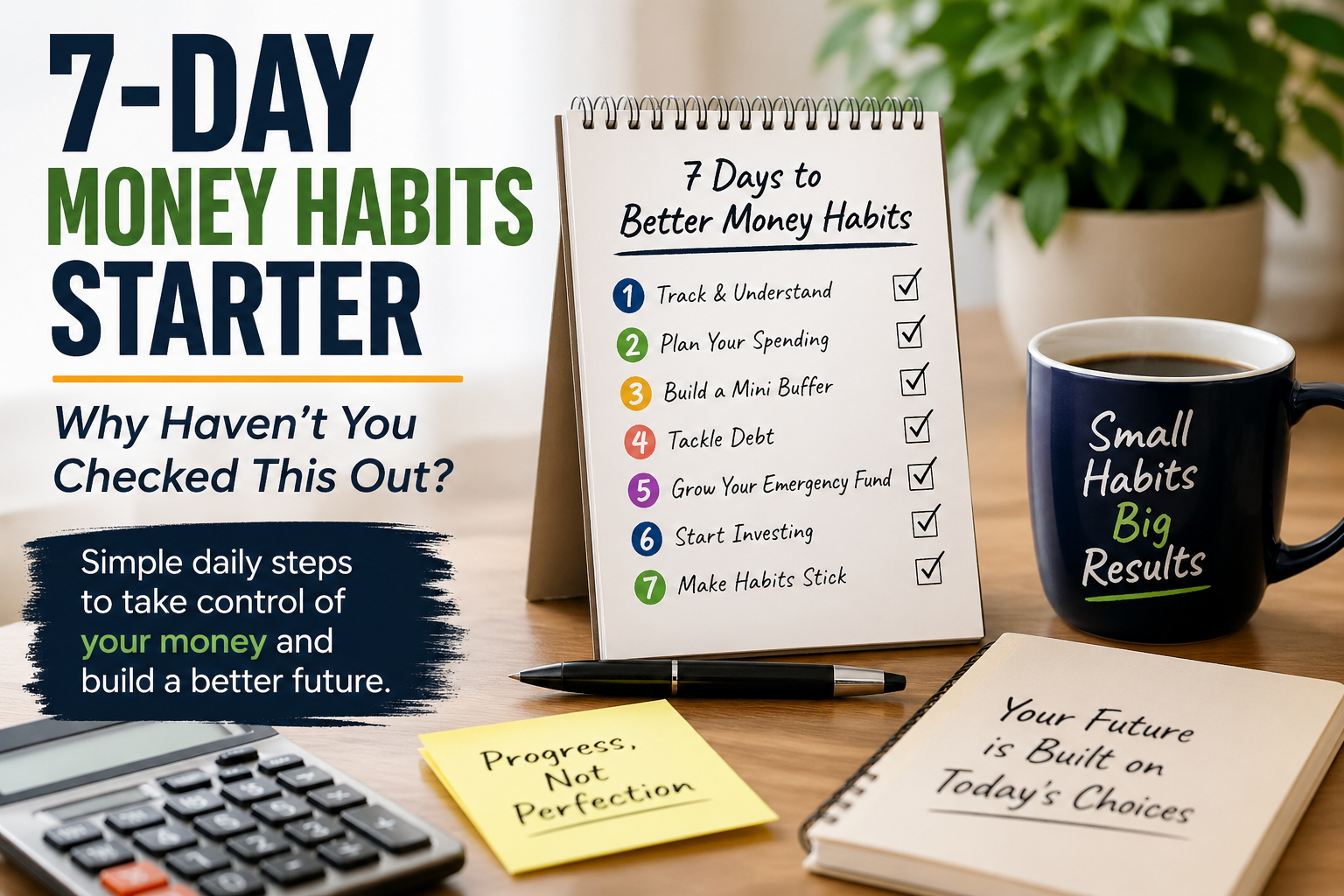
The 7-Day Money Habits Starter was created for people who know they need to do something different with their money, but keep putting it off because the whole thing feels bigger than it needs to be. That is usually where people get stuck. They know they should look at their spending, build a cushion, deal with debt, and maybe start investing, but each piece feels like another chore added to an already full plate. So instead of starting small, they wait for the perfect time to get serious.
The problem is that the perfect time rarely shows up. There is always another bill, another busy week, another unexpected expense, or another reason to say, “I’ll get to it later.” I get it. Most of us have had those seasons where money feels like something we manage only when it starts making noise. A balance gets too high, a payment comes due, a subscription renews, or the car suddenly decides it wants attention. Money has a funny way of tapping us on the shoulder only after we have ignored it for a while.
That is why the 7-Day Money Habits Starter is intentionally simple. It is not designed to turn you into a financial expert in a week. Nobody needs that kind of pressure. It is designed to help you stop drifting and start seeing what is actually happening with your money. That first step matters more than people think, because most money problems do not begin with one big mistake. They usually grow out of small habits that go unnoticed for too long.
Why Simple Money Habits Matter
A lot of financial advice sounds good until you try to use it in real life. Track every category. Build a perfect budget. Cut every unnecessary expense. Save six months of expenses immediately. Start investing aggressively. Pay off all debt as fast as humanly possible. Technically, some of that advice may be useful, but for someone who is just trying to regain control, it can feel like being handed a 40-pound instruction manual when all you wanted was a flashlight.
The 7-Day Money Habits Starter takes a different approach. Day 1 starts with awareness. Before you cut anything, change anything, or promise yourself you will never order takeout again, you simply look at where your money is really going. That alone can change behavior, because once you see the small leaks, they become harder to ignore.
From there, the process builds naturally. You create a simple spending plan, build a mini emergency buffer, look at debt with a clear head, work toward a fuller emergency fund, understand the basics of investing, and then focus on habits that can actually last. None of that requires perfection. It requires a little attention, a little honesty, and a willingness to start.
The Real Reason People Put This Off
Most people do not avoid money because they are lazy. They avoid it because money can feel uncomfortable. Looking closely at your spending can bring up frustration, regret, embarrassment, or plain old irritation. Nobody enjoys realizing that three “small” subscriptions, a few impulse buys, and too many convenience meals quietly walked off with money that could have gone somewhere better.
But avoiding the numbers does not make them kinder. It just keeps them vague. And vague money is hard to manage. Once you give your money a name, a place, and a purpose, it becomes less intimidating. That is the point of the 7-Day Money Habits Starter. It helps you move from guessing to knowing, and from reacting to making better choices.
What You Get Over 7 Days
Over seven days, you walk through the basic building blocks of stronger money habits. You start by seeing where your money is going, because awareness is the foundation. Then you set up a simple spending plan that does not require a spreadsheet that looks like it was built by a NASA engineer. After that, you work on a small emergency buffer, because even a modest cushion can keep a surprise expense from turning into new debt.
The next steps involve debt, a more robust emergency fund, and smart investing. Again, this is not about becoming perfect in one week. It is about building momentum. By the end, the goal is not for you to say, “I fixed my whole financial life in seven days.” The goal is for you to say, “I finally started, and I know what to do next.”
That is a much better place to be.
Why It Is Worth Starting Today
If the 7-Day Money Habits Starter is free, simple, and already available, the real question becomes pretty direct: why not start? It’s not next month. Not after the next paycheck. Not after everything calms down, because life rarely sends a formal notice saying, “Good news, things are calm now.”
Start with Day 1. Look at where your money is going. Do not judge it. Do not turn it into a personal courtroom drama. Just observe it. That one small step can give you more clarity than another week of thinking about getting organized.
Money habits are a lot like fitness habits. Reading about them helps, but the change comes from doing the reps. Small reps count. Simple reps count. Imperfect reps count. What matters is that you begin.
Start the Free 7-Day Money Habits Starter
The 7-Day Money Habits Starter is available now, and it is free. If you have been meaning to get a better handle on your money, this is a simple place to begin without making the process heavier than it needs to be.
You can start here:
https://moneyhabitsforme.com/7-day-money-habits-starter/
A better money system does not usually arrive in one dramatic moment. More often, it starts with one honest look, one small decision, and one step you actually take.
Tom Rooney