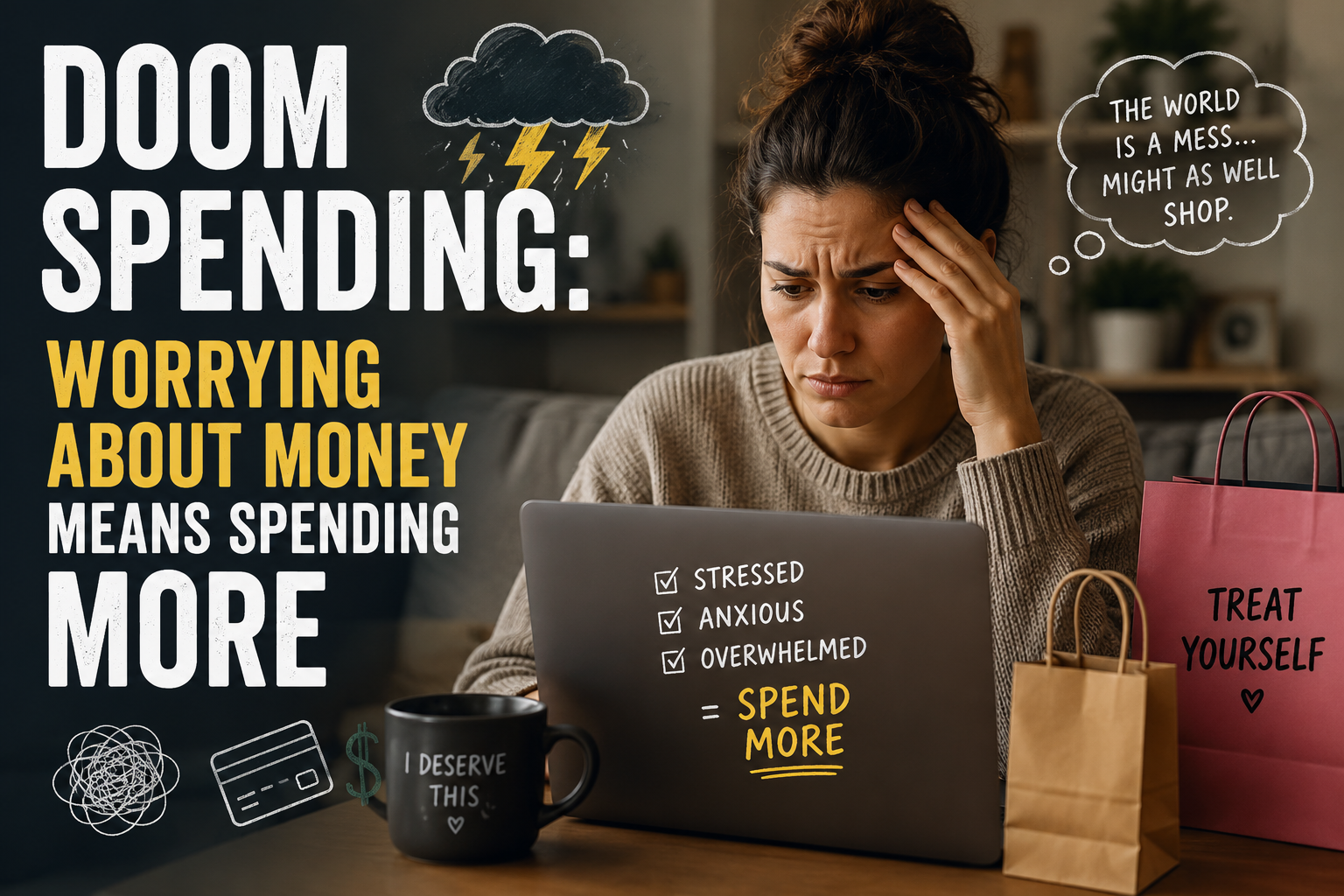
Have you ever read a discouraging economic headline, felt worried about your future, and then bought something you never planned to buy?
It seems backward. If money feels uncertain, spending more should be the last thing you want to do. But anxiety does not always produce logical financial behavior. Sometimes it creates doom spending: buying things for temporary relief because the future feels unpredictable or out of reach.
The purchase may feel comforting for a few minutes. Then the charge appears, the financial pressure increases, and the original worry comes back with company.
Doom spending is not proof that you are careless. It is a habit loop—and habit loops can be interrupted once you recognize what starts them.
What Is Doom Spending?
Doom spending is unplanned or excessive spending driven by pessimism, stress, or anxiety about the future. The term became popular as people described shopping to soothe themselves while feeling discouraged about inflation, housing costs, debt, job security, or larger financial goals.
Psychology Today has described doom spending as shopping to self-soothe when someone feels pessimistic about the economy and their financial future.
The important part is not the label. It is the reason behind the purchase.
You are not buying because you need the item or decided it fits your priorities. You are buying because spending creates a brief sense of pleasure, control, distraction, or reward.
What Doom Spending Looks Like in Real Life
Doom spending does not always look like one dramatic purchase. It often hides inside ordinary transactions:
- Ordering takeout after reading another discouraging headline
- Buying clothes late at night because the day felt overwhelming
- Upgrading a phone because saving for a home feels impossible
- Putting a vacation on a credit card because “who knows what will happen next?”
- Using buy now, pay later for several small purchases
- Buying something because everyone online seems to be enjoying life more than you are
Any one of these purchases might fit comfortably into someone’s spending plan. The warning sign is not the product. It is the pattern: anxiety appears, spending follows, and regret arrives later.
Why Money Anxiety Can Lead to More Spending
The Future Feels Too Far Away
Saving for retirement, a home, or financial independence requires patience. When those goals feel unreachable, a smaller purchase can provide an immediate win.
You may think, “I cannot afford a house anyway, so what difference will this purchase make?” One purchase may not change the housing market, but repeating that decision can quietly weaken the part of your finances you can control.
Shopping Creates a Brief Sense of Control
You cannot control interest rates, prices, layoffs, or the daily news. You can choose what to put in a cart and when it arrives.
That small decision can feel reassuring when everything else seems uncertain. The trouble is that controlling a purchase is not the same as improving your financial position.
Buying Something Changes the Feeling
A new purchase can provide anticipation, distraction, or a momentary reward. That relief is real, but it is usually short-lived.
If the purchase was unplanned or creates debt, the emotional relief may be replaced by guilt and added financial pressure.
Social Media Makes Everyone Else Look Secure
Other people’s vacations, renovations, meals, and purchases are visible. Their credit-card balances, arguments about money, and delayed savings are not.
Comparing your complete financial life with someone else’s carefully selected moments can make ordinary progress feel like failure.
Bad News Is Always Available
Economic information can be useful. Constant exposure is different.
Checking financial news repeatedly may keep your anxiety elevated even when nothing has changed in your household that day. A frightened brain can interpret buying something as a quick way to improve the moment.
The Loop That Makes Doom Spending Expensive
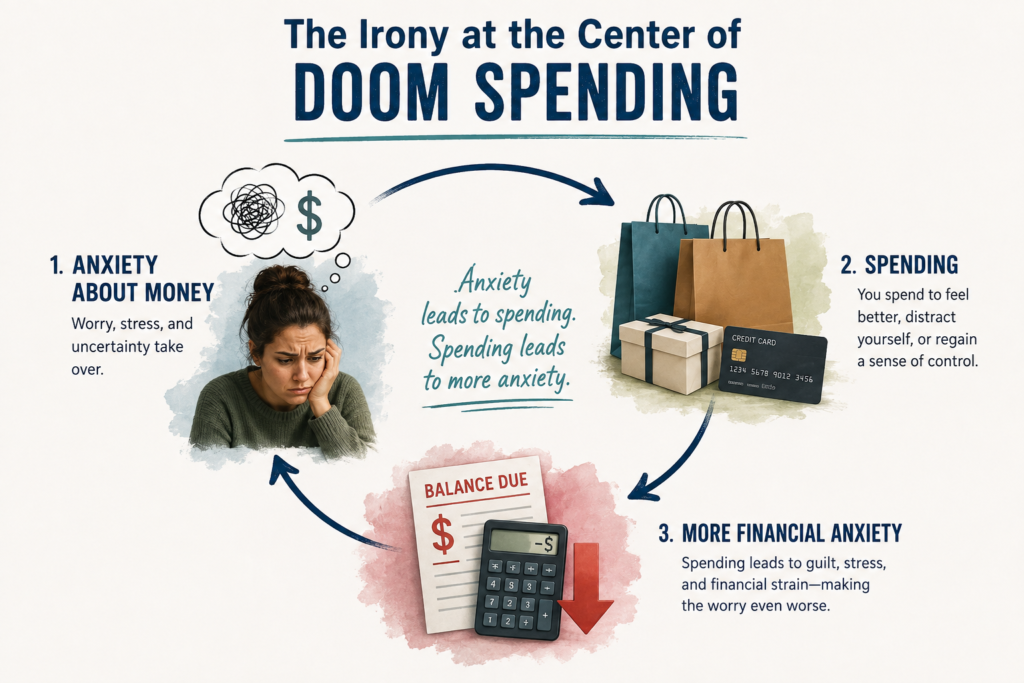
The central problem is simple: worrying about money leads to spending money, which creates more reasons to worry about money.
- You see or experience something that makes the future feel uncertain.
- Anxiety, frustration, or discouragement rises.
- You buy something for relief or a sense of control.
- The purchase feels good briefly.
- The charge reduces your available money or increases debt.
- Your financial anxiety becomes stronger.
- The next difficult moment triggers another purchase.
The consequences are greatest when money is already tight. Someone with a comfortable cushion may absorb an occasional impulse purchase. Someone living paycheck to paycheck may lose the small amount that was protecting the account from an overdraft or an unexpected bill.
How to Recognize Your Doom-Spending Triggers
Looking only at what you bought may not reveal the habit. Look at what happened immediately before the purchase.
For one week, keep a simple trigger log. Record:
- What you wanted to buy
- The price
- What you were feeling
- What happened during the previous hour
- Whether you completed the purchase
- How you felt afterward
You may notice that the urge appears after checking the news, scrolling through social media, arguing with someone, feeling bored, or reviewing a bill.
This connects to the broader pattern explained in How Emotions Secretly Drive Your Negative Spending. Doom spending is one version of emotional spending, but its trigger is usually fear or pessimism about the future.
How to Interrupt Doom Spending
1. Create a 24-Hour Waiting List
When an unplanned item catches your attention, place it on a list instead of placing it in the cart. Record the item, price, and date.
Wait at least 24 hours before buying it. For a larger purchase, wait several days.
The goal is not to ban every unplanned purchase. It is to give the feeling time to settle so you can decide whether you want the item or simply wanted relief.
2. Remove Saved Payment Information
One-click checkout removes nearly every pause between wanting and buying.
Delete saved card numbers from the retailers where you tend to impulse shop. Having to retrieve and enter the payment information creates a little friction. Sometimes that is enough time to reconsider.
3. Turn Off Retail Notifications
Retail emails, text messages, app alerts, and social media advertisements are designed to create urgency. You do not have to rely on willpower while inviting dozens of sales pitches into your day.
Unsubscribe, mute, or disable the notifications that repeatedly lead you toward shopping.
4. Schedule Your Financial Check-In
If uncertainty makes you check financial news throughout the day, replace that habit with one scheduled household review each week.
Look at your own numbers:
- Current checking balance
- Upcoming bills
- Credit-card balance
- Progress toward savings
- Any unusual expense that needs attention
Your household numbers deserve more influence over your decisions than a frightening headline written for millions of people.
5. Create a Small Comfort-Spending Amount
Trying to eliminate every enjoyable purchase can backfire. Include a reasonable amount for guilt-free spending in your plan.
When that amount is available, you can use it without arguing with yourself. When it is gone, additional comfort purchases wait until the next planned period.
This is a practical form of intentional spending: choosing where enjoyment fits instead of pretending you will never want it.
6. Replace the Purchase With Another Action
If the goal is to change how you feel, try something that addresses the feeling without creating another bill.
You might:
- Take a walk
- Call someone you trust
- Step away from the news
- Exercise
- Work on a task you can control
- Review one manageable financial next step
- Move the amount you almost spent into savings
The replacement does not need to be profound. It only needs to help you get through the emotional moment without making the financial worry worse.
7. Make Online Shopping Less Convenient
Remove shopping apps from your phone. Log out of retail accounts. Unfollow influencers or deal accounts that trigger purchases. Avoid browsing stores when you are stressed or tired.
You are not weak for changing the environment. Good habits become easier when the unhelpful choice requires more effort.
8. Name One Financial Action You Can Control
Doom spending grows when everything feels hopeless. A small action can restore a more useful sense of control.
You could:
- Transfer $10 into savings
- Cancel one unused subscription
- Schedule a bill payment
- Review one spending category
- Make a small extra debt payment
- Plan tomorrow’s meals before ordering takeout
The action may not solve the entire problem. It proves that the future is not completely outside your influence.
Questions to Ask Before an Emotional Purchase
Before checking out, ask:
- What happened immediately before I wanted this?
- Am I buying an item or trying to change a feeling?
- Was this purchase included in my spending plan?
- Would I still want it tomorrow?
- Will I need credit or delayed payments to afford it?
- What will this purchase prevent me from doing?
- Is there a free action that would help me feel better right now?
You do not need a perfect answer to every question. The pause itself interrupts the automatic part of the habit.
When the Real Problem Is the Money Worry
Sometimes the spending is only the visible part of the problem. The underlying issue may be that bills are genuinely difficult to cover, debt is growing, or the household has no margin for an unexpected cost.
In that situation, stopping a few impulse purchases may help, but it will not solve everything. You also need a realistic look at income, essential expenses, debt, and the next priority.
Start with Worrying About Money? Here’s How to Regain Control. The goal is to turn a vague sense of danger into a short list of specific problems that can be handled one at a time.
Doom Spending Is a Signal, Not a Character Flaw
Doom spending often signals that you are looking for comfort, control, or proof that life can still be enjoyable. Those needs are real. The purchase is simply an expensive and temporary way to meet them.
You do not have to respond by criticizing yourself or banning every pleasure. Notice the trigger. Add a pause. Make shopping less automatic. Give yourself a reasonable amount for enjoyment. Then take one small action that improves the financial situation instead of distracting you from it.
The future may still feel uncertain. But the next decision does not have to be.