
When some people hear the words frugal living, they picture cutting out everything enjoyable, buying the cheapest version of everything, and constantly looking for another way to save fifty cents.
That doesn’t sound particularly enjoyable to me.
And it isn’t what frugal living has to mean.
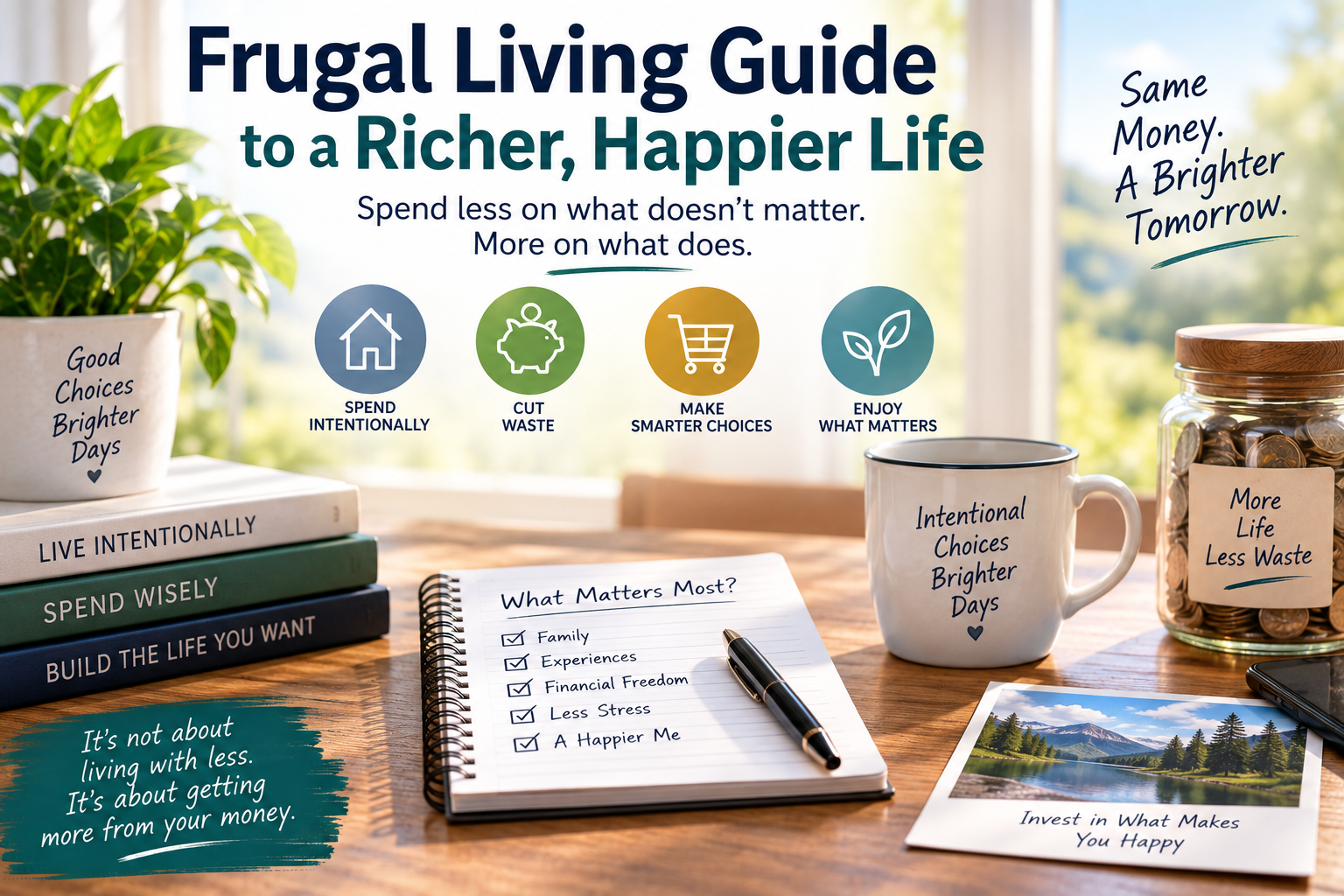
Frugal living is about being more deliberate with your money. Spend less on things that don’t matter very much to you so you have more available for the things that do.
The goal isn’t to live cheaply.
The goal is to live intentionally.
What Is Frugal Living?
Frugal living means paying attention to the value you’re getting for the money you spend.
That’s different from always choosing the lowest price.
Suppose you need a pair of shoes.
You could buy a $30 pair that needs replacing every year or spend $90 on a pair that lasts several years. The more expensive choice could actually be the more frugal one.
The same thinking can apply to appliances, vehicles, furniture, clothing, home repairs, and plenty of other purchases.
Price matters.
But so do quality, usefulness, durability, and how often you’ll actually use something.
Instead of always asking:
“How little can I spend?”
Try asking:
“Is this worth what I’m paying for it?”
That’s a much more useful question.
Start With a Simple Spending Plan
It’s difficult to make intentional decisions with your money if you don’t know where it’s going.
You don’t necessarily need to account for every penny.
Start with a simple spending plan.
Look at:
- Your monthly income
- Housing and utilities
- Food
- Transportation
- Insurance
- Debt payments
- Savings
- Entertainment and personal spending
- Other regular expenses
Then compare what’s coming in with what’s going out.
You may discover that your finances are tighter than you realized.
Or you may find money going toward things you don’t particularly care about anymore.
That’s where frugal living becomes useful.
You’re not looking to eliminate expenses just to spend less.
You’re looking for places where your money could be doing something more useful.
If you’d like help seeing how everything fits together, the Budget Calculator can help you build a basic spending plan.
Cut Waste Before You Cut Enjoyment
If you want to spend less, don’t immediately start eliminating everything you enjoy.
Look for waste first.
Maybe you’re paying for subscriptions you barely use.
Perhaps you haven’t compared your insurance with other options in several years.
Maybe you’re regularly throwing away food because you buy more than you use.
You might be paying fees you could avoid or continuing to pay for a service simply because canceling it has sat on your to-do list for six months.
Those are good places to start because eliminating them doesn’t necessarily change your quality of life.
You aren’t depriving yourself.
You’re simply stopping money from leaking out on things that don’t give you much in return.
Slow Down Before You Buy
A lot of unnecessary spending happens quickly.
You see something.
You want it.
You buy it.
Then a few days later, you’re not entirely sure why.
One of the simplest frugal living habits is creating a little space between wanting something and buying it.
Before making an unplanned purchase, ask yourself:
- Do I actually need this?
- How often will I use it?
- Do I already own something that does the same job?
- Could I borrow it?
- Would buying it used make sense?
- Will I still want it tomorrow?
- Is it worth the price to me?
You don’t need to go through the entire list every time you buy a gallon of milk.
But for purchases that weren’t part of your plan, slowing down can make a difference.
Sometimes you’ll still buy the item.
That’s fine.
The point isn’t always to say no.
It’s to make the decision deliberately.
Sometimes Spending More Is the Frugal Choice
This gets overlooked in many conversations about frugality.
Saving money today isn’t always the same as saving money.
Maintenance is a good example.
Skipping routine maintenance on your car may save some money this month. It could cost considerably more later.
The same applies to maintaining your home, caring for appliances, and replacing something before its failure creates a larger problem.
Quality matters too.
If you use something every day, paying more for something durable, comfortable, and reliable may make far more sense than repeatedly buying the cheapest option.
Frugality isn’t about winning every transaction by paying the lowest price.
It’s about getting good value over time.
Repair, Reuse, Borrow, or Buy Used
Buying something new isn’t always the only answer.
Before replacing something, see whether it can reasonably be repaired.
Before buying something you’ll use once or twice, see whether you can borrow or rent it.
And don’t automatically dismiss used items.
Furniture, tools, exercise equipment, books, clothing, and many other things can often be purchased secondhand for considerably less than new.
You can also sell things you no longer use.
That has two benefits: you may bring in a little money, and you get rid of something that’s been taking up space.
Being resourceful doesn’t mean you have to become someone who saves every empty container because it might someday become useful.
There’s a limit.
The idea is simply to consider alternatives before automatically buying something new.
Spend More on What Matters to You
Here’s where frugal living becomes personal.
What do you actually enjoy?
Travel?
Golf?
Restaurants?
Your grandchildren?
A hobby?
Concerts?
Working on your house?
No financial rule says you shouldn’t spend money on those things.
If they’re important to you and you can afford them, that’s one of the reasons you’re managing your money in the first place.
Being frugal in areas you don’t care much about can give you more freedom to spend in areas you do.
Someone who loves traveling may happily drive the same car for ten years.
Someone who loves cars may choose inexpensive vacations instead.
Neither person is doing frugality wrong.
They’re deciding where their money matters most.
Watch Out for Frugality That Costs You More
Sometimes an attempt to save money backfires.
Driving twenty miles to save a few cents per gallon on gasoline probably isn’t much of a victory.
Buying something you don’t need because it’s 50% off doesn’t save you 50%.
Buying a large quantity because the unit price is lower doesn’t help if you eventually throw half of it away.
And spending hours trying to save a couple of dollars may not be worth your time.
That’s why price alone isn’t enough.
Look at the whole decision.
What am I actually gaining by spending less here?
Sometimes the savings are worthwhile.
Sometimes they’re not.
One Simple Habit
If you want one habit to take from this article, make it this:
Before spending money on something that isn’t necessary, ask:
“Will this improve my life enough to justify what it costs?”
Sometimes the answer will be yes.
Buy it and enjoy it.
Sometimes the answer will be no.
Keep the money for something that matters more.
You won’t make the perfect decision every time. Nobody does.
But asking the question consistently can change how you spend.
Frugal Living Is About Choice
Frugal living isn’t about spending as little as possible.
It’s about having more control over where your money goes.
Cut waste before cutting things you enjoy.
Pay for quality when quality provides better value.
Repair, reuse, borrow, or buy used when it makes sense.
And don’t feel guilty about spending money on things that genuinely matter to you when they fit within your financial situation.
The important part is making the choice instead of letting spending happen automatically.
That’s also one of the ideas behind The Habit Gap. Knowing that you should spend carefully is easy. Building the habit of stopping, thinking, and making an intentional choice is harder.
But that’s where the difference happens.
Frugal living isn’t about getting less out of life so you can save more money.
It’s about getting more from the money you choose to spend.